




Spam Filters: How Email Spam Filtering Works and Why It Matters?


Email remains one of the most widely used communication channels in the world, but it’s also a significant target for cybercriminals. From phishing scams to malware-laden attachments, spam emails pose serious risks to individuals and businesses alike.
Industry estimates indicate that between 45% and 55% of global email traffic is spam, underscoring the importance of effective spam filtering.
In this blog, we’ll break down what spam filtering is, how it works, the different types of filters, and why every email user should care. Whether you’re a business owner, IT professional, or casual email user, this guide will help you understand how to keep your inbox clean and safe.
Table of Contents
What Is Spam Filtering?
Spam filtering refers to the automated process of identifying and blocking unwanted, unsolicited, or potentially harmful emails before they reach your inbox. These filters analyze incoming emails using a variety of techniques such as content scanning, probability modeling, and sender verification to determine whether a message is legitimate or spam. Modern spam filters are built into email clients like Gmail, Outlook, and Yahoo Mail, but businesses often use additional enterprise-grade filters for enhanced protection.
How Do Spam Filters Work?
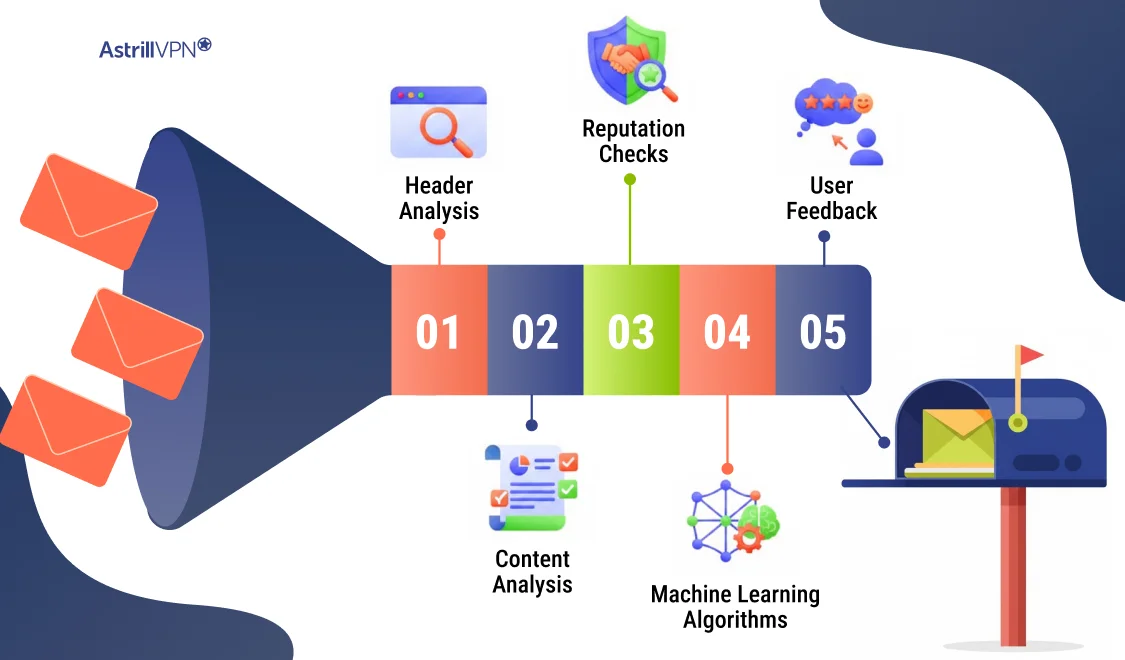
Spam filters usually evaluate emails using multiple criteria to determine the likelihood that a message is spam. While each filter uses its own algorithm, they generally work through these steps:
1. Header Analysis
Filters inspect email headers to check for:
- Spoofed sender domains
- Suspicious routing information
- Missing authentication records (e.g., SPF, DKIM, DMARC)
Businesses relying on email marketing platforms must implement proper email authentication to avoid their campaigns being caught in spam filters. To ensure your records are valid and your emails are recognized by these filters, you can use the EasyDMARC spf checker to verify your domain’s SPF status.
Legitimate email marketing platforms like Mailchimp, SendGrid, and Constant Contact incorporate anti-spam measures and help maintain sender reputation by enforcing SPF, DKIM, and DMARC protocols. Beyond standard authentication, many senders also leverage some email warmup and deliverability tools to proactively improve their standing with major email providers.
2. Content Analysis
The body of the email is scanned for:
- Trigger words like “FREE,” “WINNER,” or “URGENT”
- Malicious links
- Scam patterns
- Unusual formatting or excessive images
3. Reputation Checks
Filters consult real-time databases that score the sender’s IP or domain. If the sender appears in blacklists, the message is flagged.
4. Machine Learning Algorithms
Modern filters use algorithms trained on millions of spam examples. The more data they learn from, the better they become at predicting harmful emails.
5. User Feedback
When you mark emails as spam or “not spam,” the filter adjusts future detection models accordingly. Together, these techniques drastically reduce the amount of junk and harmful emails that reach users.
What is Spam email?
Spam email often simply called spam is any unwanted or irrelevant email sent in bulk to many recipients. These messages typically aim to advertise, scam, or spread malware, and they are sent without the recipient’s permission.
Common characteristics of spam email include:
- Mass distribution: Sent to thousands or millions of people at once
- Unsolicited: You didn’t ask for it
- Promotional or malicious intent: Often advertising products, running scams, or delivering harmful links or attachments
- Deceptive tactics: Fake sender names, misleading subject lines, impersonation of trusted brands
Examples of spam emails:
- Fake lottery winnings
- “Urgent” bank account or password verification notices
- Too-good-to-be-true product offers
- Phishing emails trying to steal your login or financial information
- Malware-laden attachments pretending to be invoices or receipts
Spam Email: Why It’s a Major Threat?
Spam email isn’t just annoying, it can be dangerous.Reports indicate that over 90% of cyberattacks start with a phishing email, making spam filtering one of the most important cybersecurity defenses today. Common risks include:
- Phishing attacks aiming to steal personal data
- Malware and ransomware attachments
- Financial scams
- Identity theft
- Brand impersonation attacks
Email Spam Filtering
Email spam filtering is the application of spam detection technologies specifically to incoming email traffic. It may include:
- Server-level filtering, where emails are scanned before reaching the inbox
- Client-level filtering, handled by your email app
- Cloud-based filtering, used by businesses to add an extra security layer
Good email spam filtering:
- Protects users from cyber threats
- Reduces inbox clutter
- Improves productivity
- Ensures compliance for organizations that handle sensitive data
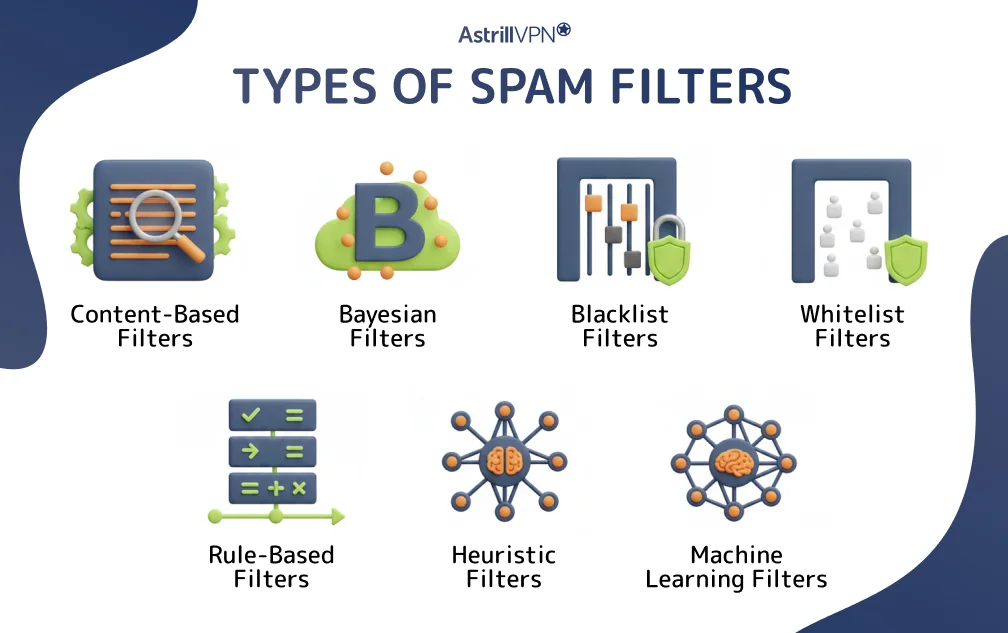
Types of Spam Filters
Following are basic types of Spam filters.
1. Content-Based Filters
These filters analyze the content of an email, its text, images, links, attachments, and formatting to identify common spam characteristics. If certain keywords (e.g., “free,” “urgent,” “credit repair”) or suspicious links are detected, the email may be flagged as spam.
2. Bayesian Filters
A Bayesian spam filter uses probability and machine learning to determine whether an email is spam. It learns from previous spam and non-spam messages, calculating the likelihood that a new email is harmful based on patterns it has seen before.
3. Blacklist Filters
Blacklist filters block emails coming from known spam-sending IP addresses or domains. If the sender appears on a spam blacklist database, their message is automatically rejected or quarantined.
4. Whitelist Filters
Whitelists allow emails from trusted senders to bypass all spam checks. This reduces the chance of false positives, ensuring important messages always reach the inbox.
5. Rule-Based Filters
They are simple but effective when configured properly. These filters follow administrator-created or system-defined rules such as:
- Block emails with certain attachments
- Flag messages larger than a specific size
- Filter emails containing certain words
6. Heuristic Filters
Heuristic filters assign a score to an email based on suspicious characteristics. If the total score exceeds a threshold, the message is marked as spam. This method catches new or evolving spam tactics.
7. Machine-Learning Filters
These advanced filters analyze huge datasets and evolve automatically. They examine sender behavior, communication patterns, and emerging threats making them highly accurate and adaptive to new spam trends.
Why Do Spam Filters Exist?
Spam filters exist because spam email is a massive and constant threat. Without filtering systems, users would be overwhelmed by junk mail and exposed to security risks.
Key reasons spam filters exist:
1. To Protect Users From Cyberattacks
Most phishing attempts, ransomware attacks, and identity theft attempts begin with spam emails. Filters block these before they reach the inbox.
2. To Reduce Inbox Clutter
Without filters, many people would receive dozens—or hundreds—of unwanted emails daily, burying important correspondence.
3. To Improve Productivity
Employees perform better when they spend less time sorting and deleting junk emails.
4. To Prevent Fraud and Scams
Spam emails often masquerade as coming from banks, government agencies, or reputable companies. Filters reduce the chance of someone falling for these tricks.
5. To Protect Network Resources
Large amounts of spam consume bandwidth, storage, and server resources. Filtering helps organizations maintain efficient systems.
How Can Spam Filters Help You?
Spam filters play a crucial role in keeping your digital life secure, organized, and efficient. Whether you’re an individual user or a business, spam filters offer multiple layers of protection against unwanted or dangerous emails.
1. Keep Your Inbox Clean and Organized
Spam filters automatically separate junk mail from legitimate messages, ensuring that your inbox stays clutter-free. This helps you focus on what matters, rather than sorting through irrelevant promotions or scam attempts.
2. Protect You From Cyber Threats
Modern spam filters detect phishing links, malware attachments, fake login pages, and impersonation scams. By blocking these emails before they reach you, spam filters significantly reduce your risk of identity theft, ransomware, and financial fraud.
3. Save Time and Increase Productivity
Deleting spam manually is time-consuming. Filters automate the process, saving you minutes or even hours each week, especially if you receive a high volume of emails. For businesses, this translates into improved employee productivity.
4. Reduce the Risk of Falling for Scams
Spam filters catch many of the trickiest scam emails, including those that impersonate banks, delivery companies, and government agencies. By filtering them out, they help protect users, especially those who may be less familiar with cyber threats.
5. Improve Email Security for Businesses
For organizations, spam filters help maintain compliance, safeguard internal communications, and protect sensitive data. Strong filtering also reduces the chance of a costly security breach.
6. Enhance Overall Email Performance
By reducing server load and preventing junk mail from clogging your inbox, spam filters improve your email system’s speed and reliability.
7. Provide Peace of Mind
Simply knowing your email is being screened for threats gives you confidence when opening messages, clicking links, or downloading attachments.
Conclusion
Spam emails are more than just a nuisance; they’re a gateway for cybercrime, data theft, and productivity loss. With over half of global email traffic estimated to be spam, robust spam filtering has never been more essential. From Bayesian filters to machine-learning algorithms, today’s spam filters are more advanced, accurate, and adaptable than ever. By understanding how they work and the different types available, you can better protect your personal data, secure your business, and maintain a clean and efficient inbox.
FAQs
Here are some frequently asked questions.
A Bayesian spam filter is a type of probabilistic filter that evaluates emails based on learned patterns. It calculates the likelihood that an email is spam by comparing words and features from known spam and legitimate messages. Over time, it “learns” and becomes increasingly accurate.
Content-based filters analyze the text, images, and attachments in an email to detect spam characteristics. They look for common spam trigger words, suspicious links, untrusted attachments, and misleading language.
Modern spam filters can block over 98% of spam before it reaches the inbox. Enterprise-grade filters often combine machine learning, sender reputation systems, and advanced threat detection for even higher accuracy.
A false negative occurs when a spam email is incorrectly classified as legitimate and delivered to the inbox. While rare with modern filters, false negatives can be dangerous because phishing or malware emails may go unnoticed.

Secure your privacy instantly. Try AstrillVPN with zero risk.
About The Author
No comments were posted yet