




Click Fraud Prevention: How to Protect Your PPC Campaigns?

Pay-per-click (PPC) advertising is one of the most effective digital marketing channels, enabling businesses to drive targeted traffic and achieve measurable results. However, as online advertising continues to grow, so does one of its biggest threats: click fraud. This malicious activity drains ad budgets, distorts performance analytics, and weakens the effectiveness of paid campaigns. Whether you run Google Ads, Facebook Ads, Instagram promotions, or display campaigns, click fraud can have a significant negative impact on your ad spend.
In recent years, click fraud has become more sophisticated. Attackers now use automated bots, device farms, and competitive sabotage tactics to generate fake clicks on ads. Even accidental or low-quality traffic can be misclassified as invalid clicks, creating additional challenges for marketers attempting to optimize performance.
Industry reports estimate that a sizeable portion of global ad spend is lost to fraudulent clicks every year. This highlights the urgent need for businesses to adopt strong click fraud prevention strategies. This blog delves into click fraud in detail, the inner workings of click fraud bots, and the most effective methods for detecting and preventing click fraud.
Table of Contents
What Is Click Fraud in Cyber Security?
Click fraud is a type of online advertising fraud where malicious clicks are generated on pay-per-click ads. Instead of real customers clicking with genuine intent, fraudulent clicks come from bots and automated scripts. The goal is typically to:
- Drain the advertiser’s budget
- Reduce campaign performance
- Artificially inflate traffic
- Manipulate data for financial gain.
In cybersecurity, click fraud is considered a digital threat because it exploits advertising platforms and manipulates data to deceive users. Cybercriminals employ various techniques to conceal their identities while generating false clicks, making detection particularly challenging.
Click fraud is not always malicious. Sometimes, low-quality traffic, accidental clicks, or misaligned placements can result in “invalid clicks.” However, intentional click fraud is harmful because it costs advertisers money without providing any actual business value.
How does Click Fraud work?
Click fraud works by generating fake clicks on online ads, links, or CTAs (calls-to-action). These clicks are designed to appear as genuine human interactions, but their primary purpose is to manipulate advertising systems, waste ad budgets, or generate artificial revenue.
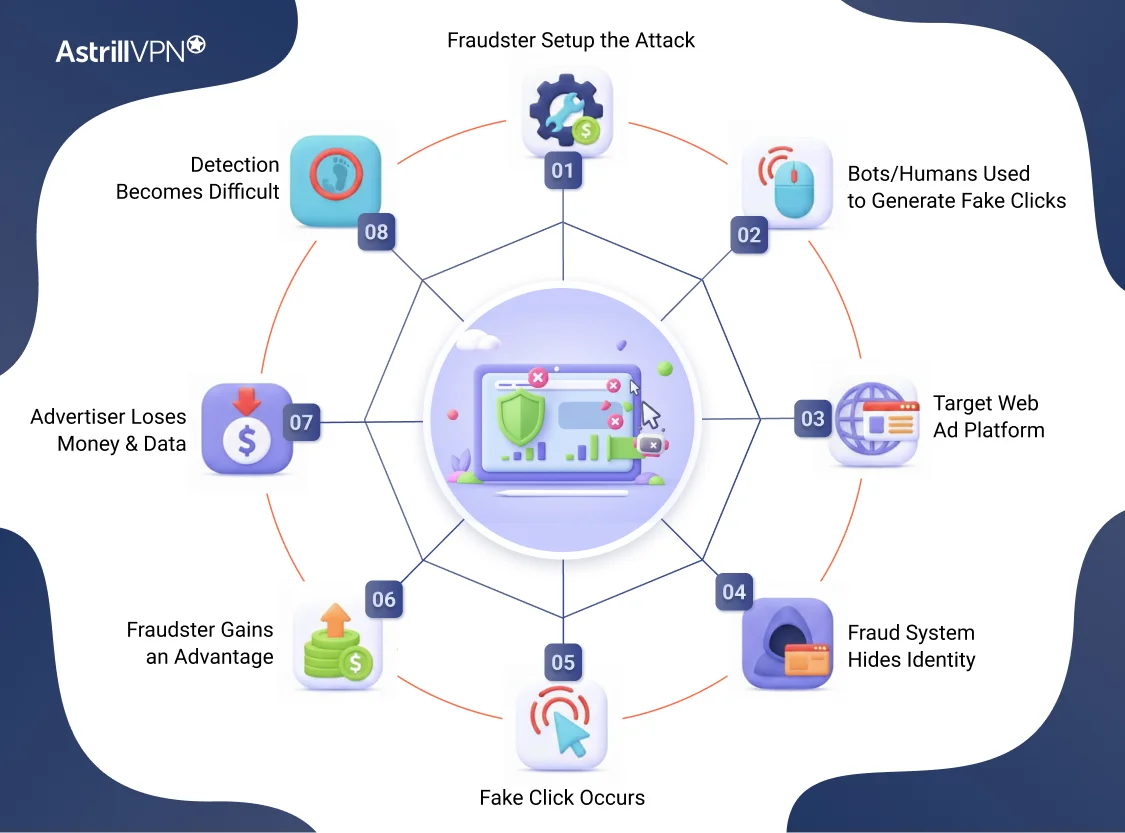
1. The Fraudster Sets Up the Attack
The first stage of click fraud begins when a fraudster decides to target an advertiser. This could be a competitor seeking to exhaust your ad budget, a publisher aiming to increase revenue from display ads, or a criminal group running large-scale ad fraud operations. They prepare the attack using software programs, automated bots, infected devices, or groups of real people hired to produce a high volume of clicks. Their goal is to create enough activity to appear genuine while still achieving their fraudulent intent.
2. Bots or Humans Are Used to Generate Fake Clicks
Once the attack is set up, the fraudster either deploys automated bots or uses human workers to click on ads. Bots are the most common method because they can create a massive number of clicks with little effort. These bots are programmed to behave like real users by moving the mouse, scrolling through pages, pausing on screen elements, and clicking at random intervals.
3. The Fraud System Loads the Target Website or Ad Platform
The next step is for the bot or human to load the web page or platform where the target ads appear. This could be Google search results, Facebook ads, YouTube ads, or websites with display advertising. The fraudulent system simulates the behavior of a real visitor by visiting the page and interacting with it. By doing this, the ad platform logs the visit as legitimate traffic and prepares to register the click as a valid user action.
4. The Fraud System Hides Its Identity
To avoid detection, click fraud systems use several methods to hide their true identity. Bots often rotate through thousands of different IP addresses, so the clicks are coming from unique users worldwide. They also spoof devices to resemble various mobile phones or browsers, making it harder to identify patterns.
Many fraudulent networks utilize proxies or VPN chains to conceal their origin, and some even clear their cookies automatically, making them appear like brand-new visitors every time. These techniques make it highly challenging for advertisers to distinguish between real users and fake ones.
5. The Fake Click Occurs
After the system successfully loads the page and masks its identity, the fraudulent click is performed. The bot or human scrolls, pauses briefly, and then clicks the ad to simulate a real user interaction. The advertising platform interprets this click as valid, charges the advertiser, and records it as part of campaign performance data. On the surface, everything appears legitimate, but in reality, the click has no potential to result in a conversion or sale.
6. The Fraudster Gains an Advantage
As soon as the click is registered, the fraudster benefits. If the fraud is motivated by competition, the victim’s ad budget is drained more quickly, giving the competitor a greater advantage. If the scam comes from a publisher, they earn money from the ad clicks on their website. In affiliate scams, fraudsters generate fake engagement to collect commissions. Large-scale criminal networks use this method to steal millions from advertisers by artificially inflating traffic that has no real value.
7. The Advertiser Loses Money and Data Quality
Every fraudulent click represents a loss of money for the advertiser. Not only do they pay for clicks that will never convert, but their campaign analytics become distorted, making it harder to optimize ads correctly. High click-through rates with low conversions lead marketers to make poor strategic decisions. Over time, this can reduce campaign effectiveness, waste a significant portion of the advertising budget, and negatively impact overall business performance.
8. Detection Becomes Difficult Due to Sophisticated Behavior
The final challenge is that modern click fraud has become extremely difficult to detect. Bots are now capable of staying on a site for realistic time periods, viewing multiple pages, and behaving in patterns that look natural. They avoid clicking too frequently and follow random intervals to mimic human behavior. This sophistication allows them to bypass many security filters, making it crucial for advertisers to use advanced detection tools and continuous monitoring.
Global Click Fraud Overview
- Recent industry research estimates that a significant portion of paid clicks are fraudulent. Some reports suggest that approximately 20–30% of all PPC (pay-per-click) ad clicks globally are fraudulent, meaning they originate from bots or other non-human sources and can waste advertising budgets.
- In terms of monetary impact, click fraud is extremely costly, with total worldwide losses exceeding $100 billion in 2025, according to comprehensive digital marketing estimates.
Financial Impact on Advertisers
Click fraud doesn’t just skew metrics; it directly costs money. Some recent figures highlight:
- Global annual losses from click fraud exceed $100 billion.
- Estimates published in 2025 place the annual global cost between $50 billion and $60 billion in some analysis.
- Click fraud can waste 20–22% of total advertising spend, meaning that roughly one in five advertising dollars is spent on invalid clicks.
How does Click Fraud affect businesses?
Click fraud affects businesses of all sizes and appears across multiple advertising networks. It occurs when individuals or bots repeatedly click on ads without any intention of making a purchase or interacting with the business. This causes:
- Wasted ad budget
- Distorted analytics
- Lower ROI
- Incorrect optimization decisions
- Poor-quality leads
Click fraud may occur in search ads, display ads, social media ads, video ads, and mobile ads. Attackers often utilize advanced tools to conceal fraudulent activity and make it appear as if genuine users are interacting with the ads.
Familiar sources of click fraud include:
- Competitors are trying to exhaust your ad budget
- Publishers are inflating revenue from display ads.
- Fraudsters earn commissions from affiliate programs.
- Click farms use cheap labor for repetitive tasks.
- Bot networks programmed to imitate real users.
Click Fraud Protection
Click fraud protection involves a set of security measures specifically designed to shield PPC campaigns from malicious clicks. Unlike prevention, which focuses on minimizing exposure, protection tools take action after spotting suspicious behavior.
Strong click fraud protection systems provide:
- Real-time traffic monitoring
- Bot detection using behavioral analysis
- IP blocking
- Device fingerprinting
- Automatic refund claims to ad platforms
- Reporting and analytics dashboards
- Suspicious activity alerts
Such tools utilize machine learning models that track how users interact with ads, enabling them to identify patterns that human reviewers may overlook. Click fraud protection systems also help advertisers maintain cleaner traffic, resulting in more accurate data and higher-quality conversions. Combining prevention and protection provides advertisers with the most robust defense against click fraud in 2025.
Click Fraud Detection
Click fraud detection is the process of identifying illegitimate clicks. It relies on analyzing data and spotting abnormal patterns that indicate suspicious activity.
Effective click fraud detection looks at metrics such as:
- High click volume with low engagement
- Multiple clicks from the same IP within seconds
- Repeated clicks from the same device fingerprint
- Traffic from VPNs, proxies, or data centers
- Unusual geographic trends
- Clicks during odd hours
- Sudden spikes in the impression-to-click ratio
Detection tools use algorithms that examine behavioral signals at scale. For example, bots often move unnaturally, load pages too quickly, or interact with websites in ways real human users would not. Advertisers should incorporate click fraud detection into their daily PPC management to ensure accurate and trustworthy campaign performance.
What are Click Fraud Bots?
Click fraud bots are automated software programs designed to perform fake clicks on online ads, links, or web pages. They mimic human interaction to trick advertising platforms and drain ad budgets or inflate revenue for website owners.
How Click Fraud Bots Work?
Click fraud bots operate by simulating real user behavior. They may load pages, move the mouse, scroll, and click on ads. More advanced bots even rotate their IP addresses, clear cookies, and use mobile emulation to appear legitimate.
Why are Click Fraud Bots created?
The following are the reasons why Click Fraud bots are created.
- Bots click your paid ads, causing your daily budget to run out quickly and negatively impacting visibility.
- Website owners may use bots to artificially inflate clicks on display ads, thereby generating more ad revenue.
- Criminal groups use botnets to generate massive amounts of fake ad traffic, stealing millions from advertisers.
PPC Click Fraud
PPC click fraud specifically targets pay-per-click advertising campaigns. Because advertisers pay each time a user clicks on an ad, fraudsters exploit this system to cause financial loss.
PPC click fraud affects campaigns by:
- Draining daily budgets prematurely
- Reducing the number of legitimate customer clicks
- Manipulating performance metrics
- Increasing cost-per-click (CPC)
- Making it more challenging to optimize campaigns
- Lowering overall return on ad spend (ROAS)
Industries such as legal services, finance, home services, and e-commerce are often targeted due to their high CPC rates. PPC click fraud is especially harmful because advertisers may mistake the fake clicks for poor targeting, leading them to make incorrect strategic adjustments.
Click Fraud Prevention Techniques
Preventing click fraud requires a combination of technology, monitoring, campaign optimization, and security practices. Businesses must implement strategies that identify unusual click patterns and block harmful traffic before it affects campaign performance.
Here are the key prevention methods:
1. Use Dedicated Click Fraud Detection Tools
One of the most effective ways to prevent click fraud is to use specialized detection platforms. These tools continuously analyze incoming traffic, monitor user patterns, and block suspicious activity in real time. They detect anomalies such as repeated clicks from a single device, abnormal click-through rates, or visits from known bot networks. Tools like ClickCease, CHEQ, and Lunio integrate directly with advertising platforms to automatically block invalid IPs before additional damage is done. By having automated systems watch traffic 24/7, advertisers significantly reduce the volume of fraudulent clicks reaching their campaigns.
2. Enable IP and Device Blocking
Blocking suspicious IP addresses is a practical and widely used method of prevention. When advertisers identify unusual activity, such as multiple clicks within a short timeframe or traffic from unexpected regions, they can manually add the associated IP addresses or device fingerprints to a blocklist. This prevents future traffic from those sources from interacting with ads. Many ad platforms, including Google Ads, offer IP exclusions that provide advertisers with more control over who sees their campaigns. Regularly reviewing traffic logs helps identify problematic patterns early.
3. Use Geo-Targeting and Location Exclusions
Geo-targeting is a powerful way to reduce click fraud by limiting where ads are shown. If specific locations consistently generate low-quality or suspicious clicks, advertisers can exclude those regions entirely. Fraudulent activity often comes from particular countries, data centers, or shared proxy networks. By narrowing campaign targeting to high-quality locations, advertisers reduce exposure to fraudulent traffic. This enhances the efficiency of ad spend and ensures the campaign is targeted at genuine users who are likely to convert.
4. Monitor Traffic Patterns and Analytics
Regular monitoring of campaign analytics helps detect early signs of fraud. Sudden spikes in clicks, sharp increases in bounce rates, or unusually short session durations all suggest that bots may be interacting with the ads. Advertisers should regularly analyze key metrics, including click-through rate (CTR), device types, and IP clusters. Behavioral red flags, such as repeated midnight activity or traffic from unexpected devices, can indicate automated fraud. Consistent monitoring enables advertisers to respond promptly before significant losses occur.
5. Enable Bot Filtering and Security Tools
Most advertising and analytics platforms offer built-in bot filtering features that automatically remove known bot traffic from campaign data. For example, Google Analytics has a bot filter that excludes traffic from known spiders and crawlers. Security tools such as Cloudflare also provide bot protection that blocks suspicious automated activity across websites. By enabling these features, advertisers create an extra layer of defense that catches low-level bots and prevents them from interacting with ads or landing pages.
6. Implement CAPTCHA and Behavior Verification
CAPTCHA systems and behavioral verification tools help distinguish genuine users from bots. These tools require users to complete a simple task, such as selecting images or clicking a checkbox, which is difficult for automated bots to bypass. Adding CAPTCHA to landing pages, sign-up forms, or high-risk areas reduces the number of computerized systems engaging with your site. While CAPTCHA cannot eliminate fraud, it makes it more complicated for bots to appear legitimate and prevents them from completing harmful interactions.
7. Restrict Ad Placement on Low-Quality Websites
Another prevention method is to control where display ads appear carefully. Ads displayed on low-quality websites are more susceptible to publisher click fraud, where site owners intentionally click their own ads to inflate revenue. By using placement exclusions or running ads only on trusted, reputable websites, advertisers can significantly reduce this risk. Avoiding broad, automatic placements and opting for high-quality ad networks helps ensure that ads reach genuine audiences rather than fraudulent sources.
8. Use Conversion Tracking for Better Detection
Conversion tracking helps identify when clicks fail to produce meaningful actions. If a campaign receives a high volume of clicks but very few conversions, it may indicate fraudulent activity. By monitoring form submissions, purchases, or sign-ups, advertisers gain insight into which traffic sources provide genuine value. This makes it easier to flag suspicious publishers, audiences, or networks and adjust campaigns to avoid them.
9. Adjust Bidding Strategies and Daily Budgets
High bids and large daily budgets attract fraudsters. Advertisers can minimize fraud by controlling bids and adjusting budgets. Lower bids reduce financial appeal for click fraud. Smaller daily budgets help prevent excessive losses. Innovative bidding strategies focus campaigns on quality traffic, not just high-volume clicks.
Conclusion
Click fraud remains a significant threat to PPC advertisers in 2025, costing businesses substantial money and compromising valuable performance insights. With the rise of sophisticated bots and AI-driven fraud, it is more important than ever to understand how click fraud works and how to detect it early.
By combining prevention, protection, and detection strategies, such as monitoring traffic patterns, utilizing fraud prevention tools, refining targeting settings, and analyzing device fingerprints, businesses can effectively defend their PPC investments and maintain healthy campaign performance. With the proper knowledge and tools, you can stay one step ahead of fraudsters and ensure your PPC campaigns deliver genuine, measurable results.
FAQs
Here are frequently asked questions listed below.
Click fraud directly inflates your ad costs because you pay for every fraudulent click. It also distorts your analytics by increasing CTR, bounce rates, and impressions while lowering conversion rates. This results in poor optimization decisions and wasted budget.
Yes. Competitor sabotage is one of the most common types of click fraud. Competitors may manually click your ads or use bots to drain your budget, allowing their ads to appear more frequently once yours stop showing.
Popular click fraud protection tools include:
ClickCease
Lunio
CHEQ Essentials
PPC Protect
ClickGuard
Fraud Blocker
TrafficGuard
Invalid clicks include accidental clicks, low-quality traffic, double clicks, or system errors. They may not be malicious. Click fraud is intentional and aimed at causing financial damage, manipulating data, or gaining a competitive advantage. It is deliberately carried out by bots, humans, or rival businesses.

Secure your privacy instantly. Try AstrillVPN with zero risk.
About The Author










No comments were posted yet