




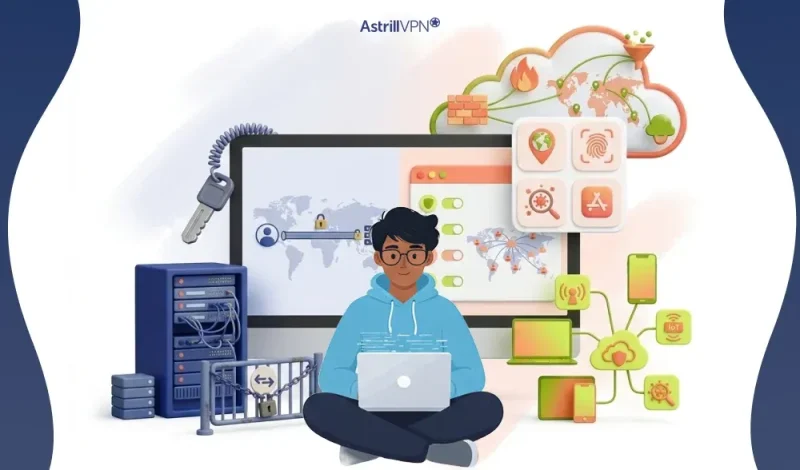
The conversation around network security has shifted. SASE keeps entering the frame, often positioned as the future of enterprise access, while VPNs quietly continue doing what they’ve always done. So what actually separates the two, and does one make the other obsolete?
The short answer is no. They solve different problems for different audiences. Here’s a clear breakdown of both.
Table of Contents
What Does SASE Mean?
SASE stands for Secure Access Service Edge. Gartner coined the term in 2019 to describe a cloud-delivered framework that merges networking and security into a single platform. Instead of routing traffic back to a central corporate server for inspection, SASE applies security at globally distributed cloud nodes called Points of Presence (PoPs), positioned close to users wherever they are.
A full SASE platform bundles several technologies together:
- SD-WAN: Intelligent traffic routing across the best available network path.
- ZTNA (Zero Trust Network Access): Users access only specific apps they’re authorized for, nothing more.
- SWG (Secure Web Gateway): Filters web traffic, blocks malicious sites and downloads.
- CASB (Cloud Access Security Broker): Monitors and controls how cloud apps are accessed.
- FWaaS (Firewall as a Service): Cloud-delivered firewall inspection without on-premises hardware.
What Is a VPN?
A VPN creates an encrypted tunnel between your device and a destination server. All traffic passes through that tunnel, masking your real IP address and shielding your data from anyone observing the network between you and the endpoint.
VPNs were built for a simpler era: corporate data lived in a building, and remote employees needed a secure way in. That use case still exists. But for individual users, the value is even more direct. On public Wi-Fi, a VPN like AstrillVPN encrypts your traffic and protects it from local eavesdroppers. It keeps your ISP from logging your activity and lets you browse privately without exposing your identity online. Simple, effective, and immediately useful.
SASE in Cybersecurity: Why It Emerged
SASE didn’t appear in a vacuum. Three specific pressures pushed organizations past what traditional VPNs could handle.
- Cloud adoption
As corporate apps moved to platforms like Microsoft 365, Salesforce, and AWS, VPNs began routing traffic through an absurd detour: from the user, back to headquarters, then out to the cloud, and back again. That “hair-pinning” adds latency and hurts productivity for no real security gain.
- The scale of remote work
Managing VPN access for a handful of remote workers is manageable. Managing it for hundreds or thousands across dozens of countries, many on personal devices, on home networks of unknown quality, quickly becomes unworkable.
- Perimeter trust
Traditional VPNs operate on a simple premise: authenticate once, get broad network access. When attackers steal valid credentials, that model becomes a liability. One compromised account can mean lateral movement across an entire corporate network.
SASE addresses all three by distributing security to the edge, eliminating backhauling, and applying Zero Trust principles at every access request.
What Is SASE Architecture?
SASE architecture runs on a distributed cloud network of globally distributed PoPs. When a user connects, their traffic hits the nearest PoP where all security checks happen in a single pass: one decrypt, one inspection, one re-encrypt. This is faster than traditional stacked architectures, where traffic cycles through separate tools sequentially.
The security model underneath is Zero Trust. Every connection request is evaluated based on user identity, device health, location context, and behavioral signals. There’s no assumption of trust based on being “inside the network.” Even authenticated users can access only the specific applications they’re authorized to use.
The practical consequence: a stolen credential doesn’t hand an attacker the keys to everything. It limits them to whatever that specific account was permitted to touch.
Differences Between SASE and VPNs
Here’s how they compare across the dimensions that matter most:
| Category | SASE | VPN |
|---|---|---|
| Architecture | Cloud-native, distributed PoPs | Centralized hub-and-spoke |
| Trust Model | Zero Trust; continuous verification | Perimeter-based, implicit trust once authenticated |
| Access Scope | Per-app, least privilege | Broad network access |
| Security Stack | SWG, CASB, ZTNA, FWaaS, SD-WAN | Encryption only; extras are add-ons |
| Scalability | Elastic, cloud-based, no hardware needed | Hardware-bound, manual scaling |
| Performance | Low latency via nearest PoP | Backhauling can cause bottlenecks |
| Best For | Enterprises, cloud-heavy, distributed teams | Individuals, SMBs, privacy-focused users |
| Cost | Higher upfront; lower TCO at scale | Low to moderate; fast to deploy |
Architecture
VPNs use a hub-and-spoke model. All traffic routes through a central point, which creates a bottleneck and a single point of failure. SASE distributes that function across dozens of cloud locations, routing traffic through whichever PoP is closest to the user.
Trust and Access
VPNs grant broad network access after authentication. SASE grants access only to specific applications, which are continuously evaluated. The difference matters most when credentials are compromised: in a VPN model, attackers can move laterally; in SASE, they’re contained to whatever that account could access.
Security Scope
A VPN encrypts the tunnel. That’s its job. Threat detection, web filtering, cloud monitoring, and application-level control all require separate tools layered on top. SASE ships with all of that built in, reducing integration complexity and closing gaps between tools.
Performance for Cloud Workloads
This is where VPN limitations are most visible in modern environments. Routing cloud-destined traffic through a corporate VPN endpoint adds unnecessary hops. SASE sends traffic directly from the nearest PoP to the cloud provider’s network, significantly reducing latency for tools users depend on daily.
Is VPN More Secure, or Is SASE the Better Option?
It depends entirely on what you’re securing and who you are.
For large enterprises with distributed workforces, complex cloud infrastructure, and sophisticated threat exposure, SASE offers a more comprehensive posture. In 2024, over 130 VPN vulnerabilities were publicly disclosed across major vendors, a 47 percent year-over-year increase. Several ransomware groups specifically targeted VPN endpoints as their initial access vector, knowing that broad network access follows a successful breach.
For individuals and small teams, a VPN is not just sufficient—it’s the right tool. SASE isn’t built for personal use. When you need to protect your traffic on public Wi-Fi, keep your ISP from logging your browsing, or maintain privacy while working remotely, a reliable VPN like AstrillVPN delivers exactly what you need. Strong encryption, a verified no-log policy, and a kill switch that prevents data leaks if the connection drops.
The more accurate framing isn’t “which is more secure” but “which is appropriate for the problem you’re actually solving.”
Who Should Use SASE vs VPN?
Choose SASE if you are:
- A large or mid-market enterprise with significant cloud infrastructure and a distributed workforce.
- Operating in a compliance-heavy industry where unified audit trails and granular access control matter.
- Experiencing performance problems caused by VPN backhauling through cloud-heavy workflows.
- Concerned about lateral movement risk from credential-based breaches.
Choose a VPN if you are:
- An individual who wants privacy protection on public or untrusted networks.
- A small business with straightforward remote access needs and limited cloud exposure.
- Looking for fast, affordable, and easy-to-deploy security without complex infrastructure.
- A remote worker who needs personal privacy protection alongside organizational tools.
Can SASE Replace a VPN?
For enterprises, yes. SASE includes ZTNA, which handles what a corporate VPN was doing: secure remote access to internal resources, but with tighter controls and without granting broad network access. At the organizational level, SASE makes traditional VPN infrastructure redundant.
For individuals, no. SASE has no consumer equivalent. Personal privacy, public Wi-Fi protection, and ISP-level anonymity still require a VPN. SASE replaces corporate VPN infrastructure. It doesn’t replace the need for one.
What Is SSE and How Does It Relate to SASE?
SSE (Security Service Edge) is SASE without the SD-WAN layer. It bundles ZTNA, SWG, and CASB into a cloud-delivered security platform for organizations that already have a networking solution in place and don’t need a full SASE stack.
When vendors use SSE and SASE interchangeably, they’re usually referring to the security enforcement components. Full SASE adds intelligent traffic routing on top. Both are categorically different from a VPN, which provides neither the security breadth nor the network optimization of either framework.
Key Benefits: SASE vs VPN Side by Side
Benefits of SASE
- Unified security: One platform replaces multiple point solutions, closing gaps between tools.
- Zero Trust enforcement: Continuous verification limits damage from compromised credentials.
- Cloud-optimized routing: Traffic goes directly to cloud destinations, no detours through corporate infrastructure.
- Elastic scalability: New users and locations are a policy change, not a hardware project.
- Centralized visibility: One dashboard, unified audit trails across all users and locations.
Benefits of a VPN
- Encryption: All traffic between your device and the server is protected from interception.
- Privacy: Masks your IP from ISPs, advertisers, and network operators.
- Simple deployment: Install, connect, done. No infrastructure planning required.
- Low cost: Accessible for individuals and small teams at a fraction of SASE pricing.
- Flexibility: Works for anyone, anywhere, without enterprise-level complexity.
Common Misconceptions About SASE
“SASE is just a cloud VPN”
A VPN encrypts a tunnel. SASE enforces identity-based access, inspects traffic for threats, monitors cloud apps, and applies firewall policy in a single pass. Similar surface, fundamentally different architecture.
“Only large enterprises need SASE”
Mid-market vendors have made SASE more accessible, but complexity and cost still favor larger deployments. For most small businesses, a VPN with targeted cloud security tools is a better fit.
“VPNs are outdated”
Enterprise VPN vulnerabilities are a legitimate concern. But a reputable provider with strong encryption and a verified no-log policy is not an outdated tool. It’s the right tool for individual privacy and straightforward, secure access.
“You have to choose one or the other”
Many organizations run both. SASE handles organizational access control; employees use personal VPNs for network-level privacy. Different layers, no conflict.
Final Thoughts
SASE vs VPN isn’t really a contest. SASE evolved to address the specific problems that emerged when the corporate perimeter dissolved: cloud-first infrastructure, global remote workforces, and the failure of perimeter-based trust models. VPNs continue to do what they’ve always done well: encrypt traffic, protect privacy, and give users control over their own connections.
Know which problem you’re solving. For enterprise-scale access security in a cloud-heavy world, SASE is worth the investment. For personal privacy and straightforward, secure access, a trusted VPN remains the right answer.
FAQs
SASE is used to securely connect users, devices, and offices to applications and data through a cloud-based security and networking framework. It combines network connectivity and multiple security controls so organizations can protect users regardless of where they work.
In some cases, yes, but not completely. Many organizations are replacing traditional remote-access VPN with SASE-based Zero Trust access, but VPNs are still commonly used, especially for legacy systems.
Generally yes. SASE provides identity-based access control, continuous monitoring, and multiple integrated security services, while a VPN mainly provides encrypted network access.
Yes. Organizations often use VPN alongside SASE, particularly during migration phases or for systems that still require traditional network access.

Secure your privacy instantly. Try AstrillVPN with zero risk.
About The Author











No comments were posted yet