
What Is a Script Kiddie? Tools, Examples, and Risks

Arsalan Rathore

A script kiddie hacker is someone who performs hacking activities using tools, exploit kits, or automated attack software created by others. Instead of discovering vulnerabilities or building their own attack methods, they rely on publicly available scripts to scan targets, attempt logins, exploit known weaknesses, or disrupt services.
The difference between a generic script kiddie and a script kiddie hacker is intent and action. A script kiddie may experiment with tools out of curiosity, while a script kiddie hacker actively uses those tools to compromise systems, deface websites, flood servers, or access accounts without authorization. Their attacks usually follow predictable patterns because they depend on automated programs rather than manual intrusion techniques.
In real cybersecurity environments, script-kiddie hackers generate a large share of everyday internet attack traffic. Automated scanners constantly search for unpatched servers, exposed admin panels, weak passwords, and vulnerable plugins. When they find one, the attack is launched automatically. No deep expertise is required, only access to the tool.
This is why script kiddie hackers remain a relevant threat. Their methods are simple, but the scale of automated attacks means any poorly secured system can still be compromised.
Table of Contents
Script Kiddies in Cyber Security: Why They Are Still a Real Threat
Script kiddies remain a real cybersecurity threat because modern attack tools automate scanning and exploitation. A person with minimal technical skill can run software that searches the internet for weak passwords, outdated systems, or exposed services and automatically attempts intrusions.
Security teams regularly detect this activity through repeated login attempts, vulnerability scans, and automated probes against public systems. These attacks are not advanced, but they succeed whenever basic security practices such as patching, strong authentication, or service hardening are missing.
The risk comes from constant volume. Automated tools can test thousands of targets quickly, so any system with a simple weakness can be discovered and compromised without being specifically targeted.
How Script Kiddie Hackers Actually Attack Targets
Script-kiddie hackers rely heavily on prebuilt hacking tools rather than developing their own techniques. These tools package scanning, exploitation, and attack execution into simple interfaces, which allows even inexperienced users to launch real intrusion attempts.
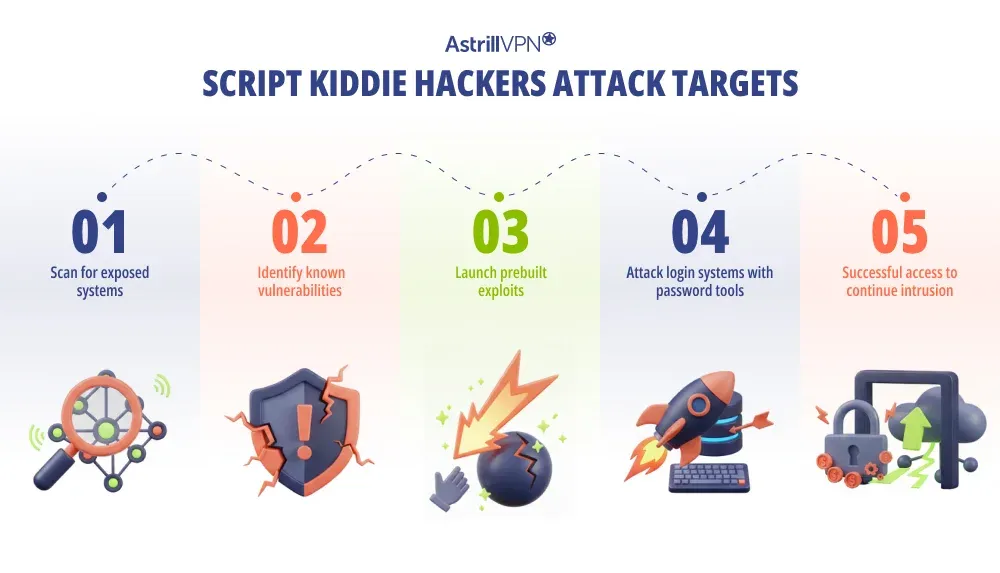
Step 1: Scan for exposed systems
Script‑kiddie hackers usually start by running automated scanning software across large ranges of IP addresses. These scanners look for open ports, exposed databases, vulnerable web panels or remote access services that might be easy to break into.
Step 2: Identify known vulnerabilities
Once potential targets are found, exploit kits are used to analyse the discovered services and software versions. The kits automatically check for outdated applications, insecure plugins or misconfigurations that match known vulnerabilities.
Step 3: Launch prebuilt exploits
When a weakness is detected, the exploit kit attempts to deploy ready‑made payloads against the target. This process is largely automated, so the attacker does not need to understand the underlying flaw or write any custom code.
Step 4: Attack login systems with password tools
In parallel, or after gaining a foothold, password‑cracking tools are pointed at exposed login pages or services. These tools run through large lists of usernames and passwords, repeatedly trying combinations until they find weak or reused credentials.
Step 5: Use successful access to continue intrusion
If any exploit or password attempt works, the script kiddie gains access using the tools’ default options or simple menus. From there, they may rely on additional built‑in modules to browse files, plant malware or pivot to other systems, again without deep technical knowledge
Common Attack Methods Used by Script Kiddies
DDoS Attacks
Script kiddies often use downloadable traffic flooding tools to overwhelm websites or online services with large volumes of requests. These attacks usually rely on automated bot traffic or on rented stress-testing services and are designed to slow or temporarily disable the target.
Website Defacement
Automated web exploitation scripts can be used to modify website content when vulnerable plugins, outdated CMS installations, or weak administrative credentials are discovered. The attacker typically replaces the homepage with their own message to demonstrate access.
Credential Stuffing
Credential stuffing tools test large collections of leaked username and password pairs against login systems. Because many users reuse passwords across multiple services, these automated attempts can still compromise accounts without sophisticated hacking techniques.
Public WiFi Snooping
On poorly secured public networks, attackers can use downloadable monitoring tools to observe unencrypted traffic or capture session data. If users access accounts without secure encryption, their authentication information may be intercepted.
Basic Phishing Kits
Prebuilt phishing packages allow attackers to deploy cloned login pages that automatically collect credentials. These kits often include ready-made templates, hosting instructions, and control panels that store submitted data, making credential theft possible with minimal technical setup.
Why Script Kiddies Often Target Easy Victims
Script kiddie attacks are usually opportunistic rather than strategic. Instead of selecting high-value targets, they look for systems with obvious weaknesses because automated tools make these easy to discover and exploit.
Curiosity often drives initial activity. Many beginners test hacking tools simply to see whether they work, and exposed systems provide immediate feedback. Reputation seeking also plays a role, since gaining visible results, such as defacing a website or accessing an account, can be shared in online groups to gain recognition.
Boredom and a culture of challenge reinforce this behavior. Online spaces frequently frame hacking as a technical puzzle, and poorly secured systems become convenient targets for experimentation rather than carefully planned operations.
Online Communities That Encourage Beginner Attacks
Specific online forums and chat groups share exploit scripts, password lists, and attack tutorials aimed at beginners. These communities often include real-world testing as part of the learning process, encouraging users to run tools against live systems rather than controlled environments.
Gamification of Hacking in Underground Forums
Some underground spaces treat hacking like a competitive activity. Users post screenshots of defaced websites, stolen credentials, or successful intrusions as proof of skill. This reward structure pushes inexperienced actors to attempt quick, visible attacks against the easiest available targets.
Script Kiddie vs Professional Hacker vs Cybercriminal
| Factor | Script Kiddie | Skilled Hacker | Organized Cybercriminal |
| Skill | Limited technical understanding and heavy reliance on existing tools | Strong technical knowledge with the ability to discover or modify exploits | Professional-level teams combining technical, operational, and financial expertise |
| Tools | Public exploit kits, automated scanners, password lists, and ready phishing templates | Custom scripts, advanced penetration frameworks, tailored attack chains | Commercial-grade malware, private exploit markets, and infrastructure networks |
| Motivation | Curiosity, experimentation, reputation, short-term disruption | Research, penetration testing, espionage, or targeted intrusion | Financial gain, large-scale fraud, ransomware operations, and data monetization |
| Scale | Opportunistic attacks against many random targets | Focused attacks against selected systems or organizations | Coordinated campaigns targeting industries, governments, or large user bases |
| Persistence | Low persistence once the attack fails or access is lost | Moderate persistence with structured follow-up attempts | High persistence with long-term infrastructure, repeated intrusion attempts, and layered operations |
Signs Script Kiddies May target Your System
The following are the signs you need to look out for to know if Script Kiddies might have targeted your system:
Repeated Login Attempts From Unknown Sources
A high number of failed login attempts, especially across multiple usernames or from different IP addresses, often indicates automated password testing. Script kiddie tools commonly run credential lists continuously until a weak or reused password is accepted.
Sudden Vulnerability Scanning Activity
Unusual traffic probing multiple ports, services, or URLs within a short period usually signals automated scanning software searching for known weaknesses. These scans often target admin panels, outdated plugins, exposed APIs, and remote access services.
Noisy and Predictable Attack Patterns
Script kiddie attacks typically lack stealth controls. Logs may show bursts of repeated requests, malformed inputs, or identical exploit attempts sent in rapid succession, which reflect automated scripts rather than manual intrusion.
Unexpected Probes Against Public-Facing Services
Unrecognized traffic attempting to access administrative dashboards, database endpoints, or rarely used service paths can indicate automated discovery attempts. Script kiddie tools routinely test common entry points to identify systems with weak exposure controls.
How Businesses and Individuals Can Protect Against Script Kiddie Attacks
By following these methods and tips, businesses and individuals can both protect themselves against these attacks:
Keep Software Patched
Regular patching removes the known vulnerabilities that automated exploit tools depend on. Most script-kiddie attacks succeed only because the vulnerability is already publicly documented and unpatched.
Use Strong Authentication
Unique passwords and multi-factor authentication prevent credential stuffing and automated login attacks from succeeding even when attackers possess leaked password databases.
Disable Unnecessary Ports
Closing unused services and restricting administrative interfaces reduces the number of exposed entry points that automated scanners can detect.
Monitor Suspicious Automated Traffic
Log monitoring and intrusion detection tools can identify repeated login attempts, scanning behavior, and abnormal request spikes early, which allows defensive action before exploitation succeeds.
Use a Secure Encrypted Connection on Public Networks
Using an encrypted VPN connection protects traffic from interception on public or shared networks. A secure tunnel ensures that browsing data and authentication sessions remain encrypted even if the local network is monitored.
IP masking prevents attackers from easily identifying the real device location, thereby reducing the risk of direct targeting. Encryption also blocks packet-sniffing tools that attempt to capture session data from insecure Wi-Fi connections. Proper DNS leak protection ensures that browsing requests remain protected and cannot be exposed outside the secure tunnel.
Real Examples of Script Kiddie Attacks
Mass Exploitation Waves After Public Vulnerability Releases (2024–2025)
Security vendors repeatedly reported large-scale automated exploitation attempts immediately after significant vulnerabilities were disclosed in widely used software. For example, throughout 2024, newly disclosed WordPress plugin flaws and web framework vulnerabilities triggered global scanning traffic within hours of disclosure. Much of this traffic came from publicly shared automated exploit scripts, allowing inexperienced attackers to begin targeting sites almost instantly. Many small business websites were compromised not through targeted attacks but through broad, computerized sweeps.
Continued Automated Log4Shell Scanning Activity
Even years after the original Log4Shell disclosure, monitoring reports in 2024 and early 2025 continued to show persistent automated probing across internet infrastructure. These probes relied on publicly released scanning scripts and exploit templates that required minimal setup. The persistence of these attacks illustrates how once an exploit becomes easy to run, it continues to attract low-skilled attackers long after the original event.
School and Small Organization Network Breaches Using Password Tools
Several education-sector incidents reported during 2024 involved unauthorized access traced to simple password-guessing or credential-reuse attacks rather than advanced intrusion techniques. Investigations frequently showed that the attackers used automated credential-testing software against remote login portals. These cases demonstrate how ready-made password tools still enable real breaches when authentication controls are weak.
Website Defacement Campaigns Using Public Exploit Kits
In 2024, security monitoring communities observed recurring waves of automated website defacement targeting outdated CMS installations and plugins. Attackers used downloadable exploit packages that automatically located vulnerable sites and replaced homepage content. These campaigns typically affected large numbers of smaller websites and exhibited identical technical signatures, strongly indicating tool-based automated execution rather than custom attacks.
Are Script Kiddies Illegal Hackers?
A person becomes an illegal hacker as soon as they try to access a system without permission, regardless of their skill level. The law focuses on the action itself. Using tools, guessing passwords, creating phishing pages, or scanning networks without permission can count as unauthorized access.
Script kiddies face the same legal consequences as advanced hackers once they start breaking into systems. Even if they use free tools or online guides, unauthorized access can lead to criminal charges or fines. Many well-known cases involve people who did not create malware but used available hacking software.
There is a difference between ethical security testing and illegal hacking. Ethical hackers have permission to test systems, while script kiddies usually do not, making their actions illegal.
Conclusion
Script kiddie hackers may lack advanced technical skills, but they remain a constant source of real cyber threats. The widespread availability of automated exploit tools, password testing software, and ready made phishing kits means that even inexperienced attackers can scan the internet, find weak systems, and attempt intrusion with minimal effort.
Most script kiddie attacks do not rely on complex techniques. They succeed when organizations or individuals leave basic security gaps such as outdated software, weak passwords, exposed services, or unsecured public connections. This makes strong security hygiene the most effective defense against the majority of opportunistic attacks.
FAQs
Script kiddies are considered hackers because they attempt unauthorized access or disruption, but they typically lack the technical skills of professional attackers. They rely on publicly available tools and automated scripts rather than developing their own exploits.
Script kiddies usually target systems with obvious and easy weaknesses, such as outdated websites, poorly secured login portals, exposed remote services, and accounts protected by weak or reused passwords. They generally look for opportunistic targets rather than specific high-value organizations.
Script kiddies commonly perform automated password attacks, vulnerability scanning, website defacement, denial-of-service attacks, phishing campaigns, and credential stuffing. These attacks typically use ready-made software that requires minimal technical knowledge to operate.
Organizations can protect against script kiddies by keeping software patched, enforcing strong passwords and multi-factor authentication, restricting unnecessary public services, monitoring logs for automated attack patterns, and ensuring encrypted connections are used for sensitive access.
A script kiddie depends on existing tools and has limited technical understanding, while a professional hacker can discover vulnerabilities, modify exploits, and conduct targeted attacks using custom methods. The difference lies primarily in technical capability, operational planning, and attack sophistication.

Secure your privacy instantly. Try AstrillVPN with zero risk.
About The Author


No comments were posted yet