




SOC 2 Compliance: Everything You Need to Know in 2026

In today’s digital landscape, organizations handle vast amounts of sensitive customer data, making security and privacy a top priority. As cyber threats continue to rise, businesses are expected to demonstrate robust controls to protect their information. This is where SOC 2 compliance plays a critical role.
According to IBM’s Cost of a Data Breach Report, the global average cost of a data breach reached $4.88 million in 2024, highlighting the financial impact of inadequate security measures. Additionally, research shows that a significant majority of consumers are more likely to trust businesses that can demonstrate strong data security practices. These trends have made SOC 2 compliance a widely recognized standard for organizations that store, process, and manage customer data. This guide explains what SOC 2 is, how SOC 2 compliance works, and why it is important for modern businesses.
Table of Contents
What Is SOC 2?
SOC 2 (System and Organization Controls 2) is a cybersecurity and data management framework developed by the American Institute of Certified Public Accountants (AICPA). It is designed to evaluate how organizations protect customer data and manage information systems.
Unlike compliance frameworks that prescribe specific technical requirements, SOC 2 focuses on whether a company has implemented effective controls to safeguard data and maintain system reliability. Organizations can choose which criteria apply to their business, although Security is mandatory for every SOC 2 audit.
SOC 2 assessments are based on five Trust Services Criteria:
- Security
- Availability
- Processing Integrity
- Confidentiality
- Privacy
What Is SOC 2 Compliance?
SOC 2 compliance refers to an organization’s ability to meet the requirements outlined in the SOC 2 framework and complete an independent audit. Many software-as-a-service (SaaS) providers, cloud service companies, and technology organizations pursue SOC 2 compliance to remain competitive and secure enterprise contracts.
To achieve compliance, a company must establish policies, procedures, and technical controls that demonstrate its commitment to protecting customer information. An external auditor then evaluates these controls and issues a SOC 2 report.
SOC 2 compliance helps organizations:
- Protect sensitive customer data
- Reduce cybersecurity risks
- Build customer trust
- Meet vendor security requirements
- Improve internal security processes
- Strengthen regulatory readiness
What Is SOC 2 Certification?
The term “SOC 2 certification” is commonly used in business and marketing, but technically, there is no official SOC 2 certification. Instead, organizations undergo a SOC 2 audit conducted by an independent CPA firm. Upon successful completion, they receive a SOC 2 report that documents the effectiveness of their controls.
Although businesses often say they are “SOC 2 certified,” the correct terminology is that they have achieved SOC 2 compliance and received a SOC 2 audit report. The report serves as evidence that the organization follows established security and privacy practices.
The Five SOC 2 Trust Services Criteria
The following are the five SOC 2 trust services criteria.
Security
Security is the foundation of SOC 2 and is required for every audit. It focuses on protecting systems against unauthorized access, cyberattacks, and data breaches.
Common security controls include:
- Multi-factor authentication
- Access management
- Firewalls
- Endpoint protection
- Security monitoring
- Incident response planning
Availability
Availability evaluates whether systems and services remain accessible as promised to customers.
Organizations must demonstrate:
- System monitoring
- Disaster recovery plans
- Backup procedures
- Capacity management
- Business continuity planning
Processing Integrity
Processing integrity ensures that systems process information accurately, completely, and promptly.
Controls may include:
- Data validation procedures
- Error detection mechanisms
- Transaction monitoring
- Quality assurance processes
Confidentiality
Confidentiality focuses on protecting sensitive information from unauthorized disclosure.
Organizations often implement:
- Data encryption
- Access restrictions
- Secure file storage
- Data classification policies
Privacy
Privacy evaluates how organizations collect, use, store, share, and dispose of personal information.
Relevant controls include:
- Privacy notices
- Consent management
- Data retention policies
- Customer data access procedures
Why SOC 2 Compliance Matters?
SOC 2 compliance is important for the following reasons.
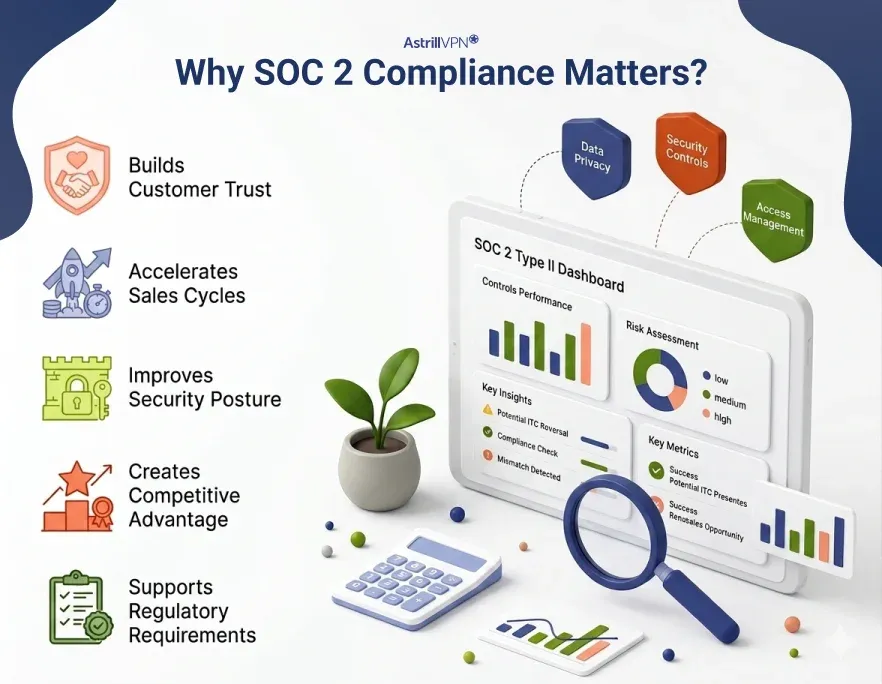
Builds Customer Trust
Customers want assurance that their information is secure. A SOC 2 report demonstrates that a company has implemented recognized security controls and follows best practices.
Accelerates Sales Cycles
Many enterprise customers require vendors to provide evidence of security compliance before signing contracts. SOC 2 compliance helps organizations satisfy these requirements more quickly.
Improves Security Posture
Preparing for SOC 2 often reveals weaknesses in security processes. Addressing these gaps can significantly reduce cyber risks and strengthen defenses.
Creates Competitive Advantage
Companies with SOC 2 compliance can differentiate themselves from competitors that lack independent security validation.
Supports Regulatory Requirements
While SOC 2 is not a legal requirement, the controls implemented for compliance often support broader privacy and security regulations.
SOC 2 Type 1 vs SOC 2 Type 2
SOC 2 reports are available in two forms.
SOC 2 Type 1
A SOC 2 Type 1 report evaluates whether an organization’s controls are properly designed at a specific point in time. Type 1 provides a snapshot of an organization’s security environment.
The audit assesses:
- Existing security controls
- Policy documentation
- Control design effectiveness
SOC 2 Type 2
A SOC 2 Type 2 report evaluates not only the design of controls but also their effectiveness over a defined period, typically 3 to 12 months. Because it demonstrates sustained effectiveness, SOC 2 Type 2 is generally considered more valuable and is often requested by enterprise customers.
The audit examines:
- Continuous operation of controls
- Security monitoring activities
- Incident management practices
- Evidence of ongoing compliance
Steps to Achieve SOC 2 Compliance
The following are the steps to achieve SOC 2 compliance.
Conduct a Readiness Assessment
Organizations begin by evaluating their current security controls and identifying compliance gaps.
Define Audit Scope
Determine which Trust Services Criteria apply to the organization and which systems will be included in the audit.
Implement Security Controls
Organizations establish policies, procedures, and technical safeguards to address identified risks.
Examples include:
- Access control systems
- Employee security training
- Risk management processes
- Vendor management programs
- Data encryption solutions
Collect Evidence
Documentation and records must be maintained to demonstrate that controls are functioning as intended.
Undergo Independent Audit
A licensed CPA firm conducts the SOC 2 examination and reviews evidence of compliance.
Receive the SOC 2 Report
If the audit is successful, the organization receives a SOC 2 report that can be shared with customers and business partners under appropriate confidentiality agreements.
How a VPN Supports SOC 2 Compliance?
While a VPN alone does not make an organization SOC 2 compliant, it can play an important role in supporting the Security Trust Services Criterion. AstrillVPN encrypts internet traffic and creates secure connections between employees, remote workers, and company resources, helping protect sensitive data from interception and unauthorized access.
This is particularly valuable for organizations with distributed teams that access corporate systems from various locations and networks. By strengthening data security, reducing exposure to cyber threats, and supporting secure access controls, a VPN can complement broader SOC 2 compliance efforts and help organizations maintain a stronger security posture.
Common Challenges in SOC 2 Compliance
These are the common challenges faced in SOC 2 Compliance.
Documentation Requirements
Maintaining comprehensive policies and procedures can be time-consuming, particularly for growing organizations.
Continuous Monitoring
SOC 2 requires organizations to continuously monitor and improve their controls rather than treating compliance as a one-time project.
Employee Awareness
Human error remains a major security risk. Regular training and awareness programs are essential for maintaining compliance.
Third-Party Risks
Organizations must assess the security practices of vendors and service providers that handle sensitive information.
Benefits of SOC 2 Compliance
Organizations that achieve SOC 2 compliance often experience several benefits:
- Increased customer confidence
- Stronger cybersecurity defenses
- Improved operational efficiency
- Reduced risk of data breaches
- Faster vendor security reviews
- Greater market credibility
- Enhanced business growth opportunities
Conclusion
SOC 2 compliance has become one of the most recognized standards for demonstrating strong security, privacy, and data protection practices. As customers increasingly demand proof that their information is being handled responsibly, achieving SOC 2 compliance helps organizations build trust, reduce risk, and gain a competitive advantage.
Whether you’re a growing SaaS startup or an established enterprise, investing in SOC 2 compliance can strengthen your security posture, streamline customer onboarding, and demonstrate your commitment to protecting sensitive data in an increasingly connected world.
Frequently Asked Questions
Here are some of the frequently asked questions.
SOC 2 Type 1 evaluates whether security controls are properly designed at a specific point in time. In contrast, SOC 2 Type 2 assesses both the design and operational effectiveness of those controls over an extended period. Type 2 provides stronger assurance because it demonstrates consistent compliance.
SOC 2 compliance is most commonly pursued by SaaS providers, cloud service companies, technology firms, managed service providers, data centers, and organizations that store and process customer information. It is particularly important for businesses serving enterprise clients.
No, SOC 2 compliance is not legally mandatory. However, many customers and business partners require a SOC 2 report before entering into contracts, making it an important business requirement for many organizations.
SOC 2 compliance costs vary depending on company size, audit scope, existing security controls, and whether the organization pursues a Type 1 and Type 2 audit. Costs can range from several thousand dollars for smaller businesses to tens of thousands of dollars for larger organizations.
A company becomes SOC 2 compliant by implementing appropriate security controls, documenting policies and procedures, conducting readiness assessments, collecting evidence, and completing an independent SOC 2 audit performed by a qualified CPA firm.

Secure your privacy instantly. Try AstrillVPN with zero risk.
About The Author










No comments were posted yet