




Cybersecurity Frameworks: A Complete Guide to Managing Cyber Risk

Every few months, there’s a new breach in the headlines, and the story is almost always the same. A company got hit, data walked out the door, and somewhere in the aftermath someone asks how this could have been prevented. More often than not, the honest answer is that the organization either didn’t have a real security framework in place, or had one sitting in a folder that nobody actually followed.
That’s really what this guide is about. Cybersecurity frameworks aren’t glamorous, and they don’t get talked about the way ransomware attacks or data leaks do, but they’re the backbone of every serious security program out there. If you’re trying to figure out where to start, what NIST actually means, or how to explain any of this to a boss who just wants a straight answer, this should get you there.
Table of Contents
What Is a Cybersecurity Framework?
So, what is a cybersecurity framework, really? Strip away the jargon and it’s just a structured way of thinking about security. It’s a set of guidelines, best practices, and controls that tell an organization how to identify what needs protecting, how to protect it, and what to do when something goes wrong anyway. Think of it less like a rulebook and more like a map. It won’t drive the car for you, but it tells you which roads exist and which ones lead somewhere useful.
Most businesses don’t build their security approach from scratch. That would be slow, expensive, and honestly a little reckless given how much has already been learned from decades of breaches, audits, and near misses. Instead, they adopt an existing framework, tweak it to fit their size and industry, and use it as the foundation for everything from firewall policies to employee training.
A good framework does three things at once. It gives technical teams a common language, it gives leadership a way to measure progress, and it gives auditors or regulators something concrete to check against. Without one, security tends to become a patchwork of individual decisions made under pressure, which rarely holds up when it matters most.
Why Cybersecurity Risk Management Needs a Framework
Here’s the thing about cybersecurity risk: it never sits still. New vulnerabilities show up, attackers get more creative, and your own systems change as you grow. Trying to manage that with instinct alone is a losing game, which is why frameworks exist in the first place.
A framework gives you a repeatable process instead of a one-off reaction. Rather than scrambling every time something feels off, you’re working through a cycle that’s already been tested by thousands of other organizations before you.
That cycle usually looks something like this:
- Identify what you actually have, meaning your data, devices, applications, and the people who touch them
- Assess where the real exposure lives, not just the obvious stuff but the quiet gaps too
- Mitigate those risks with the right mix of technology, policy, and training
- Monitor continuously, because a one-time fix doesn’t hold up against threats that keep evolving
Skip any one of those steps and the whole thing gets shaky. A lot of organizations are strong on the identify and protect side but weak on monitoring, which is exactly how breaches sit undetected for months. Frameworks force a bit of discipline into that cycle so nothing gets quietly ignored.
The NIST Framework: The Industry Gold Standard
If there’s one framework that comes up in almost every conversation about security, it’s the NIST framework. Built by the National Institute of Standards and Technology, it started out as guidance for protecting critical US infrastructure, but it’s grown into something almost every industry leans on now, regardless of whether they’re required to.
Part of the reason it’s so widely used is that it doesn’t hand you a rigid checklist. Instead, it asks better questions. What outcomes does your organization need to hit to actually reduce risk? What’s realistic given your size and resources? That flexibility is a big part of why banks, hospitals, tech startups, and government agencies can all use the same framework without it feeling like a bad fit for any of them.
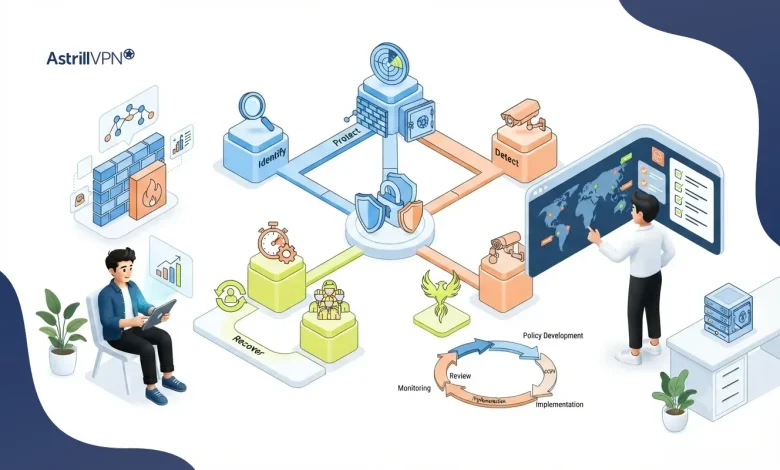
The current version, CSF 2.0, is organized around six core functions. Each one covers a different piece of the security lifecycle:
Identify
This is where you map out your assets, understand your risk exposure, and get honest about where your weak points are. You cannot protect what you haven’t accounted for.
Protect
This covers the safeguards themselves, things like access controls, employee training, data encryption, and system hardening. It’s the layer most people picture when they think of cybersecurity.
Detect
Here the focus shifts to spotting trouble early. Monitoring tools, anomaly detection, and log analysis all live in this category, because catching an issue on day one is a completely different situation than catching it on day ninety.
Respond
Once something happens, this function kicks in. It’s about having a plan ready so the response is calm and coordinated instead of chaotic.
Recover
This is the return to normal operations, restoring systems, communicating with affected parties, and pulling lessons out of the incident so it doesn’t repeat itself.
Govern
Added more formally in CSF 2.0, this function ties everything together at the leadership level. It’s about accountability, policy, and making sure cybersecurity decisions are actually connected to business goals rather than living in an IT silo.
What makes the NIST framework worth the attention it gets is that it doesn’t just apply to giant enterprises. Small businesses can scale it down, and NIST even publishes resources specifically for smaller teams that don’t have a dedicated security department. It’s genuinely one of those rare frameworks that works whether you have five employees or fifty thousand.
Cybersecurity Framework Examples You Should Know
NIST tends to get most of the spotlight, but it’s far from the only option out there. Depending on your industry, your customer base, or the regulations you fall under, one of these other cybersecurity framework examples might actually be a better fit, or you might end up using more than one at the same time.
ISO 27001 and ISO 27002
These international standards focus on building a full information security management system, or ISMS. ISO 27001 lays out the requirements, while ISO 27002 gets into the specific controls. It’s a popular choice for companies that operate globally and need something recognized well beyond their home country.
SOC 2
SOC 2 is less about a checklist and more about proving, through an independent audit, that your controls actually hold up over time. It’s become close to mandatory for SaaS companies, since customers and partners often ask for a SOC 2 report before they’ll even consider signing a contract.
CIS Controls
Originally built with smaller and mid-sized organizations in mind, the CIS Controls break security down into a prioritized list of actions. If you’re not sure where to even begin, this is often the friendliest entry point because it tells you what to tackle first.
HIPAA
Technically a regulation rather than a voluntary framework, HIPAA shapes how healthcare organizations in the US handle patient data. Anyone in or around the healthcare space ends up dealing with it in some form.
PCI DSS
If your business touches credit card transactions in any way, PCI DSS is the standard you’ll be measured against. It was built by the major card networks specifically to protect payment data during processing and storage.
COBIT
COBIT sits a bit higher up, focusing on IT governance rather than technical controls alone. It’s useful for organizations trying to connect their cybersecurity strategy directly to broader business objectives.
MITRE ATT&CK
This one works differently from the rest. Instead of listing controls, it catalogs real attacker behavior, tactics and techniques observed in actual incidents. Security teams use it to think like an attacker and find blind spots before someone else does.
FISMA and CMMC
Both are worth knowing if you work with US government contracts. FISMA applies to federal agencies and their vendors, while CMMC is specific to the Department of Defense supply chain. Neither is optional if you’re in that world.
Quick Comparison
| Framework | Best For | Mandatory? | Complexity |
|---|---|---|---|
| NIST CSF | Any organization wanting a flexible, risk based approach | Voluntary | Moderate |
| ISO 27001/27002 | Global companies building a formal ISMS | Voluntary | High |
| SOC 2 | SaaS and tech companies handling customer data | Often required by clients | High |
| CIS Controls | Small and mid-sized businesses starting out | Voluntary | Low |
| HIPAA | Healthcare providers and their vendors | Mandatory (US healthcare) | Moderate |
| PCI DSS | Any business handling card payments | Mandatory | Moderate |
| COBIT | Aligning IT governance with business strategy | Voluntary | High |
| MITRE ATT&CK | Threat detection and red team exercises | Voluntary | Moderate |
Building a Cyber Risk Management Framework for Your Organization
There’s a subtle but important difference between adopting a broad framework like NIST CSF and actually building out a working cyber risk management framework inside your own organization. The first gives you the philosophy. The second is where you turn that philosophy into something your team follows every single week.
Frameworks like NIST’s Risk Management Framework, or RMF, and ISO 27005 are specifically built for this. They walk through how to categorize systems by sensitivity, select the right controls, assess whether those controls are actually working, and keep reassessing as things change. It’s less about picking a framework off a shelf and more about running an ongoing process.
If you’re starting from nothing, a realistic sequence looks roughly like this:
- Take an honest inventory of your current state, meaning your existing policies, tools, and known gaps
- Define your scope so you’re not trying to secure everything at once with no clear priorities
- Assess risk based on both likelihood and potential impact, not just gut feeling
- Select and implement controls that match your actual risk profile rather than copying someone else’s checklist
- Monitor and reassess on a regular schedule, since a risk profile from a year ago rarely reflects where you stand today
The organizations that do this well tend to treat it as a living process rather than a one-time project. Security postures shift constantly, new tools get added, employees change roles, and third-party vendors come and go. A cyber risk management framework that isn’t revisited regularly starts drifting away from reality pretty fast.
How to Choose the Right Cybersecurity Framework
With so many options on the table, picking one can feel overwhelming, but it usually comes down to a handful of practical questions rather than an exhaustive search.
- What industry are you in, and does it come with specific regulatory requirements already attached
- How big is your organization, and how much can you realistically dedicate to implementation and upkeep
- Who are your customers, and do they expect proof of specific certifications before doing business with you
- How mature is your current security setup, since a company with almost nothing in place needs a different starting point than one that’s already fairly advanced
A small business just getting serious about security might start with the CIS Controls simply because they’re approachable and prioritized. A growing SaaS company will probably need SOC 2 sooner rather than later because customers will ask for it directly. A multinational company juggling operations across several countries often ends up blending NIST with ISO 27001 to satisfy both domestic and international expectations.
There’s no universal right answer here, and that’s actually fine. The goal isn’t to pick the most impressive sounding framework, it’s to pick the one that matches where your organization actually stands today.
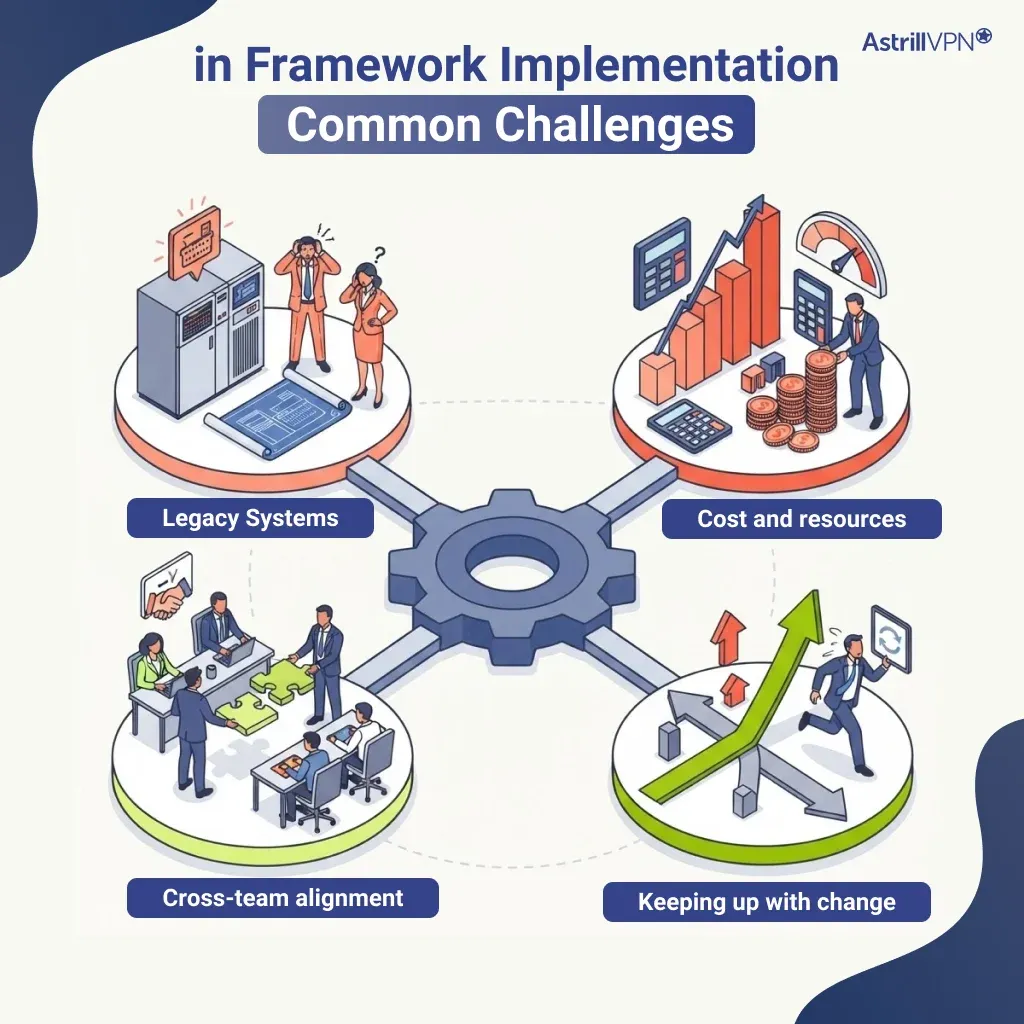
Common Challenges in Framework Implementation
It would be misleading to pretend that adopting a framework is simple once you’ve picked one. Plenty of organizations stall out here, and it’s worth knowing why before you hit the same walls yourself.
Legacy systems
Older infrastructure often wasn’t built with modern security controls in mind, and retrofitting it can be slow, expensive, and occasionally risky if it means taking critical systems offline for updates.
Cost and resources
Proper implementation takes time, tools, and often outside expertise, and that’s a real strain for smaller teams operating on tight budgets.
Cross-team alignment
Security can’t live in a silo. Getting IT, leadership, and everyday employees all pulling in the same direction is often harder than the technical work itself.
Keeping up with change
Frameworks get updated, regulations shift, and new threats emerge constantly. Treating implementation as a finished project rather than an ongoing commitment is one of the most common mistakes organizations make.
None of this means frameworks aren’t worth the effort. It just means going in with realistic expectations tends to produce better results than assuming it’s a quick checkbox exercise.
Where VPNs and Network Security Fit Into a Cybersecurity Framework
A lot of the conversation around frameworks focuses on policy and process, but the technical layer matters just as much, and this is where something like a VPN quietly earns its place. Inside the NIST structure, encrypting traffic and controlling remote access falls squarely under the Protect function. It’s one of the more practical, immediate steps an organization or an individual can take.
Remote and hybrid work have made this even more relevant. Employees connecting from home networks, coffee shops, or shared spaces widen the attack surface considerably, and a VPN helps close some of that gap by encrypting the connection and masking the traffic from anyone trying to intercept it along the way.
This isn’t just a business concern either. Anyone handling sensitive information on public Wi-Fi, whether that’s banking details, work files, or just personal browsing, benefits from the same principle that frameworks are built on: reduce exposure wherever you reasonably can. A tool like AstrillVPN fits naturally into that layer, giving both individuals and organizations a straightforward way to add encryption and privacy without needing to overhaul an entire security stack.
Conclusion
Cybersecurity frameworks aren’t about chasing a certification for the sake of having one. They exist because managing cyber risk without any structure tends to end badly, usually at the worst possible time. Whether you lean on NIST, ISO 27001, SOC 2, or a mix of several, the real value comes from actually living the process rather than filing it away and forgetting it.
Start with a clear picture of what you’re protecting, choose a framework that fits your size and industry instead of the most talked about one, and build in the habit of revisiting it regularly. Layer in the practical basics too, encrypted connections, strong access controls, and ongoing monitoring, and you’ll be in a genuinely stronger position than most organizations that skip the fundamentals entirely.
FAQs
They give organizations a tested, structured way to manage security instead of reacting to problems as they come up. They also make it easier to prove compliance, communicate risk to leadership, and keep security efforts consistent even as staff and systems change over time.
NIST CSF and ISO 27001 are the two most widely referenced, with SOC 2, HIPAA, PCI DSS, and CIS Controls also showing up frequently depending on the industry and region involved.
They break risk management into a repeatable cycle, identifying assets, assessing exposure, applying the right controls, and monitoring continuously, so nothing gets handled purely on instinct or left unaddressed.
Most frameworks touch on the same core areas in some form: asset identification, protective controls, threat detection, incident response, recovery planning, and governance to keep everything accountable at the leadership level.
A framework is generally flexible and outcome focused, offering guidance you can adapt to your situation. A standard, like ISO 27001 or PCI DSS, tends to be more rigid, with specific requirements you need to meet exactly in order to achieve certification or compliance.

Secure your privacy instantly. Try AstrillVPN with zero risk.
About The Author










No comments were posted yet