




Reverse Shell: What It Is, How It Works, and Prevention

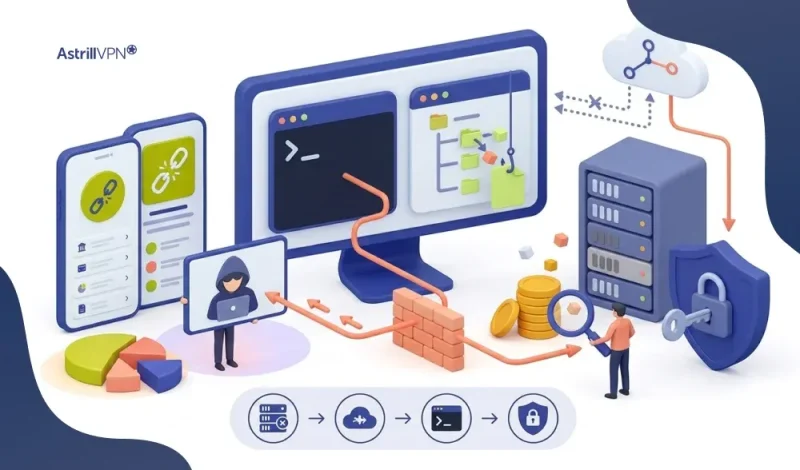
Cyberattacks have become increasingly sophisticated, and attackers often use stealthy techniques to gain unauthorized access to systems. One such technique is the reverse shell. A reverse shell allows a compromised device to initiate a connection back to an attacker-controlled system, giving the attacker remote access and control over the target machine. Forescout analyzed more than 900 million cyberattacks during 2025, highlighting a significant increase in post-exploitation activities and attacker movement within compromised environments.
Reverse shells are commonly associated with malware infections, penetration testing exercises, and post-exploitation activities. Understanding how reverse shells work, the risks they pose, and the methods used to prevent them is essential for organizations and individuals seeking to strengthen their cybersecurity defenses.
In this guide, we’ll explain what a reverse shell is, how reverse shell attacks work, common examples, including Python and Bash reverse shells, and the best practices for preventing them.
Table of Contents
What Is a Reverse Shell?
A reverse shell is a type of shell session in which the target machine initiates a connection to a remote system controlled by a security professional. Once the connection is established, the remote user gains command-line access to the target device.
Unlike traditional remote access methods, where an attacker connects directly to a victim machine, a reverse shell reverses the direction of communication. The compromised device reaches out to the attacker’s system, often bypassing firewall restrictions that block incoming connections.
Because outbound traffic is usually allowed through firewalls and network security devices, reverse shells are frequently used in cyberattacks to maintain remote access after an initial compromise.
What Is a Reverse Shell Attack?
A reverse shell attack occurs when an attacker exploits a vulnerability, executes malicious code, and tricks a user into running a payload that establishes a reverse shell connection. Reverse shell attacks are often part of larger attack chains involving phishing, malware delivery, web application exploitation, and misconfigured services.
Once the reverse shell is active, attackers may be able to:
- Execute system commands remotely
- Access sensitive files and data
- Install malware and ransomware
- Escalate privileges
- Move laterally through a network
- Maintain persistence on compromised systems
How Does a Reverse Shell Work?
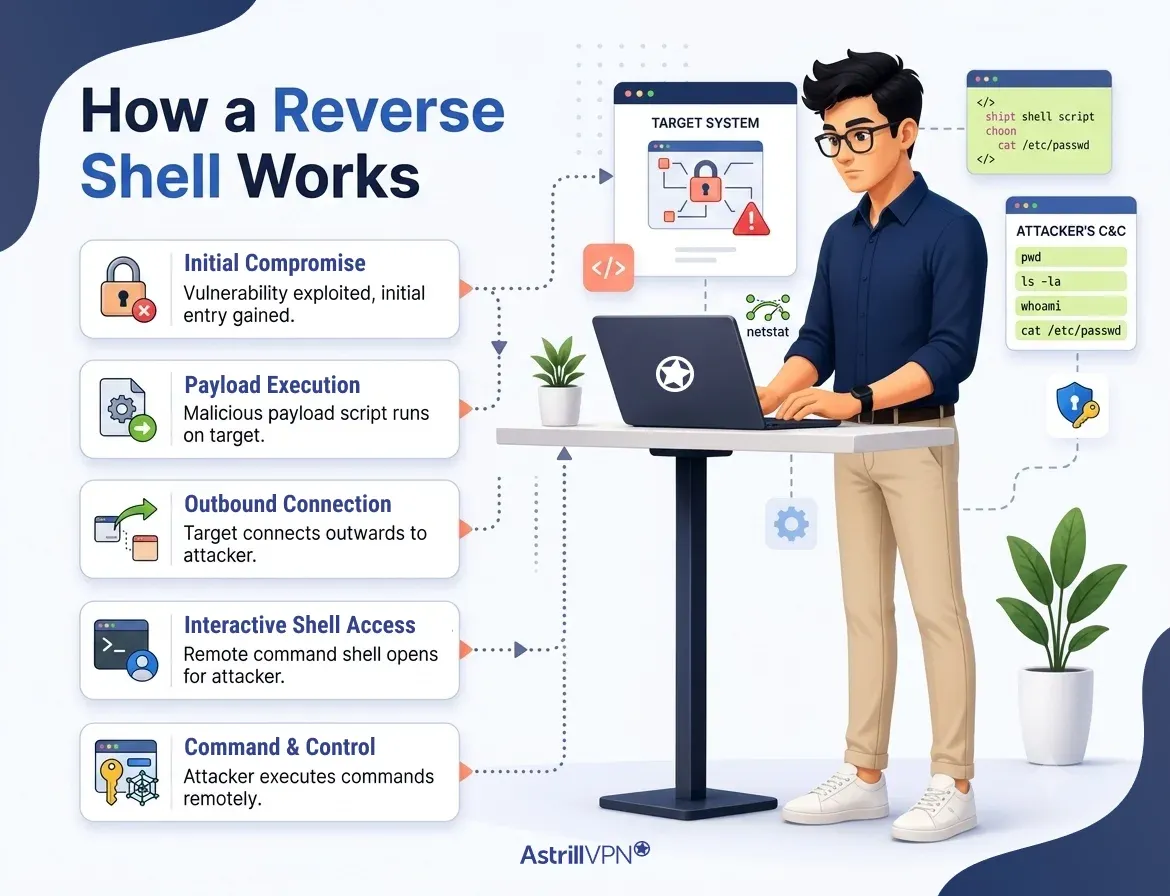
A reverse shell typically follows these steps:
Initial Compromise
The attacker first gains access to the target system through a vulnerability, a phishing attack, a malicious download, or another exploitation method.
Payload Execution
A reverse shell payload is executed on the victim machine. The payload contains instructions to initiate an outbound connection.
Outbound Connection
The compromised device connects to an attacker-controlled server using a specific IP address and port.
Interactive Shell Access
Once the connection is established, the attacker receives an interactive shell session and can execute commands remotely.
Command and Control
The attacker uses the shell to control the compromised machine, gather information, and perform additional actions.
How AstrillVPN Helps Improve Security?
While a VPN cannot directly stop reverse shell attacks, it can strengthen a security posture. AstrillVPN encrypts internet traffic, helps protect users on public Wi-Fi networks, and reduces exposure to certain network-based attacks. Combined with endpoint protection, firewall monitoring, and secure system configurations, a VPN can be part of a broader cybersecurity strategy designed to protect sensitive communications and online activities. If you use a VPN on untrusted networks, it reduces certain attack paths (like easy MITM) that might otherwise be used to deliver exploits that later spawn a reverse shell.
Reverse Shell Example
A simple reverse shell scenario might involve a vulnerable web server. An attacker exploits a remote code execution flaw and runs a reverse shell payload.
The compromised server then initiates an outbound connection to the attacker’s machine. Through this connection, the attacker gains terminal access and can issue commands as if they were physically using the server. This example demonstrates why reverse shells are often used after successful exploitation rather than as the initial attack vector.
Python Reverse Shell
Python is commonly installed on Linux and many server environments, making it a popular language for reverse shell implementations.
A Python reverse shell generally works by:
- Creating a network socket
- Connecting to a remote host
- Redirecting standard input and output streams
- Launching a command shell
Security researchers and penetration testers may use Python-based reverse shells in controlled environments to validate security controls and test detection capabilities. Because Python is widely available and flexible, attackers often use it to establish unauthorized remote access.
Bash Reverse Shell
Bash reverse shells are particularly common on Linux and Unix-based systems.
A Bash reverse shell typically uses built-in shell functionality to establish an outbound network connection and redirect command input and output through it.
Bash reverse shells are often favored because:
- Bash is installed on many Linux systems by default
- They require minimal dependencies
- They can be executed quickly
- They leave a relatively small footprint
Due to their simplicity, Bash reverse shells are frequently encountered during penetration tests and real-world cyberattacks.
Key Reverse Shell Stats
- According to Forescout’s 2025 threat review, ransomware attacks averaged 20 targets per day, with attackers increasingly using compromised devices and overlooked systems as footholds for lateral movement, often enabled by reverse shells and remote access techniques.
- Web applications became the most targeted service type in 2025, accounting for 61% of observed attacks, up from 41% in 2024. Exploited web applications are among the most common entry points for deploying reverse shell payloads.
- CrowdStrike reported a continued rise in malware-free, hands-on-keyboard attacks during 2025, in which attackers increasingly rely on legitimate tools and shell access rather than traditional malware. Reverse shells often play a key role in these operations.
Why Attackers Use Reverse Shells?
Attackers use reverse shells because they provide a reliable way to gain and maintain remote access to compromised systems. By having the target machine initiate the connection, reverse shells can bypass many traditional security controls and allow attackers to interact with the system as if they were physically present. This makes them a valuable tool during the post-exploitation phase of a cyberattack.
Bypass Firewall Restrictions
Most firewalls are configured to block unsolicited inbound connections while allowing outbound traffic. Reverse shells exploit this by having the compromised device connect to the attacker’s server, making the connection appear as legitimate outbound traffic.
Gain Remote Command Execution
Once a reverse shell is established, attackers can execute commands remotely on the target system. This allows them to explore the environment, gather information, and perform additional malicious actions without needing direct physical access.
Maintain Persistent Access
Attackers often use reverse shells to maintain access to a compromised machine after the initial exploit. Even if the original vulnerability is patched, they may still have a way to reconnect and control the system.
Move Laterally Across Networks
After gaining access to one device, attackers can use a reverse shell to identify other systems within the network. This enables lateral movement, allowing them to compromise additional devices and expand their control over the environment.
Steal Sensitive Data
Reverse shells provide attackers with direct access to files, databases, credentials, and other valuable information. This access can be used to steal sensitive data, intellectual property, and customer records.
Deploy Additional Malware
A reverse shell can serve as a launch point for installing other malicious tools, such as ransomware, spyware, keyloggers, and remote access trojans (RATs). This helps attackers deepen their foothold within the compromised system.
Evade Detection
Reverse shell traffic can sometimes blend in with normal network communications, especially when it uses common protocols and ports. This can make detection more difficult and allow attackers to remain hidden for longer periods.
Escalate Privileges
Attackers frequently use reverse shells to identify privilege escalation opportunities. Higher-level permissions allow them to access protected resources and gain greater control over the target environment.
Conduct Reconnaissance
A reverse shell enables attackers to gather information about the operating system, installed software, network configuration, user accounts, and security controls. This intelligence helps them plan subsequent stages of an attack.
Automate Post-Exploitation Activities
Many attackers integrate reverse shells into automated attack frameworks and malware campaigns. This enables them to manage multiple compromised systems efficiently and perform actions across large numbers of devices.
Common Methods Used to Establish Reverse Shell Connections
Attackers typically need an initial foothold on a system before they can establish a reverse shell. They achieve this through various attack techniques that allow them to execute code on a target machine and initiate an outbound connection to a remote server. Understanding these methods can help organizations identify and mitigate potential security risks.
Exploiting Software Vulnerabilities
One of the most common ways to establish a reverse shell is by exploiting vulnerabilities in operating systems, web applications, and network services. Remote Code Execution (RCE) flaws, command injection vulnerabilities, and unpatched software can allow attackers to run malicious commands that launch a reverse shell and connect back to their systems.
Web Application Attacks
Attackers frequently target vulnerable web applications to gain access to servers. Weak input validation, insecure file uploads, server-side template injection, and command injection vulnerabilities can be abused to execute reverse shell payloads. Once successful, the compromised server initiates a connection to the attacker’s machine.
Phishing and Social Engineering
Phishing emails often contain malicious attachments designed to trick users into executing malware. When the payload runs, it may establish a reverse shell connection, giving attackers remote access to the victim’s device. Social engineering remains one of the most effective methods for delivering reverse shell payloads.
Malware and Trojan Infections
Many malware families include reverse shell functionality as part of their command-and-control capabilities. After infecting a system, the malware contacts an external server and creates a communication channel through which attackers can issue commands and manage the compromised device.
Misconfigured Services and Applications
Poorly configured systems can provide attackers with opportunities to establish reverse shells. Exposed administrative interfaces, insecure remote management services, weak authentication mechanisms, and publicly accessible development tools may allow unauthorized users to execute commands remotely.
File Upload Vulnerabilities
Websites that allow users to upload files can become targets if they do not properly validate uploaded content. Attackers may upload malicious scripts or web shells that, when executed, initiate a reverse shell connection and provide remote access to the server.
Compromised Credentials
Stolen usernames and passwords obtained through phishing, credential stuffing, and data breaches can give attackers access to systems. After logging in, they may run scripts and tools that create a reverse shell, allowing them to maintain persistent access.
Supply Chain Attacks
In a supply chain attack, attackers compromise trusted software, libraries, and third-party services and distribute malicious code through legitimate channels. Once installed, the malicious component can establish a reverse shell connection and provide attackers with access to affected systems.
Insider Threats
Malicious insiders and disgruntled employees with authorized access intentionally install reverse shell tools and scripts on company systems. Because insiders often have legitimate permissions, their actions can be more difficult to detect.
Exploiting Public-Facing Services
Internet-facing services such as web servers, VPN gateways, database servers, and remote desktop solutions are common targets. Attackers scan for weaknesses in these services and exploit them to execute reverse shell payloads and gain remote access.
Removable Media and Malicious Downloads
In some cases, reverse shell payloads are delivered through infected USB drives, pirated software, and malicious downloads. Once executed, the payload establishes an outbound connection to the attacker’s server and grants remote control of the device.
Risks Associated With Reverse Shell Attacks
Reverse shell attacks are considered highly dangerous because they give attackers interactive remote control over a compromised system. Once established, the attacker can operate within the target environment almost as a legitimate user, significantly increasing the potential impact of the breach.
Unauthorized System Access
The most immediate risk is unauthorized access to the infected system, either partial or full. Attackers can execute commands, browse files, and manipulate system settings without detection if proper monitoring is not in place.
Data Theft and Privacy Breaches
Reverse shells enable attackers to locate and extract sensitive data, including personal information, financial records, intellectual property, login credentials, and confidential business documents. This can lead to serious privacy violations and regulatory consequences.
Credential Harvesting
Once inside a system, attackers often search for stored passwords, API keys, SSH keys, and browser-saved credentials. These credentials can be reused to access other systems and escalate the attack further.
Lateral Movement Across Networks
A compromised system can serve as a stepping stone to other devices within the same network. Attackers use reverse shells to explore internal systems, identify vulnerabilities, and spread laterally across servers, endpoints, and databases.
Installation of Malware and Ransomware
Attackers can use reverse shell access to install additional malicious tools such as spyware, keyloggers, rootkits, and ransomware. This can escalate a single compromise into a large-scale security incident affecting multiple systems.
Privilege Escalation
If initial access is limited, attackers may attempt to escalate their privileges to gain administrative or root-level access. This increases their ability to turn off security controls, modify system files, and maintain persistence.
System Disruption and Downtime
Malicious activity carried out via reverse shells can cause system crashes, service interruptions, or complete shutdowns. This can severely impact business operations, especially in critical infrastructure or enterprise environments.
Persistence and Long-Term Control
Attackers often establish persistence mechanisms through reverse shells, allowing them to regain access even after system reboots and password changes. This makes the threat’s removal more difficult.
Evasion of Security Controls
Reverse shell traffic blends in with normal outbound connections, making it harder for traditional security systems to detect. Attackers may also use encryption and common ports to avoid triggering alerts.
Compliance and Legal Consequences
Organizations affected by reverse shell attacks may face violations of data protection regulations such as GDPR, HIPAA, and PCI DSS. This can result in legal penalties, financial losses, and reputational damage.
Financial Losses
The combined impact of data theft, downtime, incident response costs, regulatory fines, and recovery efforts can cause significant financial damage to organizations.
Reputation Damage
Public disclosure of a breach involving reverse-shell access can erode customer trust, harm brand reputation, and affect long-term business relationships.
Use of Compromised Systems in Larger Attacks
Compromised machines may be used in botnets and as staging points for launching further attacks against other organizations, spreading the impact beyond the original victim.
How to Detect a Reverse Shell on Your System?
Detecting a reverse shell can be challenging because it often blends into normal network traffic and uses legitimate system tools. However, with proper monitoring of network behavior, processes, and logs, it is possible to identify suspicious activity early and respond before significant damage occurs.
Monitor Unexpected Outbound Connections
One of the strongest indicators of a reverse shell is unusual outbound network traffic. A system that suddenly connects to unknown external IP addresses or rare ports, especially from a server that normally has limited internet communication, should be investigated.
Security teams often focus on:
- Connections to unfamiliar geographic locations
- Persistent outbound sessions to a single IP
- Traffic on unusual and high-numbered ports
Analyze Running Processes
Reverse shells often spawn command-line processes such as cmd.exe, bash, sh, or powershell in unusual contexts. If these processes are running without user interaction and are launched by web services, it indicates a compromise.
Suspicious signs include:
- Shell processes running under web server accounts
- Unexpected parent-child process relationships
- Command shells running in the background without a user login
Review System and Security Logs
System logs can provide valuable evidence of reverse shell activity. Attackers trigger abnormal authentication attempts, process executions, and service misuse.
Key logs to review include:
- Authentication logs (unexpected login patterns)
- Process creation logs
- Web server access and error logs
- Security event logs (Windows Event Viewer or Linux audit logs)
Inspect Network Traffic Patterns
Network monitoring tools can help identify reverse shell communication patterns, such as:
- Continuous low-volume traffic (heartbeat-like connections)
- Encrypted traffic to unknown destinations
- Repeated connections at regular intervals
Intrusion Detection Systems (IDS) and Intrusion Prevention Systems (IPS) can also flag suspicious command-and-control behavior.
Use Endpoint Detection and Response (EDR) Tools
Modern EDR solutions are one of the most effective ways to detect reverse shells. These tools analyze behavior rather than just signatures, allowing them to identify:
- Suspicious command execution
- Memory-based payloads
- Unauthorized remote connections
- Process injection and privilege escalation attempts
Check for Abnormal User Activity
User behavior analytics can help detect anomalies such as:
- Logins at unusual hours
- Access from unfamiliar devices or locations
- Execution of administrative commands by non-admin users
- Sudden spikes in file access and downloads
Look for Listening and Suspicious Ports
While reverse shells typically use outbound connections, attackers also open unusual ports temporarily for communication. Tools like netstat and network monitoring dashboards can help identify:
- Unknown listening services
- Unexpected port usage
- Short-lived network listeners
Monitor DNS Requests
Some reverse shells rely on DNS-based communication or domain name resolution to reach command-and-control servers. Suspicious DNS patterns include:
- Requests to newly registered and unknown domains
- High-frequency DNS queries to the same domain
- Random domain names
Detect Living-off-the-Land Techniques
Attackers often use legitimate system tools (PowerShell, WMI, curl, bash, etc.) to avoid detection. Monitoring unusual usage of these tools can help identify reverse shell activity disguised as normal system behavior.
Use File Integrity and Behavioral Monitoring
Changes to system files, startup scripts, and scheduled tasks indicate an attempt to maintain reverse-shell persistence. Monitoring these changes helps detect long-term compromises.
Enable Real-Time Alerts
Security systems should be configured to trigger alerts for:
- New outbound connections from critical servers
- Execution of command shells by non-interactive processes
- Suspicious PowerShell and script execution patterns
Reverse Shell Prevention
Preventing reverse shell attacks requires a layered security approach because attackers typically gain access through multiple weak points, such as vulnerable applications, phishing, misconfigurations, and unpatched systems. Strong prevention focuses on reducing attack surfaces, blocking unauthorized execution, and improving detection and response capabilities.
Keep Systems and Software Updated
Unpatched vulnerabilities are one of the most common entry points for reverse shell attacks. Regularly updating operating systems, web applications, plugins, and third-party libraries helps close security gaps that attackers exploit to execute remote code.
Implement Strong Firewall Rules
Since reverse shells rely on outbound connections, controlling egress traffic is especially important. Proper firewall configuration can significantly reduce risk:
- Block unnecessary inbound and outbound ports
- Restrict outbound traffic from servers that don’t need internet access
- Use allowlists for trusted IPs and services
Use Endpoint Detection and Response (EDR)
EDR tools provide behavioral monitoring that can detect reverse shell activity in real time. EDR solutions can also automatically isolate infected systems. These systems analyze:
- Suspicious command execution
- Unusual process behavior
- Unauthorized network connections
- Memory-based payloads
Enforce Least Privilege Access
This prevents attackers from easily escalating control through a reverse shell. Limiting user permissions reduces the damage an attacker can do if they gain access:
- Users should only have access to the necessary resources
- Administrative privileges should be tightly controlled
- Service accounts should have minimal permissions
Secure Web Applications
Web application firewalls (WAFs) can also help block malicious payloads. Since web apps are a major entry point, secure development practices are critical:
- Validate and sanitize all user inputs
- Prevent command injection and file upload vulnerabilities
- Use secure coding frameworks
- Conduct regular penetration testing
Monitor Network Traffic
Intrusion Detection Systems (IDS) and Security Information and Event Management (SIEM) tools can correlate these patterns. Continuous network monitoring helps detect suspicious outbound behavior:
- Unexpected external IP connections
- Persistent beaconing traffic
- Encrypted traffic to unknown destinations
Disable Unnecessary Services
Every active service is a potential attack vector. Reducing exposed services lowers the chance of exploitation. Disable and remove:
- Unused remote access services
- Development interfaces on production systems
- Legacy protocols and outdated services
Implement Application Allowlisting
This is especially effective in enterprise environments. Application control policies ensure only approved software can run:
- Blocks unauthorized scripts and executables
- Prevents execution of malicious payloads
- Reduces the risk of file-based reverse shell execution
Strengthen Email and Phishing Protection
Many reverse shells originate from malicious attachments. Since phishing is a common delivery method:
- Use email filtering systems to block malicious attachments
- Scan links and downloads before user access
- Train users to recognize suspicious emails
Use Network Segmentation
Even if a reverse shell is established, segmentation can contain the damage. Segmenting networks limits attacker movement:
- Separate critical systems from general user devices
- Restrict communication between segments
- Isolate sensitive databases and servers
Enable Logging and Real-Time Alerts
Real-time alerts allow faster response to suspicious activity. Comprehensive logging helps detect early signs of compromise:
- Log process creation and command execution
- Monitor authentication attempts
- Track outbound network connections
Conduct Regular Security Awareness Training
Human error remains a major factor in cyberattacks. Educated users reduce the likelihood of initial compromise. Training should cover:
- Phishing recognition
- Safe browsing and download habits
- Reporting suspicious system behavior
Use Multi-Factor Authentication (MFA)
If credentials are stolen, MFA can block unauthorized access and prevent attackers from establishing reverse shell sessions through compromised accounts.
Conclusion
Reverse shells are powerful tools that can provide remote access to compromised systems. While they are commonly associated with cyberattacks, they also serve legitimate purposes in authorized penetration testing and security assessments. Understanding how reverse shells work, recognizing the signs of compromise, and implementing strong preventive measures can significantly reduce the risk of unauthorized access.
Organizations should adopt a defense-in-depth strategy that includes patch management, network monitoring, endpoint protection, user awareness training, and secure system configurations to defend against reverse shell attacks and other advanced threats.
FAQs
Here are some of the frequently asked questions.
A reverse shell allows a remote user to gain command-line access to a target system by having the target initiate a connection back to the remote host. It is commonly used in penetration testing and by attackers after system compromise.
In a reverse shell, the target machine initiates the connection to the remote host. In a bind shell, the target machine opens a port and waits for the attacker to connect. Reverse shells are often more effective at bypassing firewall restrictions.
Penetration testers use reverse shells to validate vulnerabilities, assess security controls, simulate attacker behavior, and demonstrate the potential impact of successful exploitation in authorized environments.
Attackers typically establish reverse shell connections by exploiting vulnerabilities, deploying malware, conducting phishing attacks, abusing misconfigured services, and executing malicious code on a target system.
You can detect reverse shells by monitoring outbound network connections, analyzing logs, reviewing active processes, inspecting command execution activity, and using intrusion detection solutions.
Common monitoring tools include EDR platforms, Security Information and Event Management (SIEM) systems, Intrusion Detection Systems (IDS), Intrusion Prevention Systems (IPS), network analyzers, and firewall monitoring solutions.
Reverse shells themselves are not inherently illegal. Cybersecurity professionals widely use them during authorized penetration tests and security assessments. Using reverse shells to gain unauthorized access to systems is illegal and unethical.

Secure your privacy instantly. Try AstrillVPN with zero risk.
About The Author










No comments were posted yet