




Double Your Privacy: An Introduction to Double VPN

Bisma Farrukh
Have you ever worried about your online privacy and security when browsing the web or accessing sensitive info? We all have. However, there’s something you can do about it; double up your protection with a double VPN. In this blog, we’ll walk you through exactly how a double VPN works and why it can seriously boost your privacy. We’ll explain the pros and cons, how it works, and give you step-by-step instructions for setting up multi-hop connections on your devices. Whether you’re a total newbie or a tech expert, you’ll learn how to double your privacy in no time. Let’s dive in!
Table of Contents
What Is a Double VPN?
A double VPN, also known as a multi-hop VPN, routes your internet traffic through two VPN servers instead of one. First, it encrypts your data and sends it to the first VPN server. Then, that server decrypts the data and sends it to the second VPN server, which re-encrypts it before sending it to the internet.
Added Security
Using two VPN servers adds an extra layer of security and privacy. If one VPN has a security flaw or gets compromised, your data still has to go through the second VPN server before reaching the internet. It also hides your online activities and location even more thoroughly by obscuring your connection to either VPN server.
Slower Speeds
The downside is that multihop VPN typically reduce your internet speeds by up to 30% compared to a single VPN. The extra encryption and network hops require more processing power and can introduce latency. For many users concerned with privacy, the speed trade-off is worth the added security.
How Does a Double VPN Work?
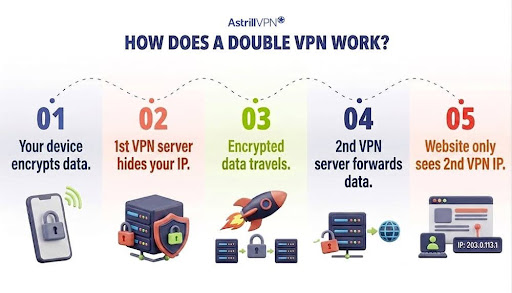
A double VPN routes your internet traffic through two separate VPN servers, adding encryption at each step. Here’s what happens when you connect:
- Your device encrypts your data and sends it to the first VPN server.
- The first server re-encrypts the data and hides your original IP address. It knows where you came from, but not where you are going.
- The doubly encrypted data travels to the second VPN server.
- The second server removes the outer layer of encryption and forwards your traffic to its final destination. It knows where your traffic is headed but has no record of your original IP address.
- The website you visit only sees the IP address of the second server.
What is AstrillVPN’s multihop VPN feature?
AstrillVPN’s multihop VPN feature, also known as double VPN, allows you to connect to a VPN server through another VPN server for enhanced privacy and security. When you turn on the multihop VPN feature in the AstrillVPN app, your internet traffic is encrypted and routed through two separate VPN servers in different locations before reaching the destination server.
This double layer of encryption and routing makes it much more difficult for anyone to track your online activity or determine your real IP address and location. The multihop VPN feature is ideal if you’re using public Wi-Fi, streaming geo-restricted content, or living in a country with heavy internet censorship.
With AstrillVPN’s multihop VPN, you can choose from hundreds of VPN server locations around the world to create your own custom multihop VPN chain. For the strongest privacy protection, select VPN servers in separate jurisdictions. You can configure up to 3 multi-hop servers and use them with OpenWeb. The multihop VPN feature works on all of AstrillVPN’s apps including Windows, Mac, Android, and iOS.
To enable the multihop VPN feature, you must be Astrill’s VIP user. You can get VIP addon additionally starting from $10/month. You can select two or more locations from the list of VPN servers in the AstrillVPN app. The app will automatically create an encrypted tunnel through each server, hiding your real IP address and masking your online traffic and activity. For enhanced security, you can also enable additional features like the kill switch, IPv6 leak protection, and DNS leak test.
Double VPN Features and Benefits
A double VPN, also known as a multi-hop VPN, provides an extra layer of protection for your online activities. Here are some of the key benefits of using a double VPN:
Increased Privacy
By routing your internet traffic through two separate VPN servers in different locations, a double VPN makes it much more difficult for anyone to trace your online activity back to you. Your IP address and personal information are masked behind two layers of encryption.
Enhanced Security
A double VPN uses military-grade encryption protocols to secure your data twice, once for each VPN connection. This doubled security helps prevent cybercriminals, government agencies, and internet service providers from monitoring your internet usage or stealing your personal information.
Access Restricted Content
Some streaming services, websites and mobile apps block access to users connecting from a VPN. A double VPN can bypass these restrictions by disguising your VPN connection to appear as normal internet traffic. You’ll enjoy unrestricted access to geographically-blocked content from anywhere.
Redundancy
If one VPN server goes down for any reason, your double VPN will automatically reroute your connection through the other server so you stay protected at all times. This built-in redundancy gives you peace of mind that your privacy and security won’t be compromised.
Using a double VPN is really the best way to maximize your online privacy in today’s digital world.
What are the pros and cons of Double VPN?
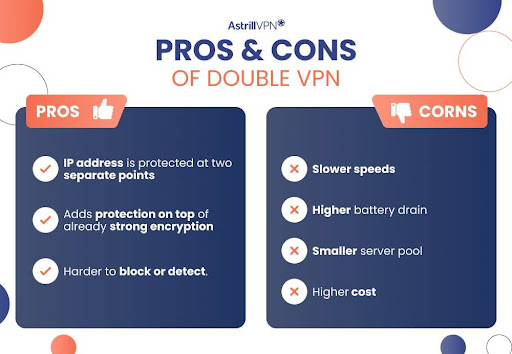
Pros
Your IP address is protected at two separate points
With a standard VPN, your IP address is hidden behind one server. With double VPN, it is hidden behind two. Even if one server is compromised or legally compelled to hand over data, the attacker still cannot connect your IP to your online activity, because neither server holds both pieces of information at the same time.
Adds protection on top of already strong encryption
A single hop of AES-256 encryption is already computationally unbreakable for most real-world threat scenarios. Double VPN does not dramatically change that picture in terms of raw encryption strength. What it does add is a second layer of metadata protection. Even if someone can see that you are using a VPN, they cannot determine which server is your actual exit point.
Harder to block or detect
Double VPN obscures the fact that you are using a VPN more effectively than a single connection. For users in countries with aggressive VPN detection or deep packet inspection, routing through two servers in different jurisdictions makes it harder for censors to identify and block the connection.
Cons
Slower speeds
Your data has to travel further and be processed twice. For most use cases, this is a noticeable slowdown. If you are streaming, gaming, or doing anything that requires low latency, double VPN will make the experience worse. Use it when privacy matters more than speed.
Higher battery drain
The extra encryption and decryption cycles require more processing power from your device. On mobile especially, this can reduce battery life more noticeably than a standard VPN connection.
Smaller server pool
Not every server in a VPN provider’s network is configured to support double VPN or multihop connections. That limits your options for exit locations, which can affect which geo-restricted content you can access.
Higher cost
Most providers restrict double VPN to premium plans or charge for it as an add-on. AstrillVPN’s multihop feature, for example, requires a VIP add-on starting at $10 per month on top of your base plan.
Top Use Cases for a Double VPN
A double VPN is ideal for users concerned about online privacy and security. By encrypting your traffic and routing it through two VPN servers in different locations, a double VPN can help mask your online identity and location.
Streaming geo-restricted content
If you want to access streaming media that is blocked in your country or region, a double VPN can help circumvent those restrictions by assigning you an IP address from another location. By connecting to VPN servers in the U.S. and then another country, you can trick streaming services into thinking you’re accessing them from a different region.
Public Wi-Fi security
When you connect to public Wi-Fi hotspots, all of your online activity and personal data are visible to hackers. A double VPN helps prevent man-in-the-middle attacks by encrypting your data twice and routing it through two separate VPN servers. Even if a hacker intercepts your data at one location, they won’t be able to access or read it.
Anonymity and privacy
For those concerned with privacy, anonymity, and avoiding government surveillance online, a double VPN may provide an added layer of protection and security. By connecting to AstrillVPN servers in privacy-friendly locations, you can better mask your real IP address and location.
When do you need Double VPN?
Some situations call for an extra layer of protection for your online activity. If you’re concerned about privacy in an insecure network or location, a multi-hop VPN is a great solution.
- Maybe you’re connected to public Wi-Fi at a coffee shop or airport. On these networks, your internet traffic is visible to anyone else on the network. A double VPN encrypts your connection twice, hiding your online activity from prying eyes.
- Activists, journalists, and political dissidents often rely on double VPN services when communicating sensitive information. The double encryption helps ensure their anonymity and security, even on compromised networks.
- For people living under repressive regimes with heavy internet censorship, a multi-hop VPN may be the only way to access banned websites and apps. The multiple layers of encryption are more difficult for censors to detect and block.
Of course, for most casual internet users double VPN is overkill. The extra encryption does slow down your connection a bit. But for those who need maximum privacy and security online, a double VPN provides peace of mind that your digital footprint is well hidden.
Is Double VPN safer than a regular VPN connection?
Yes, double VPN can be safer than a regular single VPN connection. With double VPN, your internet traffic goes through two VPN servers instead of one. This makes it much more difficult for anyone to track your online activity or steal your personal information.
Double VPN gives you an extra layer of security and privacy. Even if one VPN connection gets compromised, your data and IP address are still hidden by the second VPN. Snoops, spies and hackers will have a much harder time pinpointing your actual IP address or physical location.
When set up properly with reputable VPN services, double VPN can be a very effective way to safeguard your digital privacy and security. For many people concerned about widespread government surveillance and corporate data mining, double VPN may well be worth the extra cost and complexity.
Double VPN is really about peace of mind. For a little more effort, you can rest assured that your online communications and personal details are obscured not just once, but twice over.
Difference between Double VPN and VPN over VPN
These two setups are often confused, but there is an important distinction between them.
With a built-in double VPN (like AstrillVPN’s multihop feature), both servers are managed by the same provider within a single coordinated system. Your data is encrypted twice, your IP address is changed at each hop, and neither server can see your complete identity and destination at the same time.
VPN over VPN, also called layered VPN or VPN chaining, means running two separate VPN clients from two different providers simultaneously. Your data does get encrypted twice here as well. However, the setup creates a different problem: the second VPN receives your traffic from the exit point of the first VPN and assigns it a new IP, but the two VPN tunnels may conflict with each other, cause routing errors, or trigger kill switches. Managing compatibility between two separate clients is also significantly more complicated.
The more meaningful distinction is trust, not encryption count. With a built-in double VPN from a no-log provider, you have one provider’s infrastructure handling the chain in a controlled way. With VPN over VPN using two separate providers, you are relying on both providers independently, and if one of them has poor logging practices, that undermines the whole setup.
Double VPN vs. Tor over VPN (Onion over VPN)
Both double VPN and Tor over VPN give you more than one layer of protection. They are built differently and suited for different situations.
How Tor over VPN works
With Tor over VPN, you first connect to a VPN server, and then your traffic enters the Tor (The Onion Router) network. Tor routes your connection through at least three volunteer-operated nodes, encrypting it separately at each one. By the time your traffic exits the Tor network, it has been through multiple relayers, none of whom can see both who you are and where you are going.
How they compare
Anonymity
Tor over VPN generally provides stronger anonymity than double VPN. The Tor network uses three or more nodes operated by independent volunteers around the world, making traffic correlation attacks significantly harder. Double VPN uses two servers that, in most cases, belong to the same provider.
Speed
Tor is slow. Traffic bouncing through three or more nodes adds substantial latency. Double VPN is noticeably faster than Tor over VPN, which makes it the more practical choice for most users who need extra privacy without sacrificing usability entirely.
Who it is for
Tor over VPN is the right choice for high-risk situations: whistleblowers, journalists communicating with sensitive sources, or activists operating in countries where getting caught has serious consequences. The performance trade-off is worth it when the threat model demands it.
Double VPN is better suited for users who need stronger privacy than a standard VPN meaningfully provides, but still need a connection that is fast enough to actually use. Remote work on sensitive projects, traveling through high-surveillance environments, or bypassing advanced censorship systems are all reasonable use cases.
How to set up a multi hop connection on your device?
To enable multihop VPN on your device, you’ll need to take a few steps. First, sign up for AstrillVPN that allows up to 3 multihop connections. Install the AstrillVPN app on your device.
Next, connect to a server location. For the first connection, choose a location in a country that is far from your physical location. Then, connect to a second server. Pick a country that is also distant from the first VPN server location.
For example, you could connect to a server in the US, then connect to a server in Australia. This multihop connection chains together two separate VPN servers in different locations to add an extra layer of privacy and security for your internet traffic.
- To set this up manually on your device, you need to get VIP addon starting from $10.
- Now open the settings for AstrillVPN and look for MultihopVPN.
- Tap to enable this feature, then select the server locations you want to use for each hop.
- The VPN services will automatically forward your traffic through two distant servers.
- Your multihop VPN is now active.
All your internet traffic will be anonymized by passing through multiple servers in separate locations. This makes it much harder for anyone to trace the origin or destination of your data. For the strongest privacy, choose VPN servers in politically and geographically distinct countries for your multihop chain.
FAQs
Using two VPNs simultaneously can be possible but not be practical solution. The basic process involves signing up for two different VPN providers, then connecting to one VPN, then connecting to the second VPN while the first one is still running. Using two VPNs can provide some additional security and privacy benefits over a single VPN but it can also lead to complexity, compatibility and speed issues.
For most casual users, a double VPN is probably overkill and not worth the additional cost or complexity. However, for those concerned about anonymity and hiding their digital footprints, double VPN may provide enhanced security. The double encryption makes your traffic more difficult to monitor and trace. Just keep in mind, more hops also mean potentially slower speeds.
Onion over VPN, also known as Tor over VPN, routes your traffic through the Tor network after connecting to a VPN. This approach is generally considered a bit safer than double VPN. Tor is designed specifically for anonymous communication and hidden services. That said, both double VPN and Onion over VPN can improve your privacy, and which is “safer” for you depends on your specific needs and threat model.
Conclusion
Now as we have reached the end of this guide on double VPN. Hopefully you now have a solid grasp of what a multihop VPN is, why it can crank up your online privacy, and how to set one up. We covered the key things like encryption, multiple server connections and potential speed impacts. While it does take more effort than a standard VPN, a double VPN can be a smart move if you want to lock down your web traffic. Give it a try and see if it works for your needs – you may be surprised by how easy it is to get running.

Secure your privacy instantly. Try AstrillVPN with zero risk.
About The Author
No comments were posted yet