




What Is a Supply Chain Attack? How Hackers Exploit the Chain of Trust

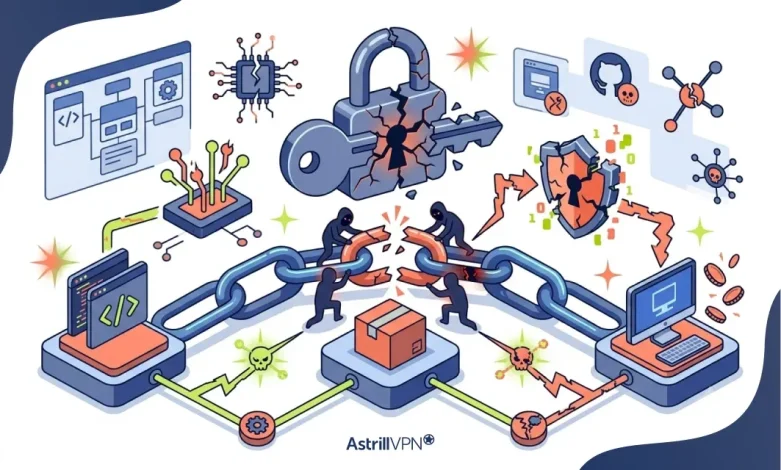
Most organizations spend enormous effort hardening their own systems. Firewalls, endpoint protection, multi-factor authentication, security audits. And yet, some of the most devastating breaches in recent history didn’t come through any of those defenses. They walked right through the front door, disguised as a routine software update or a trusted vendor’s file.
That’s the unsettling thing about supply chain attacks. They don’t break your lock. They use a key that was already trusted.
This guide breaks down what supply chain attacks are, how they actually work, what the major real-world examples tell us, and what you can realistically do to protect yourself or your organization from them.
Table of Contents
What is a Supply Chain Attack?
So, what is a supply chain attack? At its simplest, it’s when an attacker doesn’t target you directly. Instead, they go after someone you already trust, a software vendor, an open-source library, a managed service provider, a hardware manufacturer, and use that trust relationship to get to you.
Think of it like a food contamination scenario. If someone poisons the water supply at a distribution point rather than each household individually, everyone downstream drinks the contaminated water without ever knowing the source was compromised. The same logic applies here. Compromise the upstream, and every downstream consumer becomes a victim.
According to the Verizon 2025 Data Breach Investigations Report, 30% of all breaches now involve third-party compromise, double the previous year’s figure. That number alone explains why this threat category has climbed to the top of almost every security team’s priority list.
How Does a Supply Chain Attack Work? (Step-by-Step)
The mechanics, once you understand them, are actually pretty logical. Here’s how most supply chain attacks unfold:
- The attacker identifies a target organization and works backwards to find a trusted supplier, vendor, or dependency that the target relies on.
- They compromise that upstream entity by stealing credentials, exploiting a vulnerability in the vendor’s own systems, or patiently inserting themselves into an open-source project over months.
- Once inside, they inject malicious code, modify software updates, tamper with a build pipeline, or plant a backdoor that will be packaged and distributed to all downstream users.
- The target organization installs what looks like a legitimate update or uses a trusted library. The malicious payload is delivered silently, arriving through channels that security tools are configured to trust.
• The attacker now has access to the target’s environment, often with high privileges, and the clock starts on a very long dwell time. According to the IBM Cost of a Data Breach Report 2025, the average supply chain breach takes 267 days to identify and contain.
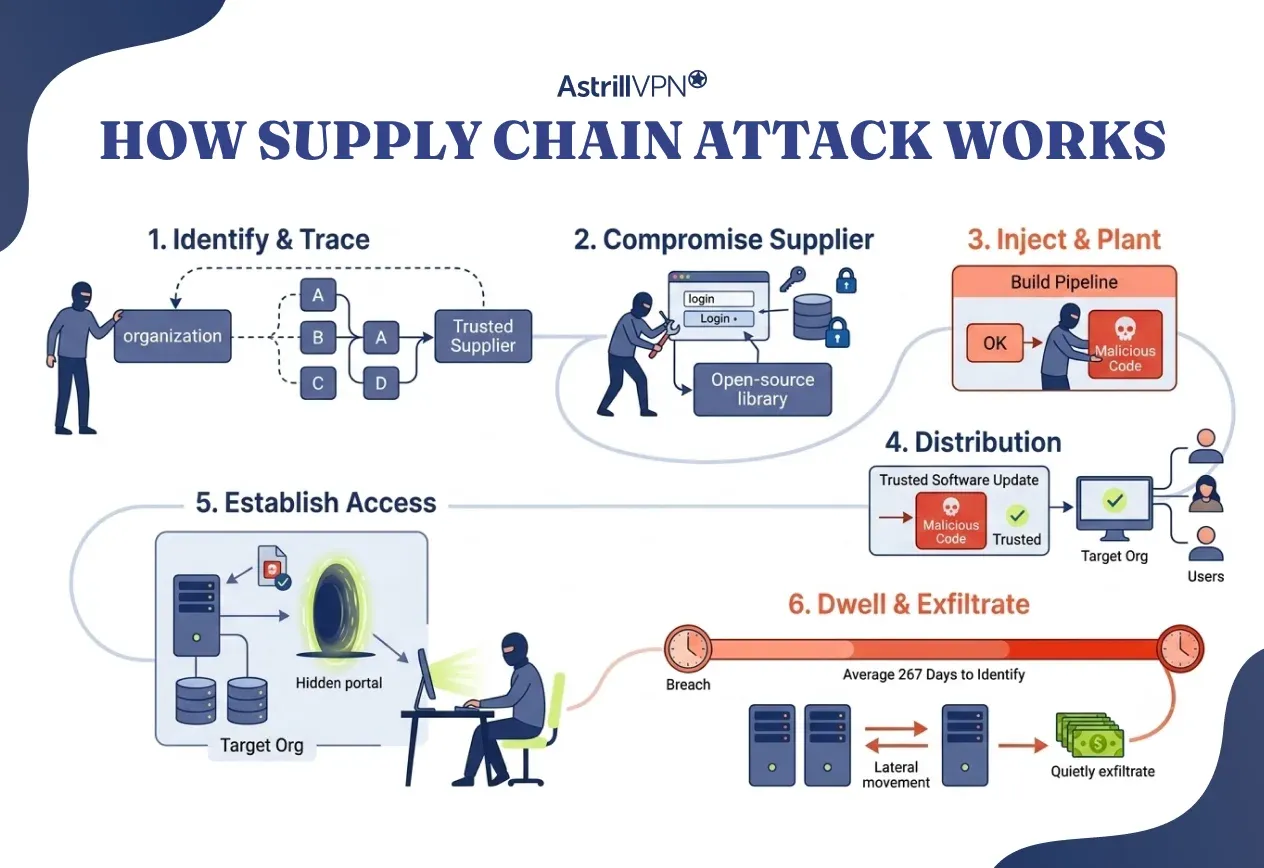
What makes this particularly nasty is the last point. By the time an organization realizes something is wrong, the attackers have often been inside for months, quietly moving laterally, exfiltrating data, or laying groundwork for a larger payload.
Why Attackers Target the Supply Chain Instead of You Directly
The honest answer is that it’s far more efficient. A single successful compromise of a widely used software vendor can cascade into thousands of victim organizations simultaneously. The effort-to-reward ratio is dramatically better than targeting each organization individually.
There’s also the trust factor. Security tools are built to scrutinize unknown activity. But when malicious code arrives as part of a signed software update from a recognized vendor, endpoint detection tools don’t flag it. Firewalls let it through. Security teams don’t catch it because nothing looks wrong. The attacker is essentially exploiting the implicit trust that holds modern software ecosystems together.
Nation-state actors figured this out years ago. Ransomware groups are catching up fast. According to Cyble’s threat intelligence research, supply chain attacks nearly doubled in 2025, with threat groups claiming 297 documented attacks, a 93% increase compared to the prior year.
Supply Chain Attack vs. Traditional Cyberattack: What’s the Difference?
The table below captures the core differences clearly:
| Factor | Supply Chain Attack | Traditional Direct Attack |
|---|---|---|
| Entry Point | Trusted vendor or third-party software | Organization’s own systems directly |
| Detection Difficulty | Very high (arrives via legitimate channels) | Moderate (standard perimeter tools apply) |
| Scale of Impact | Potentially thousands of victims from one breach | Usually limited to the targeted organization |
| Bypasses Perimeter Security? | Yes, entirely | Partially, if defenses are strong |
| Common Attack Vector | Malicious update, poisoned package, compromised vendor | Phishing, brute force, unpatched vulnerabilities |
| Average Dwell Time | 267 days on average before detection | Varies, typically shorter with active monitoring |
| Average Breach Cost | $4.91 million per incident (IBM, 2025) | $4.44 million global average (IBM, 2025) |
The fundamental difference is where the attacker operates. In a traditional attack, they’re trying to get past your defenses. In a supply chain attack, they’ve already gotten past your defenses before the malicious payload ever reaches you, because it came from a source you trusted.
What Is a Software Supply Chain Attack?
While supply chain attacks can target physical goods and hardware components, the category that’s exploding right now is software supply chain attacks. This is what most security teams are dealing with day to day, and it’s what’s behind the majority of high-profile incidents in recent years.
A software supply chain attack is when malicious code gets introduced somewhere in the process of building, packaging, or distributing software, so that by the time the software reaches end users or enterprise systems, it’s already been tampered with. The user installs it legitimately. The vendor pushed it legitimately. But somewhere upstream, the code was compromised.
What Software Supply Chain Includes
Most people picture the software supply chain as just the code a vendor writes. It’s actually much broader than that. The software supply chain includes:
- Open-source libraries and packages pulled from repositories like npm, PyPI, and GitHub
- Third-party APIs and SDKs integrated into applications
- CI/CD pipelines that automate the build and deployment process
- Build tools, compilers, and development environments
- SaaS platforms and cloud services that applications depend on
- Code signing infrastructure and update distribution mechanisms
- GitHub Actions and other automation tools used in development workflows
Every single one of those is a potential entry point for an attacker. And the average production application today consists of roughly 97% third-party or open-source code. What that means in practice is that the actual attack surface for most organizations isn’t their own codebase. It’s the enormous web of external dependencies their software relies on.
Why Software Supply Chains Are So Vulnerable
Speed and convenience are the two biggest culprits. Modern development workflows are designed for velocity. Developers pull packages from public registries without manually reviewing every line of code in every dependency. CI/CD pipelines run automatically, trusting that if a package comes from a known registry it’s probably fine. Updates ship continuously.
That culture of speed and trust is exactly what attackers exploit. Nobody is auditing every npm install. Nobody reviews every GitHub Action that runs in their pipeline. And because open-source maintainers are often unpaid volunteers managing dozens of packages, they’re real targets for social engineering campaigns. ReversingLabs’ State of Software Supply Chain Security report recorded a 1,300% increase in threats from open-source package repositories over a recent reporting period.
How Software Supply Chain Attacks Differ from Hardware Supply Chain Attacks
| Software Supply Chain Attack | Hardware Supply Chain Attack | |
|---|---|---|
| What Gets Compromised | Code, packages, updates, CI/CD pipelines | Physical chips, firmware, circuit boards |
| When Compromise Occurs | During development, build, or distribution | During manufacturing or shipping |
| Detection | Hard but possible with SBOM and behavioral monitoring | Extremely difficult, requires physical inspection |
| Common Targets | Enterprises, developers, SaaS users | Government, critical infrastructure, defense |
| Examples | SolarWinds, XZ Utils, Shai-Hulud npm worm | Stuxnet, Supermicro alleged hardware implants |
Hardware attacks tend to be rarer and far more expensive to execute, which is why they’re typically associated with nation-state actors going after high-value government or critical infrastructure targets. Software supply chain attacks, by contrast, are increasingly accessible to cybercriminal groups and have become a preferred attack vector across industries.
Types of Supply Chain Attacks
Not every supply chain attack looks the same. Attackers have developed a range of methods depending on what they’re targeting, how much time they have, and what level of access they’re going for. Understanding the different types of supply chain attacks helps you recognize where your specific exposure is.
Software Supply Chain Attacks
This is the most prevalent category right now. The attacker compromises the software itself, typically by injecting malicious code into a package or update before it reaches end users. This can happen at the developer’s own machine, inside the build system, or at the point of distribution. The SolarWinds attack is the defining example: malicious code was injected into the Orion platform’s build cycle and distributed to over 18,000 customers as a legitimate signed update.
Hardware Supply Chain Attacks
Rather than targeting code, these attacks tamper with physical components during manufacturing or while goods are in transit. A compromised chip or firmware implant can give an attacker persistent, low-level access that survives OS reinstalls and is nearly impossible to detect through software-based scanning. Firmware-level malware is particularly dangerous because it executes before the operating system even loads, sitting below everything that security tools can see.
Open-Source and Dependency Poisoning
Attackers publish malicious packages to public registries like npm or PyPI, or compromise the accounts of legitimate maintainers to push malicious versions of trusted packages. Sometimes they create packages with names that closely resemble popular legitimate ones, banking on developers making a small typo during installation. According to Sonatype’s State of the Software Supply Chain report, attacks against open-source ecosystems have doubled year over year, with malicious packages proliferating across npm and PyPI at an alarming rate.
Watering Hole Attacks via Trusted Vendors
Here the attacker identifies a website, tool, or service that the target organization regularly uses, and compromises that resource instead. When the target visits or downloads from the compromised source, the malware is delivered. This is the digital equivalent of poisoning a watering hole that your prey regularly visits, hence the name. A 2025 example involved over 100 car dealerships being affected through a shared automotive video service that was quietly compromised.
Insider Threats and Third-Party Vendor Compromise
Sometimes the entry point isn’t technical at all. A disgruntled employee at a supplier, or someone who has been socially engineered by an attacker, can introduce malicious code or provide credential access from the inside. Third-party vendors who have been granted access to a client’s systems are especially valuable targets, because their legitimate credentials let an attacker operate without triggering any unusual activity alerts.
Build System and CI/CD Pipeline Attacks
The build pipeline is where software goes from source code to a distributable product. If an attacker can insert malicious steps into that pipeline, they can modify the final output in ways that won’t be visible in the source code repository itself. OWASP’s Top 10 2025 ranks Software Supply Chain Failures as the number three risk, largely because of how effectively CI/CD compromises bypass multiple defensive layers at once.
Typosquatting and Dependency Confusion
Typosquatting involves registering package names that are close to popular, legitimate packages, hoping developers will make a typo during installation and pull the malicious version instead. Dependency confusion is a related but more sophisticated technique where an attacker publishes a public package with the same name as a company’s internal private package, and exploits the way some package managers prioritize public registries to get the malicious version pulled automatically.
Supply Chain Attack Examples: Real-World Incidents That Shook the Industry
Looking at actual supply chain attack examples is the fastest way to understand just how sophisticated and far-reaching these attacks can get. The incidents below represent the most significant cases across the last several years, and collectively, they show how the threat has evolved.
Axios Compromise (2026): 174 Minutes That Hit Every Build Pipeline
Axios is a JavaScript HTTP client with over 100 million weekly downloads. In a targeted social engineering campaign, attackers gained control of the lead maintainer’s npm credentials via a RAT installed on his computer. T
hey used those credentials to push a compromised version of axios to npm. For 174 minutes, every automated build pipeline running npm install against the latest version was pulling down a malicious package that contained North Korean RAT malware.
Whether a team was affected often came down to one small difference in how they ran their builds. The incident is a vivid illustration of how a single credential compromise can become a global-scale event almost instantaneously.
Shai-Hulud npm Worm (2025): The First Self-Propagating Supply Chain Attack
Shai-Hulud was a landmark in supply chain attack history because it was the first confirmed self-propagating npm worm. Once it infected a developer’s machine via a malicious package, it would harvest npm credentials from the environment and automatically use those credentials to push malicious versions of any other packages that the developer had publish access to.
As documented by OWASP in its Top 10 2025 report, the worm spread to over 500 package versions before npm was able to contain it. Developers themselves became the attack vector, their machines acting as unwitting distribution points for the next wave of compromised packages.
XZ Utils Backdoor (2024): Two Years of Patience
This one demonstrated just how long sophisticated attackers are willing to play the long game. An attacker using a fake identity spent over two years contributing to the XZ Utils compression library, building trust with the project’s maintainers through consistent, legitimate contributions. Once they’d earned enough trust to become a co-maintainer, they inserted a carefully hidden backdoor that would have allowed remote code execution on Linux systems.
The backdoor was discovered before widespread deployment, but only because a Microsoft developer noticed a small performance anomaly during routine testing. Had it gone undetected, it would have been embedded in a significant portion of Linux distributions worldwide.
Polyfill.io Attack (2024): 385,000 Websites Compromised Overnight
When a Chinese company acquired the polyfill.io domain, they modified the service to inject malicious JavaScript that redirected mobile visitors to betting and scam websites. Polyfill.io was a JavaScript compatibility service used by over 385,000 websites, including properties associated with Warner Bros, Hulu, and the World Economic Forum.
None of those website owners had changed anything on their end. The attack exploited the trust they’d placed in an externally hosted script, a vivid illustration of the risk of relying on code you don’t control.
3CX Supply Chain Attack (2023): A Chain Within a Chain
The 3CX attack is notable as the first publicly confirmed double-supply-chain attack. Attackers first compromised a software package from Trading Technologies, a financial trading platform. An employee at 3CX downloaded that compromised software, which gave attackers a foothold to then compromise 3CX’s own build process.
The resulting malicious 3CX desktop application was then pushed to 3CX’s 600,000 business customers. The whole cascade started from a single upstream compromise that nobody at 3CX had any reason to suspect.
SolarWinds Attack (2020): The Attack That Changed Everything
This is the one that put supply chain attacks on the map for executives and policymakers. Attackers, later attributed to a Russian state-sponsored group, compromised SolarWinds’ build environment and inserted malicious code called Sunburst into software updates for the Orion platform. About 18,000 SolarWinds customers downloaded and installed those updates, including multiple US government agencies and major corporations.
The attackers then selectively activated a second-stage payload on roughly 100 high-value targets. The malware sat undetected for months, and the breach wasn’t discovered until December 2020.
What made SolarWinds so alarming was that the victims had done nothing wrong. They’d installed a legitimate, signed update from a trusted vendor. Their defenses were irrelevant.
Software Supply Chain Attacks: Why This Attack Vector Is Exploding
The numbers around software supply chain attacks in recent years aren’t just alarming in isolation. According to Cyble’s 2025 threat landscape research, supply chain attacks doubled year over year, and the category has gone from a sophisticated nation-state technique to something that ransomware groups and financially motivated criminal organizations are actively pursuing at scale.
The Scale Problem: Your App Is 97% Someone Else’s Code
Modern development organizations don’t write software from scratch. They assemble it from components: open-source libraries, third-party SDKs, cloud services, and automation tools. The actual first-party code in a typical production application is a small fraction of the total. That means the security of that application depends not just on your own team’s practices, but on the security posture of dozens or hundreds of upstream maintainers, many of whom are volunteers managing their projects in their spare time.
The Trust Problem: Signed Updates Don’t Mean Safe Updates
Code signing and package verification are important security controls, but they only confirm that a package came from who it says it did. If the attacker has compromised the maintainer’s signing credentials, those signatures are meaningless. The SolarWinds update was signed. The compromised axios package was pushed through legitimate npm credentials. Trust in the source is no longer sufficient verification.
The Detection Problem: The Average Breach Takes 267 Days to Discover
Supply chain compromises are so hard to detect because the malicious activity arrives through trusted channels. Standard signature-based security tools don’t flag it because nothing looks out of place at the point of entry. According to the IBM Cost of a Data Breach Report 2025, supply chain breaches take the longest of any attack vector to identify and contain, averaging 267 days. By that point, most organizations are discovering breaches long after significant damage has been done.
The Cost Problem: $4.91 Million Average per Supply Chain Breach
The IBM Cost of a Data Breach Report 2025 puts supply chain compromise as the second costliest initial attack vector at $4.91 million per incident, just behind malicious insider attacks. That’s already above the global average breach cost of $4.44 million, but it understates the real exposure in catastrophic cases. The Marks & Spencer attack in 2025 resulted in an estimated GBP 300 million impact to operating profit. For healthcare organizations, where supply chain compromises can disrupt patient care systems, the costs extend well beyond financial impact.
How Supply Chain Attacks Bypass Cybersecurity Defenses
Understanding supply chain attack cybersecurity means understanding why the usual playbook fails against this threat. Most enterprise security architectures are built around a relatively simple model: defend the perimeter, trust what’s inside, and block what looks suspicious. Supply chain attacks are designed to break every assumption in that model.
Why Perimeter Security Fails Against Supply Chain Threats
Perimeter defenses, including firewalls, intrusion detection systems, and email filters, are designed to identify and block malicious traffic. But when malicious code arrives inside a signed software update delivered over an encrypted HTTPS connection from a known vendor, it looks identical to legitimate traffic. The delivery mechanism is trusted. The source is trusted. The signature is valid. There’s nothing for the perimeter to catch.
How Supply Chain Attacks Evade Endpoint Detection
Endpoint detection and response tools work by recognizing known malicious patterns or identifying suspicious behaviors. Supply chain attacks often evade these tools because the initial payload doesn’t exhibit classically suspicious behavior. It executes within the context of legitimate, trusted software.
The malicious activity can look like normal application behavior until it’s too late. This is why behavioral analytics and anomaly detection are increasingly important: looking for unusual activity patterns rather than known malicious signatures.
The Role of Implicit Trust in Making These Attacks So Effective
Every modern organization runs on implicit trust. We trust that the package registry delivers what it says it does. We trust that vendor updates are safe to install. We trust that our CI/CD pipeline outputs match our source code. Supply chain attacks systematically exploit each of those trust assumptions. Until organizations move toward a model of continuous verification rather than assumed trust, these blind spots remain.
Nation-State Actors vs. Cybercriminals: Who Is Launching Supply Chain Attacks?
For a long time, supply chain attacks were considered the domain of nation-state actors with significant resources and patience. SolarWinds, XZ Utils, the Lazarus Group’s Operation 99 targeting Web3 developers: all of those fit a patient, highly resourced attacker profile. But that’s changed. According to Vectra AI’s supply chain threat analysis, ransomware groups are now consistently behind more than half of all supply chain attacks, executing sophisticated compromises to maximize their downstream reach. The Cl0p group’s exploitation of vulnerabilities in Cleo’s file transfer products in late 2025 affected at least 66 confirmed organizations from a single upstream compromise.
How to Protect Your Organization from Supply Chain Attacks
Supply chain security isn’t a single technology or a checkbox you tick on an annual audit. It’s an ongoing practice of understanding your dependencies, verifying what you trust, and maintaining visibility into every layer of your software and vendor ecosystem. The good news is that there are concrete, practical steps that meaningfully reduce your exposure.
Map and Audit Every Vendor and Dependency You Rely On
You cannot protect what you can’t see. The first step in building genuine supply chain security is creating a complete inventory of every vendor, partner, open-source library, and third-party service that touches your environment or your code. For software, this means generating a Software Bill of Materials (SBOM) for every application.
For vendor relationships, it means mapping which suppliers have access to your systems and what level of access they have. Without this visibility, you’re essentially defending a perimeter you can’t see.
Implement Zero-Trust Architecture Across Your Vendor Ecosystem
Zero trust means never assuming that any connection, credential, or piece of code is safe simply because it comes from a known source. In practice, this means requiring continuous authentication and authorization, not just at login, but throughout every session.
Vendors and third parties should have access only to the systems they need for their function, with that access expiring when it’s no longer needed. No implicit trust, no elevated permissions by default.
Use a Software Bill of Materials (SBOM) for Full Dependency Visibility
An SBOM is a machine-readable inventory of every component, library, and dependency in an application. When a new vulnerability is disclosed anywhere in the ecosystem, organizations with current SBOMs can immediately identify which of their systems contain the affected component and prioritize remediation.
Standard formats include SPDX and CycloneDX. Regulatory mandates in the US and EU increasingly require SBOMs for software used in government and critical infrastructure contexts, making this a compliance requirement rather than just a best practice.
Lock Your CI/CD Pipeline Down
Your build pipeline is one of the highest-value targets in your software supply chain. Key controls include:
- Pinning dependency versions rather than pulling whatever is tagged as ‘latest’
- Enforcing code signing for all build outputs
- Implementing strict separation of duty so no single person can write code and deploy it to production without a second review
- Auditing third-party GitHub Actions and automation tools before adding them to your pipeline
- Monitoring pipeline logs for unexpected outbound connections or credential access
Enforce Strict Third-Party Access Controls and Least Privilege
Vendor access is a significant surface area for risk. Every supplier or contractor who has credentials to your environment is a potential entry point. Access should be granted on a least-privilege basis, meaning vendors get only the access they absolutely need to do their jobs. That access should be time-limited, regularly reviewed, and revoked immediately upon the engagement’s end. Multi-factor authentication should be mandatory for every third-party account, with no exceptions.
Monitor for Behavioral Anomalies, Not Just Known Signatures
Signature-based detection falls short against supply chain threats, as malicious code can come from trusted channels. Behavioral analytics and network detection tools aim to identify unusual patterns, such as unexpected outbound connections and atypical user behavior. These anomaly-based signals often serve as the initial warning of a supply chain compromise.
Run Regular Vendor Security Assessments
Vetting a vendor only at contract signing creates a significant gap in supply chain security. Vendor security postures fluctuate over time due to factors such as changes in staffing or security practices. Regular assessments, at least annually, and ongoing monitoring are essential to ensure vendors meet your security requirements. Key areas to evaluate include incident response capabilities, third-party risk management, and any security incidents since the last review.
Employee and Developer Awareness Training
Social engineering is one of the most reliable ways for attackers to gain the access they need to execute a supply chain attack. The Axios compromise started with a targeted phishing campaign that installed RAT malware on the maintainer’s machine.
Regular training that helps employees and developers recognize phishing attempts, understand the risks of installing unverified tools on development machines, and know how to respond to suspicious activity is a foundational control that’s often undervalued.
Have an Incident Response Plan Specific to Supply Chain Compromise
A generic incident response plan isn’t enough. Supply chain breaches are unique: entry points are trusted third parties, scope can quickly expand downstream, and forensics are complex as the initial breach occurs outside your environment. Your response plan should include protocols for isolating affected dependencies, notifying downstream partners if you’re compromised, and coordinating with vendors on root cause analysis.
How a VPN Fits into Your Supply Chain Security Strategy
A VPN isn’t a supply chain security silver bullet, and it’s worth being clear about that. But within a layered security strategy, it addresses several real exposure points that recur in supply chain attack scenarios, particularly regarding remote access and credential security
Encrypting Developer and Vendor Connections to Reduce Exposure
Developer workstations are prime targets in supply chain attacks, with breaches like the Axios compromise, Shai-Hulud worm, and CI/CD breaches often involving attackers accessing or near developer environments to steal credentials. Connecting over unsecured networks risks credential interception. Using AstrillVPN encrypts traffic between a developer’s machine and remote resources, reducing interception risk on shared or public networks.
Preventing Credential Interception Across Third-Party Access Points
Third-party vendors accessing your systems remotely pose a supply chain risk. Unsecured and unencrypted connections risk credential theft. AstrillVPN’s StealthVPN offers an encrypted, hard-to-intercept tunnel resistant to deep packet inspection. Using it with MFA and least-privilege controls reduces this common exposure point.
Why Remote Developer Workstations Are the New Attack Surface
With distributed teams, remote work is common, and developer machines often connect to sensitive environments from various networks with uncertain security. Attackers target these connections as they’re less monitored than on-premises links. A VPN provides a secure, encrypted access layer, minimizing connection variability to critical infrastructure.
FAQs
Every organization relying on third-party software, vendors, or service providers faces supply chain risk, with some sectors more exposed. Technology companies and software developers are targeted to cause multiplier effects downstream. Healthcare and financial services face the highest breach costs when incidents occur.
Small vendors often have the same enterprise access as larger ones but with fewer security resources, less mature practices, and less visibility. Enterprises may audit top-tier partners but overlook small providers managing remote monitoring. Attackers exploit this, finding it easier to target small vendors for access, which can be as effective as breaching the enterprise directly.
Vendor due diligence involves verifying suppliers’ security practices to ensure they meet standards you’d defend if they became a breach point. Supply chain attacks often involve third parties with trusted access. Proper security assessments could have identified high-risk access, allowed for narrower scope, or added monitoring. While not foolproof, due diligence greatly reduces exposure by pinpointing weak links early.
A VPN alone can’t prevent supply chain attacks. If a software package is compromised upstream, encrypting your internet connection won’t stop malicious code. A VPN helps protect credentials and traffic in transit, secures remote access, and reduces credential interception risks. It’s a useful part of layered supply chain security but works with other controls, not instead of them.
AstrillVPN encrypts remote access sessions, especially useful for developer-to-vendor and third-party connections. Its StealthVPN resists deep packet inspection, ideal for monitored environments. Routing remote teams or vendors through AstrillVPN reduces credential interception risk, a common pathway for supply chain attacks.
Treat a VPN as part of a broader supply chain security program. Use AstrillVPN for all remote access, including staff and vendors. Implement zero-trust network access for specific resources, complement with SBOM dependency tracking, vendor security checks, behavioral monitoring, and a supply chain incident plan. VPN secures access; other controls ensure visibility, verification, and response to cover the entire threat surface.

Secure your privacy instantly. Try AstrillVPN with zero risk.
About The Author










No comments were posted yet