




Astrill vs. Legacy VPNs: Why Speed and Stability Matter More in the AI-Threat Era?

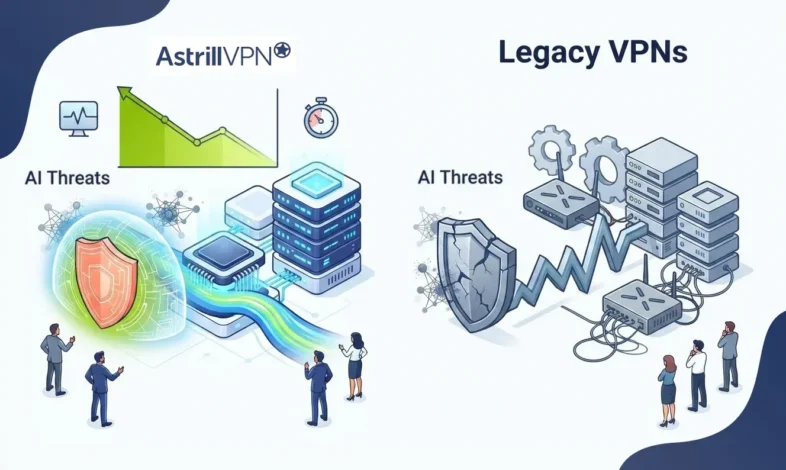
Cybersecurity is undergoing rapid change worldwide. Companies are no longer only manually defending themselves from lone hackers. But they are being attacked by very clever, highly intelligent hackers who can use automation. They automatically conduct reconnaissance, identify weaknesses, initiate credential-stuffing attacks on a massive scale, and even shift tactics in real time without letting the defense know in advance.
Recent industry reports highlight a shocking 89% increase in AI-related cyber incidents! Alarmingly, hackers now breach systems within just 29 minutes, and for lightning-fast attacks, they can spread to other systems in under 1 minute and 9 seconds. Besides that, researchers are finding that AI is not just a passive assistant anymore but a proactive operator that can be involved in almost all phases of an attack.
At present, using a VPN is not merely about providing an extra layer of privacy but also about enhancing a company’s defense. In this context, the reliability and speed of a system are no longer just aspects that matter to customers; they are critical to security. A delay in communication, an unexpected internet disconnection, and unstable usage sessions can lead to data interception, the exfiltration of sensitive information, or attackers exploiting temporary exposures.
This is why it is important to have new VPN software. Although many company-level VPN solutions still use the old mode, they were designed for an entirely different era. The likes of AstrillVPN, on the other hand, have placed greater emphasis on high-speed networking, a robust server environment, and modern protocols that reflect today’s internet.
Table of Contents
The AI-Threat Era: What’s Changed?
Rise of Agentic AI Attacks and Automated Exploitation
Cyberattacks have entered an entirely new phase.
Traditional attacks typically required human operators to scan networks, identify vulnerabilities, and manually execute exploits. AI has compressed this entire workflow into automated pipelines that operate around the clock.
Today’s AI-powered attackers can:
- Continuously scan internet-facing services
- Generate convincing phishing campaigns
- Perform credential stuffing at a massive scale
- Identify vulnerable VPN gateways
- Automate privilege escalation
- Move laterally across networks significantly faster than before
According to Check Point Research, AI has transitioned from simply assisting attackers to actively operating within live cyberattacks, dramatically reducing defenders’ response windows.
Meanwhile, Anthropic’s research found malicious actors using AI across all 14 MITRE ATT&CK tactics and hundreds of attack techniques, illustrating how deeply AI has become integrated into offensive cyber operations.
Why Slower, Older Defenses No Longer Keep Up?
Legacy enterprise security solutions were built for a world where attacks unfolded over hours or days. Today’s AI-driven attacks unfold in minutes. When attackers automate reconnaissance, vulnerability discovery, and exploitation, organizations lose valuable response time.
Modern VPNs must therefore provide:
- Fast authentication
- Low-latency encrypted tunnels
- Reliable failover
- Stable connectivity
- Minimal interruption during network switching
Even small delays can matter when attackers are continuously exploiting vulnerabilities.
The Problem with Legacy VPNs
Outdated Protocols and Centralized Server Bottlenecks
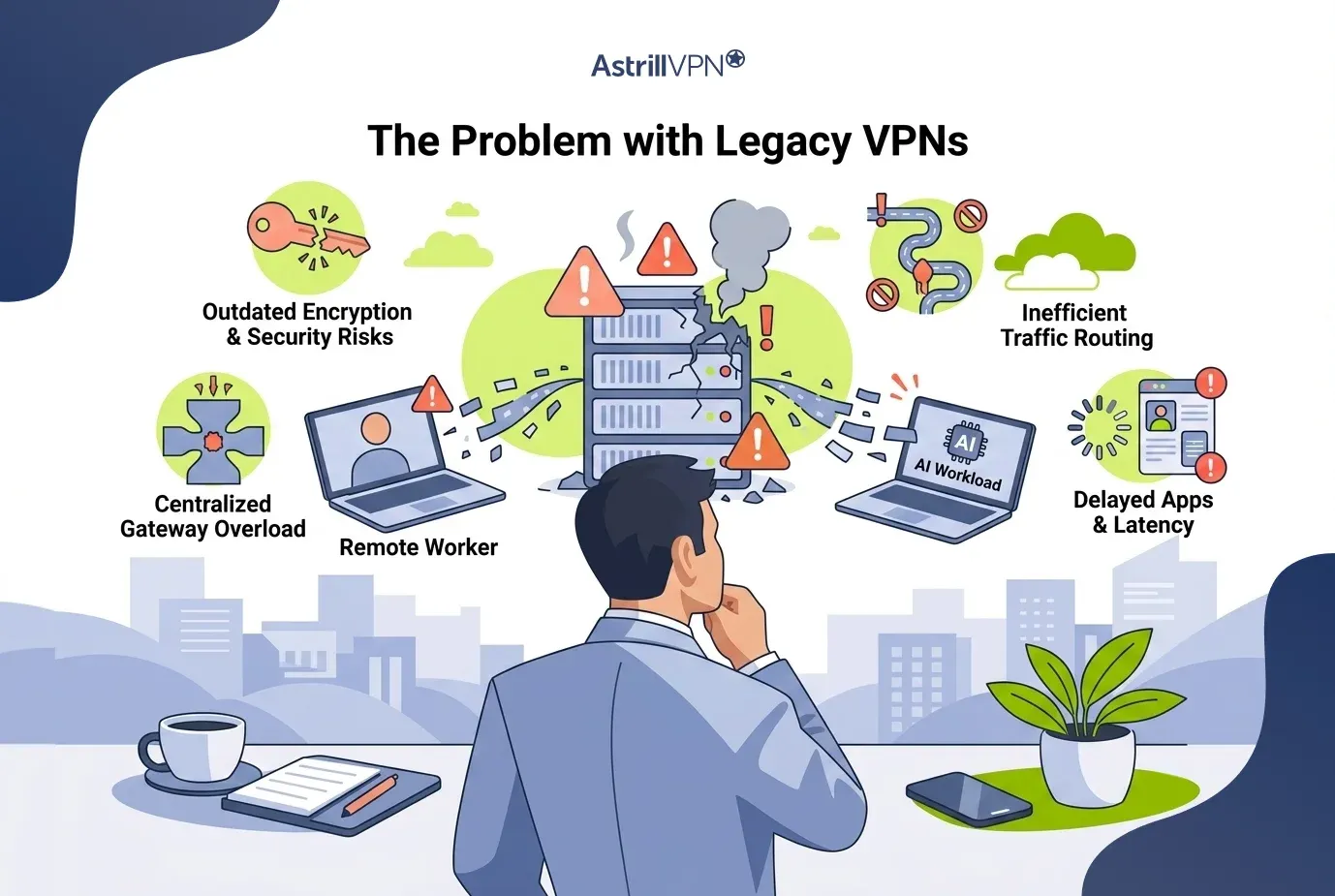
Many enterprise deployments of remote access networks still depend on an architecture that has changed little over the years. The most obvious shortcomings are:
- Outdated implementation of secure encryption algorithms
- Servers are so busy
- Inefficient routing of network traffic
- Overreliance on the centralized gateway
- Increased transmission slippage at the heavy load level
Along with the increasing popularity of remote work, the use of cloud-based computing, and AI-generated workloads, these points of failure become even more painful, and the limitations harder to hide. People get to see:
- Delayed app reactions
- Increase in response delay
- Delays in the verification process
- Inefficiency in operations
From a security standpoint, it could not only delay the update rollout if someone’s gateway gets too busy, but it could also increase timeout counts or add an unnecessary step during authentication.
Connection Drops and Exposure Windows
One of the biggest risks isn’t necessarily encryption failure.
It’s connection instability.
If a VPN unexpectedly disconnects:
- traffic may briefly leave the encrypted tunnel,
- applications may reconnect using the public network,
- Sensitive sessions may become exposed if safeguards aren’t enabled.
Although modern VPNs mitigate this risk through features like automatic kill switches, unstable VPN connections can still disrupt workflows and increase operational risk.
Recent reporting also highlights that attackers increasingly target VPN infrastructure via stolen credentials, phishing, weak authentication, and unpatched systems rather than directly breaking VPN encryption.
Why Speed and Stability Are Now Security Essentials?
Speed’s Role in Real-Time Threat Response
VPN speed affects more than streaming quality. For enterprises, faster VPN performance supports:
- Rapid authentication
- Efficient cloud application access
- Faster security updates
- Quicker incident response
- Lower user friction
Security teams increasingly rely on cloud-based monitoring, endpoint detection, and zero-trust verification systems. A high-performance VPN helps these tools communicate with minimal delay. When defenders are working against attacks measured in seconds instead of hours, every performance improvement contributes to operational resilience.
Stability, Kill Switches, and Preventing Data Leaks
Stability means maintaining consistent encrypted connectivity, not just achieving high peak speeds.
Modern VPNs should provide:
- Automatic reconnect
- Reliable kill switches
- DNS leak protection
- IPv6 leak protection
- Consistent session persistence
- High uptime
These capabilities help reduce the likelihood that sensitive traffic is exposed during unexpected network interruptions. In today’s hybrid work environments, where employees frequently switch between office, home, and public Wi-Fi networks, stable VPN connections are essential for maintaining secure communications.
How Astrill Is Built for This Era?
StealthVPN Protocol and Distributed Server Network
AstrillVPN differs from other enterprise-style VPNs in its architecture.
Some of the main features are:
- StealthVPN protocol, developed by Astrill, aims to increase internet connection reliability in situations where network bandwidth is very limited.
- A server network available worldwide is a great tool that can reduce bottlenecks.
- Various protocol options to meet diverse, constantly evolving networking demands.
- Encrypted connection support at high speed over a vast geographical footprint.
Astrill’s approach is to rely solely on standard VPN protocols. The variety of Astrill that allows organizations to modify their operations in response to changes in the network environment is a big advantage. Such architecture is very helpful for companies with operations across different locations and facing changes in network stability.
Real-World Speed and Uptime Considerations
Actual VPN performance depends on several variables, including:
- geographic distance,
- local ISP performance,
- server load,
- selected protocol,
- device hardware,
- destination service.
For that reason, no provider can truthfully guarantee to be the fastest under all conditions. However, Astrill emphasizes:
- high-performance routing,
- optimized server infrastructure,
- reduced congestion,
- reliable uptime,
- low-latency connections.
Organizations evaluating VPN solutions should conduct performance testing using their own workloads and locations to determine which service best fits their operational needs.
Astrill vs. Legacy VPNs — Head-to-Head
| Feature | Astrill VPN | Typical Legacy Enterprise VPN |
| Speed Optimization | High-performance routing and optimized infrastructure | Often dependent on centralized gateways |
| Network Stability | Designed for reliable long-duration sessions | Can experience congestion under heavy enterprise load |
| Protocol Flexibility | Multiple protocols, including StealthVPN | Often limited to traditional VPN protocols |
| Global Connectivity | Distributed server network | May rely on fewer regional gateways |
| Kill Switch Protection | Available | Varies by deployment |
| Leak Protection | DNS and IP leak protection | Depends on implementation |
| Remote Workforce Support | Strong support for geographically distributed teams | Can require additional infrastructure scaling |
| AI-Threat Readiness | Benefits from fast, stable, encrypted connectivity that supports rapid response | Older architectures may introduce latency or operational bottlenecks. |
Conclusion
The AI era has fundamentally changed cybersecurity. Organizations are no longer defending against attackers operating on human timescales. They’re facing automated systems capable of scanning, exploiting, and moving through networks at unprecedented speed.
That shift changes how VPNs should be evaluated. Encryption remains essential, but it’s no longer enough. For businesses looking to modernize their remote access strategy, Astrill VPN offers a feature set designed to address many of the networking challenges organizations face today. As with any enterprise security decision, evaluating the solution against your own performance, compliance, and operational requirements is the best way to determine whether it fits your environment.
Frequently Asked Questions (FAQs)
Here are some of the most frequently asked questions.
A legacy VPN typically refers to solutions built around older architectures, centralized gateways, and traditional protocols that may not be optimized for today’s cloud-first, distributed work environments. Modern VPNs often emphasize faster routing, flexible protocols, better scalability, and enhanced resilience.
Speed supports security by enabling faster authentication, quicker communication with cloud security tools, and more responsive incident handling. In an environment where attackers increasingly automate exploitation, reducing delays can improve operational responsiveness, although speed alone does not prevent attacks.
Attackers generally do not “break” modern VPN encryption. Instead, they commonly target the surrounding ecosystem, such as stolen credentials, phishing, weak authentication, exposed management interfaces, or unpatched vulnerabilities in VPN infrastructure. AI helps automate and accelerate these attack methods.
Performance depends on many factors, including location, network conditions, protocol selection, server load, and device configuration. Astrill emphasizes optimized routing, a distributed server network, and multiple protocol options, but organizations should conduct their own testing to compare providers in their specific environment.
Evaluate:
Server locations relevant to your users
Protocol compatibility
Kill switch and leak protection features
Device support
Performance under your typical workloads
Security policies and compliance requirements
Customer support and deployment options
Testing the VPN in your production-like environment is the most reliable way to assess whether it meets your organization’s performance and security needs.

Secure your privacy instantly. Try AstrillVPN with zero risk.
About The Author










No comments were posted yet