




Why StealthVPN Servers Matter in Censored Regions?


Internet censorship has become a daily reality for millions of users worldwide. Governments increasingly restrict access to websites, apps, and online services, often while monitoring traditional VPN connections. This is where StealthVPN servers play a critical role. Designed to disguise VPN traffic as regular internet activity, StealthVPN technology helps users bypass deep censorship systems, access blocked content, and maintain online privacy in regions with heavy surveillance. In censored environments, StealthVPN servers aren’t just useful, they’re essential.
Table of Contents
What Are StealthVPN Servers?
StealthVPN servers use advanced traffic obfuscation to hide that a VPN is in use. Unlike standard VPNs, which can be detected through Deep Packet Inspection (DPI), StealthVPNs mask encrypted traffic so it appears as regular HTTPS traffic.
How StealthVPN Is Different From Regular VPNs?
Traditional VPNs encrypt data but still show identifiable VPN signatures. StealthVPN servers remove these patterns, allowing users to connect when VPN usage is restricted.
How StealthVPN Servers Work?
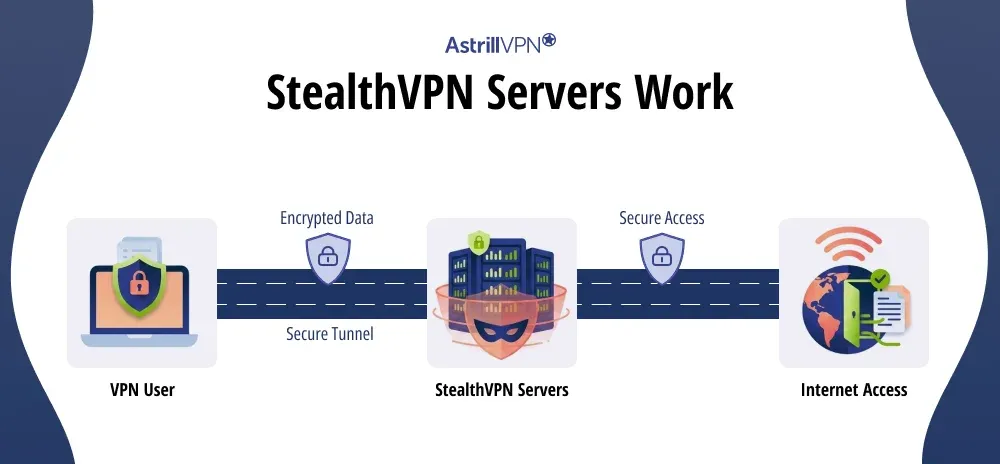
- StealthVPN servers first encrypt all your internet data, preventing ISPs, hackers, and authorities from reading your online activity.
- After encryption, StealthVPN applies obfuscation to remove identifiable VPN patterns, making the traffic appear non-VPN.
- The obfuscated data is made to look like regular HTTPS web traffic, which is commonly allowed even in highly censored networks.
- StealthVPN servers defeat DPI systems by hiding protocol headers and randomizing packet metadata so firewalls cannot detect VPN usage.
- StealthVPN connections typically run on standard ports like 443, which are used for secure websites and rarely blocked.
- Exceptional stealth or obfuscated protocols mimic ordinary internet protocols, blending VPN traffic with everyday browsing activity.
- Once disguised, traffic is securely tunneled to StealthVPN servers located outside censored networks.
- The StealthVPN server replaces the user’s real IP address with its own, ensuring anonymity and location privacy.
- StealthVPN servers are optimized to stay connected even on heavily restricted or monitored networks.
- Many StealthVPN systems dynamically adjust obfuscation methods to counter new blocking and detection strategies.
Why VPNs Are Blocked in Censored Regions?
VPNs are blocked in censored regions because they undermine government control over information, surveillance, and online behavior. Below are the key reasons why authorities actively restrict VPN usage.
Government Control Over Information
Many governments restrict VPNs to control what citizens can see, read, and share online. VPNs allow users to bypass content filters and access blocked news, social media, and foreign websites, reducing the effectiveness of state-controlled narratives.
Countries such as China and North Korea use strict internet controls to limit access to external information, making VPNs a direct threat to censorship systems.
Surveillance and User Monitoring
VPNs encrypt internet traffic, preventing governments and ISPs from monitoring users’ online activities. In regions where surveillance is widespread, this loss of visibility is unacceptable to authorities, leading to VPN bans.
Prevention of Anonymous Communication
VPNs enable anonymous browsing and communication. This is especially common during protests, elections, or political unrest. Governments in censored regions often block VPNs to:
- Identify political dissent
- Monitor journalists and activists.
- Track opposition movements
Enforcement of Local Internet Laws
Some countries require companies and citizens to comply with strict data-retention laws. As a result, governments block unauthorized VPN services to enforce compliance. VPNs allow users to bypass:
- Local content regulations
- Website blocklists
- Platform bans
Use of Deep Packet Inspection (DPI)
Censored regions often deploy Deep Packet Inspection (DPI) technology to detect VPN traffic patterns. This method is widely used in countries like Iran and Russia. Once identified, VPN connections are:
- Blocked
- Throttled
- Reset automatically
Protection of State-Approved Services
VPNs allow users to bypass geo-restrictions and access foreign platforms that compete with government-approved or state-owned services. Blocking VPNs helps protect local platforms and maintain digital sovereignty.
National Security Justifications
While these reasons are frequently cited, VPN restrictions often extend far beyond genuine security concerns. Authorities often claim VPN blocking is necessary to prevent:
- Cybercrime
- Terrorism
- “illegal” content
Why StealthVPN Servers Matter in Censored Regions?
1. Bypassing VPN Blocks and Firewalls
StealthVPN servers help users bypass sophisticated firewalls such as those used in China, where most standard VPNs are blocked.
2. Avoiding Detection and Throttling
Because StealthVPN traffic looks like regular web traffic, ISPs and authorities are far less likely to detect, block, or throttle the connection.
3. Access to Blocked Websites and Apps
Users in regions like Iran and Russia rely on StealthVPN servers to access social media, news platforms, and messaging apps.
4. Protecting User Privacy and Identity
StealthVPN servers add an extra layer of privacy by concealing both user data and VPN usage, which is critical in regions where VPN use may attract scrutiny.
5. Enabling Secure Communication
Journalists, activists, and remote workers depend on StealthVPNs to communicate securely without exposing themselves to monitoring or retaliation.
Key Benefits of Using StealthVPN Servers
Bypass VPN Blocks in Censored Regions
StealthVPN servers hide VPN usage, allowing users to connect even in countries where standard VPNs are blocked, such as China and Iran.
Avoid Detection by Firewalls and ISPs
By disguising VPN traffic as regular HTTPS activity, StealthVPN servers prevent detection by ISPs and government firewalls using Deep Packet Inspection (DPI).
Access Blocked Websites and Apps
StealthVPN servers enable access to restricted social media platforms, news websites, streaming services, and messaging apps in heavily controlled networks.
Enhanced Online Privacy and Anonymity
StealthVPNs protect not only your data but also the fact that you are using a VPN, which is crucial in regions where VPN use may attract attention.
Secure Communication Under Surveillance
Journalists, activists, and remote workers rely on StealthVPN servers for encrypted and undetectable communication in high-risk environments.
Reduced Risk of Throttling
Since StealthVPN traffic blends with regular internet traffic, ISPs are less likely to throttle speeds or forcibly disconnect sessions.
Reliable Internet Access During Restrictions
StealthVPN servers remain functional during internet slowdowns, political events, and periods of heightened censorship.
Protection on Public and Untrusted Networks
StealthVPN servers encrypt data on public Wi-Fi, preventing man-in-the-middle attacks while remaining invisible to network monitoring tools.
Access to Global Content Without Alerts
Users can browse international websites and platforms without triggering automated security systems or alerts.
Greater Digital Freedom and Safety
StealthVPN servers restore internet freedom while minimizing risk, making them one of the most effective tools for users in restrictive digital environments.
StealthVPN Usage Statistics
- Over 40% of global internet users live in countries with some form of online censorship.
- VPN blocking has increased by 30%+ worldwide in the past five years
- StealthVPN connections achieve success rates up to 70% higher than standard VPNs in restricted networks.
Conclusion
In censored regions, standard VPNs often fail under advanced surveillance and firewall systems. StealthVPN servers fill this critical gap by disguising VPN traffic, enabling users to bypass restrictions, avoid detection, and reclaim online freedom. Whether for privacy, security, or access to blocked information, StealthVPN technology has become an essential tool in today’s increasingly controlled digital landscape. For users living under strict internet censorship, StealthVPN servers are not optional; they are vital.
FAQs
Here are frequently asked questions.
A StealthVPN server is used to bypass VPN blocks and censorship by hiding VPN traffic as regular internet activity.
Legality depends on local laws. In some regions, VPN usage is restricted or regulated, so users should understand local regulations before using it.
StealthVPNs are specifically designed to avoid detection, though no technology can guarantee 100% invisibility.
They may be slightly slower due to extra obfuscation layers, but the trade-off is reliable access in restricted networks.
No. StealthVPN technology is usually available only with premium or advanced VPN services.
In unrestricted regions, standard VPNs are usually sufficient. StealthVPNs are most valuable where VPN blocking is standard.

Secure your privacy instantly. Try AstrillVPN with zero risk.
About The Author










No comments were posted yet