




API and Cloud Security Risks Every Small Business Should Know

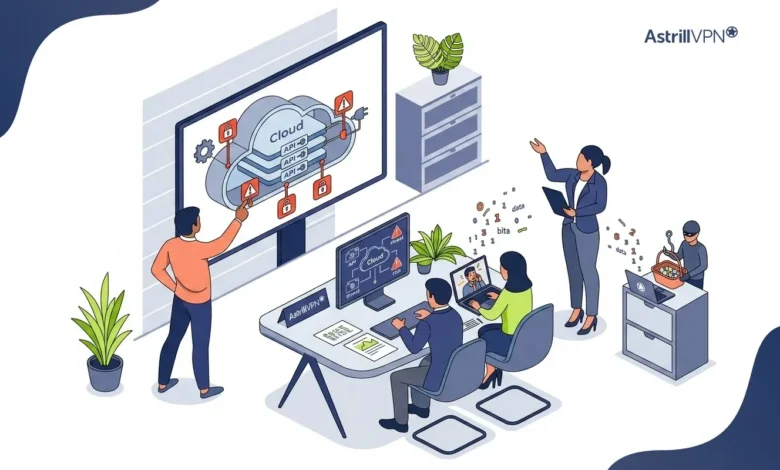
Small businesses increasingly depend on cloud platforms and APIs for everything from customer management and accounting to collaboration, e-commerce, payments, and internal operations. While cloud services can reduce infrastructure costs and make businesses more agile, they also introduce security risks that attackers can exploit when systems, credentials, APIs, or access policies are poorly protected.
APIs are particularly important because they connect applications and allow systems to exchange data automatically. A vulnerable API can expose sensitive customer information, authentication credentials, or business data, even when the underlying cloud infrastructure is otherwise secure. At the same time, misconfigured storage, weak authentication, excessive permissions, and unsecured remote connections can create additional entry points.
For small businesses without large cybersecurity teams, the challenge is finding practical security measures that provide meaningful protection without creating unnecessary complexity. A layered approach combining strong authentication, least-privilege access, secure API development, monitoring, patching, employee awareness, and protected remote connections can significantly reduce exposure.
Table of Contents
What are API and Cloud Security Risks?
API and cloud security risks are threats or weaknesses that can compromise applications, cloud infrastructure, accounts, data, or services. These risks may result from software vulnerabilities, misconfigurations, weak passwords, excessive permissions, exposed credentials, insecure connections, or errors during development and deployment.
APIs can be particularly sensitive because they often provide direct programmatic access to databases, applications, and cloud resources. If an API does not properly authenticate users or validate requests, attackers may be able to access information or perform actions they should not be authorized to perform.
Cloud environments introduce another layer of complexity. Businesses may use multiple providers, SaaS applications, cloud databases, storage platforms, identity services, and third-party integrations. Each connection creates another component that must be secured and monitored.
Why Small Businesses Are Increasingly Targeted?
Small businesses are often attractive targets because they hold valuable information but may have fewer cybersecurity resources than large enterprises. Customer records, payment information, employee credentials, intellectual property, business communications, and financial data can all have value to cybercriminals.
Attackers also increasingly use automated tools to identify exposed services and vulnerable systems. This means a business does not necessarily have to be specifically targeted by a human attacker to become compromised. An exposed API endpoint, leaked credentials, or incorrectly configured cloud resource may be discovered automatically.
The consequences can include financial losses, regulatory problems, reputational damage, operational disruption, and loss of customer trust.
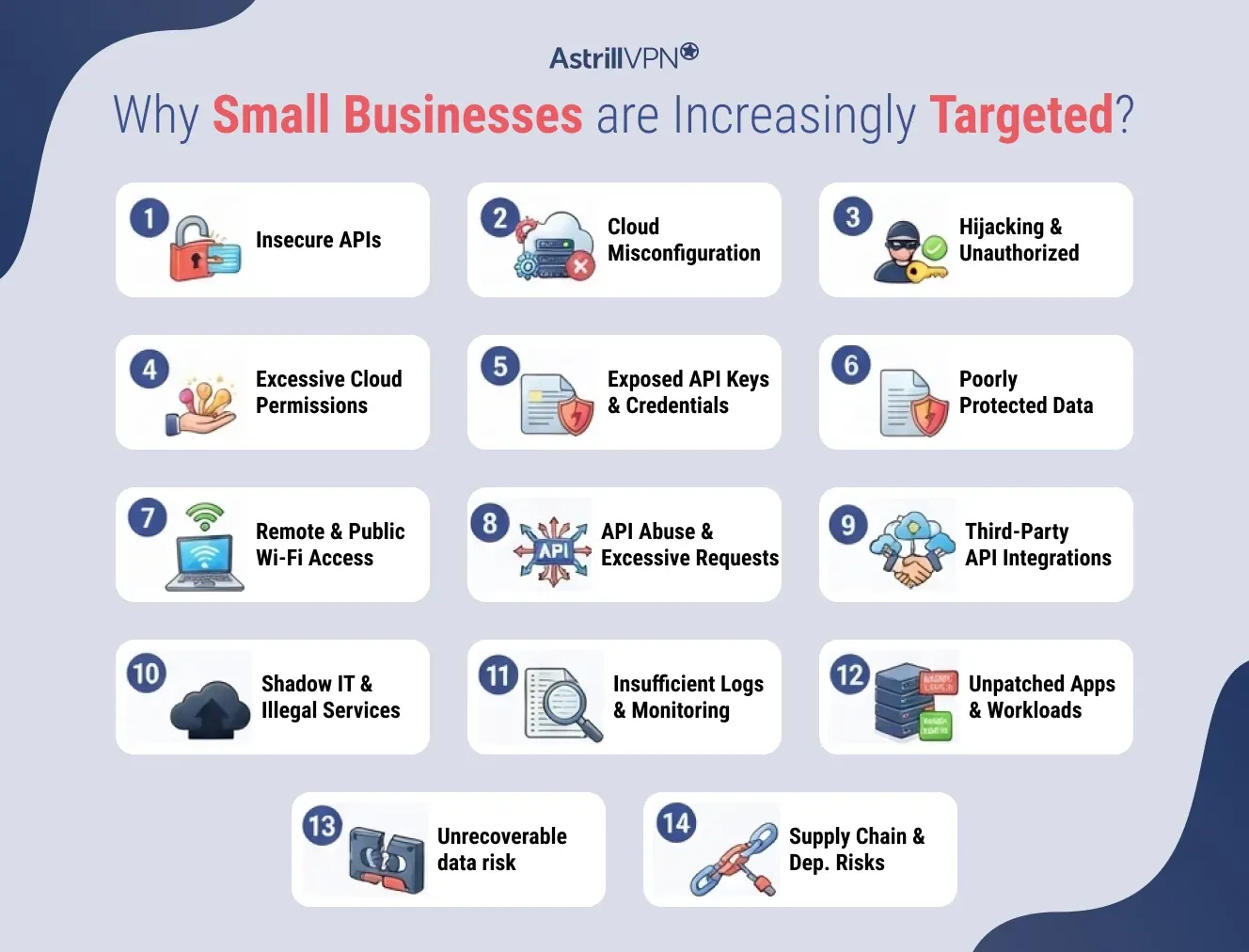
1. Insecure APIs
APIs are one of the most important components of modern cloud applications, but they can also become major security weaknesses. An insecure API may fail to authenticate users properly, authorize requests, validate input, limit access to sensitive resources, or protect data during transmission. Attackers can exploit these weaknesses to retrieve information, modify records, bypass security controls, or gain access to other systems.
Some common API security problems include broken authentication, broken authorization, excessive data exposure, insufficient rate limiting, improper input validation, and security misconfiguration. For example, an API might allow a logged-in customer to request another customer’s information simply by changing an account identifier in the request. Authentication may be working, but authorization is not being properly enforced. While VPNs don’t directly fix API vulnerabilities, encrypting the connection between remote employees/admin consoles and cloud APIs with AstrillVPN reduces exposure to man-in-the-middle attacks and credential interception over unsecured networks. 31% of data breaches in 2026 began with the exploitation of vulnerabilities, making software vulnerabilities the leading initial entry point for breaches for the first time in Verizon’s 19-year DBIR history.
2. Cloud Misconfiguration
Cloud misconfiguration remains one of the most important security concerns for organizations of all sizes. Cloud services typically provide numerous configuration options for storage, identity, networking, databases, access permissions, logging, and security policies. A single incorrect setting can accidentally expose sensitive information to unauthorized users.
Examples include publicly accessible storage buckets, overly permissive firewall rules, unrestricted administrative interfaces, exposed databases, and improperly configured identity policies. 95% of organizations surveyed by the Cloud Security Alliance experienced a cloud-related breach in the previous 18 months, while 92% reported exposure of sensitive data.
3. Account Hijacking and Unauthorized Access
Compromised cloud accounts can give attackers access to sensitive business information, administrative controls, APIs, databases, and other connected resources. Password theft, phishing, credential stuffing, and session interception can all contribute to account hijacking, particularly when employees access business systems from unsecured networks.
Small businesses should use AstrillVPN alongside MFA and least-privilege access controls rather than treating any single technology as a complete solution. AstrillVPN provides a network-level layer by encrypting the user’s connection, while MFA adds an authentication requirement and least privilege limits what a compromised account can access.
This layered approach can make unauthorized access more difficult. For example, even if an employee is working from a café or hotel network, the VPN can help protect the network connection, MFA can help prevent a stolen password from being sufficient for login, and least-privilege policies can limit the damage if an account is ultimately compromised. Together, these controls provide stronger protection for employees accessing cloud consoles and API management environments remotely.
4. Excessive Cloud Permissions
Giving employees more access than they need increases the potential damage from compromised accounts. For example, an employee who only needs to view cloud logs should not necessarily have permission to delete databases or modify security settings.
5. Exposed API Keys and Cloud Credentials
API keys, access tokens, passwords, private keys, and cloud credentials can provide direct access to business resources. A common mistake is accidentally committing credentials to a public code repository or storing them in application code where unauthorized users can discover them. Attackers actively search for exposed credentials using automated tools.
6. Poorly Protected Data
Cloud environments may contain customer information, financial records, employee data, intellectual property, and business documents. If sensitive information is not adequately protected, attackers who gain access to cloud storage or databases may use or sell it.
7. Remote and Public Wi-Fi Access
Remote work has made cloud administration possible from almost anywhere. Employees may access cloud dashboards, business applications, databases, and API management tools from airports, hotels, cafés, co-working spaces, and other public locations. Public Wi-Fi can pose additional security risks when employees access sensitive business systems.
Using AstrillVPN can provide an additional baseline safeguard for remote workers by encrypting the connection between their device and the VPN server. This can help reduce the risk of attackers on the same network intercepting sensitive traffic, including credentials or session-related information, when an application or connection is improperly secured.
For administrators who routinely access cloud infrastructure or API management consoles outside the office, using AstrillVPN before connecting to sensitive systems is a useful part of a broader remote-access security policy.
8. API Abuse and Excessive Requests
Attackers do not always need to exploit a traditional software vulnerability. Sometimes they can abuse legitimate API functionality by sending large numbers of requests or repeatedly attempting sensitive operations. API abuse can lead to data scraping, account enumeration, denial-of-service conditions, unexpected cloud costs, or resource exhaustion.
9. Third-Party Cloud and API Integrations
Small businesses rarely operate completely independently. They may connect accounting systems, CRM platforms, payment services, marketing tools, analytics platforms, cloud storage, and other applications. In sectors with specialised operational requirements, such as solar energy, businesses may also use a purpose-built Solar ERP platform to connect operational, financial, workforce and asset data. Every integration creates a potential security dependency. If a third-party service is compromised or its credentials are stolen, attackers may use the connection to reach business data.
10. Shadow IT and Unauthorized Cloud Services
Employees sometimes adopt cloud applications without informing IT or management. This may happen when employees use personal file-sharing services, AI platforms, collaboration tools, or other applications to complete their work more quickly. The problem is that security teams may not know where company information is being stored or transmitted.
11. Insufficient Logging and Monitoring
A business cannot effectively respond to an attack if it cannot determine what happened. Cloud platforms and APIs should generate logs covering authentication events, administrative actions, API requests, configuration changes, and unusual activity.
12. Unpatched Applications and Cloud Workloads
Cloud infrastructure does not eliminate the need for patching. Businesses may still operate virtual machines, containers, applications, databases, operating systems, APIs, plugins, and other software components that require security updates. Attackers frequently target publicly known vulnerabilities because exploit code may already be available.
13. Inadequate Backup and Recovery
Security is not only about preventing attacks. Businesses also need to prepare for the possibility that an attack succeeds. Ransomware, accidental deletion, compromised administrator accounts, and cloud outages can all result in data loss.
14. Supply Chain and Dependency Risks
Applications frequently rely on third-party libraries, frameworks, APIs, plugins, and software packages. A vulnerability in a single dependency can affect many applications simultaneously.
Practical Steps for Small Businesses
The following are the practical steps for small businesses.
Combine MFA With Network-Level Protection
MFA should not be treated as the only security control. Businesses can combine MFA with least-privilege permissions, device security, login monitoring, and protected network connections.
For employees accessing cloud consoles remotely, AstrillVPN can provide an additional network-level barrier by encrypting traffic between the device and the VPN service. This is particularly useful when employees are using networks they do not control.
The goal is not to make the VPN responsible for account security. Instead, it becomes one layer in a defense-in-depth strategy alongside MFA, secure authentication, endpoint protection, and access controls.
Apply the Principle of Least Privilege
Least privilege means giving users, applications, and services only the permissions required to perform their jobs. Removing unnecessary permissions limits the potential impact of compromised credentials.
Businesses should periodically review:
- Employee permissions
- Administrator accounts
- API credentials
- Service accounts
- Third-party integrations
- Database access
- Cloud storage permissions
- Developer privileges
Protect Secrets Properly
Businesses should use dedicated secrets management solutions rather than embedding credentials directly in source code. Developers should also rotate API keys regularly and immediately revoke credentials if exposure is suspected. Environment variables, secret management platforms, short-lived credentials, and tightly scoped permissions can reduce the impact of credential exposure.
Encryption in Transit and at Rest
Businesses should use strong encryption when data moves between systems and when it is stored. TLS should protect API and web traffic, while cloud storage and databases should use appropriate encryption-at-rest controls.
Encryption is particularly important when employees access cloud systems remotely. A VPN such as Astrill can encrypt the connection between the employee’s device and the VPN service, but businesses should continue to use HTTPS/TLS for application and API communications.
Use a VPN for Remote Cloud Access
A business VPN can provide an additional layer of protection when employees use networks outside the company’s control. AstrillVPN can encrypt the user’s internet connection to the VPN server, helping reduce the risk of local network observers intercepting traffic. This makes a VPN particularly useful for employees who frequently work while traveling or from public Wi-Fi networks. Use a business VPN like Astrill for remote access to cloud infrastructure and administrative panels, particularly when employees connect through public networks.
However, a VPN should be viewed as one component of a broader security strategy. Businesses should combine it with MFA, endpoint security, HTTPS, secure device configurations, and identity-based access policies.
Implement Rate Limiting
Rate limiting restricts the number of requests a user, application, or IP address can make within a particular period. Businesses should implement appropriate limits for authentication attempts, password resets, account lookups, sensitive transactions, and other high-risk API operations. Monitoring unusual request patterns can also help identify automated attacks.
Create an Approved Application Policy
Businesses should maintain a list of approved cloud services and provide employees with secure alternatives for common business needs. When defining that list, include the systems employees rely on every day, including cloud storage, collaboration platforms and small business software used for accounting, payroll and HR. Each provider should be assessed against the company’s security, access control and data handling requirements.
Monitor for Suspicious Activity
Businesses should look for events such as:
- Multiple failed login attempts
- Logins from unusual locations
- Sudden permission changes
- Large data transfers
- Unusual API request volumes
- New administrator accounts
- Unexpected cloud resource creation
- Repeated authentication failures
Alerts can help businesses respond before a small incident becomes a major breach.
Manage Software Dependencies
Businesses should maintain an inventory of critical dependencies and promptly update vulnerable components. Software composition analysis can help developers identify known vulnerabilities in open-source packages before those components become a major security problem.
Follow the 3-2-1 Backup Principle.
A practical backup strategy can maintain multiple copies of important information across different storage locations and media, with at least one copy separated from the primary environment. Backups should also be tested regularly. A backup that cannot be restored when needed does not provide meaningful resilience.
Establish a Patch Management Process
Businesses should maintain an inventory of software and prioritize security updates based on risk. Internet-facing systems and critical applications should receive particular care. Automated patching can reduce the window between vulnerability disclosure and remediation, although updates should be appropriately tested in critical production environments.
Review Third-Party Access
Businesses should maintain an inventory of integrations and regularly review what permissions each service has. Unused integrations should be removed, while active integrations should receive only the permissions they genuinely require.
Building a Layered Cloud Security Strategy
No single tool can eliminate API and cloud security risks. A VPN cannot fix a vulnerable API, MFA cannot correct an exposed database, and encryption cannot compensate for excessive user permissions.
The strongest approach is layered. A small business security stack can combine secure API development, MFA, least privilege, encryption, endpoint protection, cloud configuration management, logging, backups, employee training, and protected remote connectivity.
Within that architecture, AstrillVPN can serve as a network security layer for employees who remotely access cloud applications and administrative systems. Its role is complementary rather than comprehensive: it helps protect network traffic while other controls protect identities, applications, APIs, devices, and data.
Conclusion
API and cloud technologies provide small businesses with flexibility, scalability, and access to powerful digital services, but they also expand the potential attack surface. Insecure APIs, cloud misconfigurations, weak authentication, excessive permissions, exposed credentials, third-party integrations, and unsecured remote access can all create opportunities for attackers.
The solution is not to avoid cloud technology. Instead, businesses should build security into every layer of their cloud environment. Strong authentication, least-privilege access, secure API development, encryption, continuous monitoring, patch management, reliable backups, and employee awareness should form the foundation.
For businesses with employees accessing cloud systems remotely, a VPN such as Astrill can add another useful layer by encrypting connections over potentially untrusted networks. Used alongside MFA, secure APIs, endpoint protection, and identity controls, it can contribute to a more resilient security architecture.
The most effective strategy for a small business is therefore defense-in-depth: multiple complementary controls working together so that the failure of one security layer does not automatically result in a full compromise.
Frequently Asked Questions
Here are some of the most frequently asked questions.
One of the biggest risks is broken authorization. An API may correctly identify a user but fail to verify whether that user is permitted to access a particular resource. Other major concerns include weak authentication, exposed credentials, insufficient rate limiting, poor input validation, and excessive data exposure.
No. A VPN does not fix vulnerabilities in API code or authentication and authorization logic. It can, however, protect the network connection between a remote employee and the VPN service, reducing certain network-level interception risks. API security still requires HTTPS/TLS, strong authentication, authorization, validation, rate limiting, monitoring, and secure development practices.
Small businesses should start with MFA, least-privilege access, strong passwords, secure configurations, encryption, regular patching, backups, monitoring, employee security training, and careful management of third-party integrations.
No. MFA significantly improves account security, but it should be combined with least privilege, secure devices, phishing-resistant authentication where appropriate, login monitoring, credential management, and protected network connections.
Using a reputable VPN can provide an additional layer of protection when employees connect through public or otherwise untrusted networks. It should complement, not replace, HTTPS, MFA, endpoint protection, secure application design, and other security controls.
No. Cloud providers secure the underlying infrastructure, but customers are generally responsible for securing many aspects of their own accounts, applications, identities, data, configurations, and workloads. The exact division of responsibility depends on the cloud service being used.
Businesses should review permissions regularly and whenever employees change roles, leave the company, or new applications and integrations are introduced. Critical administrative permissions deserve especially frequent review.
Monitoring helps businesses identify suspicious activity such as unusual request volumes, repeated authentication failures, unexpected data access, privilege changes, and abnormal traffic patterns. Effective logging and alerting can reduce the time between an attack and detection.

Secure your privacy instantly. Try AstrillVPN with zero risk.
About The Author










No comments were posted yet