




Why Astrill’s Security Stack Matters in 2026

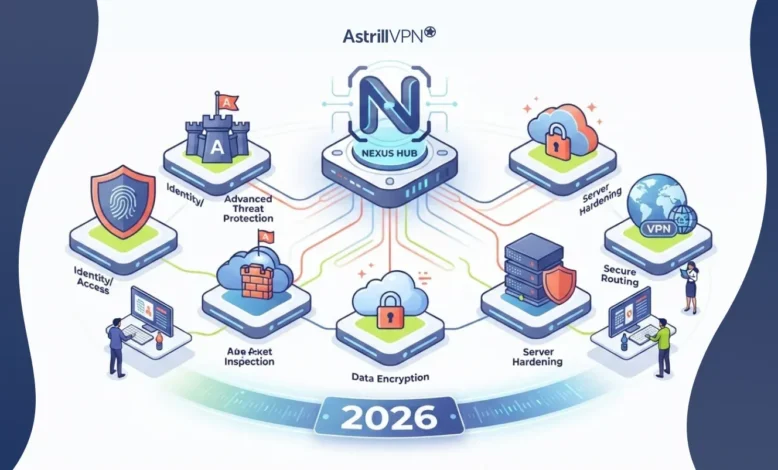
Using a VPN today has not become easier. With changing surveillance laws and with data brokers piece by piece reconstructing our online lives, there are plenty of new privacy concerns online. While online we deal with sensitive data such as online banking, online work, online shopping, even buying online a couch from people you have never met before, the VPN has become something you always carry with you, like a wallet in your back pocket. Something you can install and then forget about, a VPN is not anymore.
A few years ago when I was researching VPNs to write feature lists for Astrill, I came up with 3 core values to ensure that any VPN would meet my requirements. These core values are the basis of how Astrill functions. They are: strong encryption, minimum logging, and a robust server setup. Each of these core values functions as a layer. I will go through each of the core values in detail, to explain how each of the core values functions as a layer and how all of the layers work together.
Table of Contents
What AES-256 Encryption Actually Means for Your Privacy?
I used to just write off any reference to “military grade encryption”, but actually, AES-256 encryption is pretty serious business. Not only do banks use this to secure your finances online, governments also use this to secure the classified documents they work with. So naturally, any decent VPN provider will have secured their VPN with the same kind of encryption. We worry for anyone who hasn’t.
To give you a sense of the massive size of 2^256, consider that even the fastest supercomputer in the world (a huge machine in development right now to factor large numbers very quickly) won’t be able to break AES-256-encrypted traffic through brute force, even running day and night for several lifetimes.
To break it down a bit further, it’s worth noting that even if someone were to intercept your traffic while you are connected to a VPN server, all that they would receive is a bunch of jumbled-up data. In other words, without the proper keys to unlock the data, there is no easy way to unscramble the sent data and return it to its original form. This is basically what encryption is, a way to add ‘keys’ to sent data so that only the intended recipient can unlock it.
How We Implement AES-256 in Practice?
We apply AES-256 to every protocol we support, including OpenVPN, WireGuard, StealthVPN, and OpenWeb. That consistency matters more than people usually realize, because some providers reserve their strongest encryption for one or two protocols and quietly leave the rest weaker.
We didn’t want that gap to exist, so we run hardware-accelerated encryption across our servers, which keeps things fast even with all that computational weight sitting behind it.
What this looks like day to day is pretty straightforward. Your browsing stays private on networks you’d never fully trust, like hotel WiFi or the open network at a coffee shop. Streaming gets the exact same protection as everything else, so there’s no soft spot just because you’re watching a show instead of sending an email. And if you’re running a business and your team is working from home, a shared office, or somewhere in between, that encryption layer becomes a real safeguard for client data, not just a checkbox on a compliance form.
RAM-Only Servers, and Why Server Architecture Actually Matters
Using the Internet today means that lots of your data will be encrypted while it’s traveling across the World Wide Web. Yet the servers that transmit your traffic around the globe use physical hard drives to store all of the traffic that they send.
Typical VPN servers hold information on hard disks. Even when a session has expired with a VPN server, the information from previous sessions can be left on the servers for long periods of time. Moreover, even after such information has been supposedly deleted from the servers, remnants of the information can be retrieved from the hard disks. This is how things are done differently at VPN-2018.
Data is stored in RAM (volatile memory) on our servers. Information stored in RAM is lost after the server is rebooted. This means information was never stored on a hard disk in the first place, therefore there is nothing to recover.
So why does any of this matter? Well, for one, the servers themselves could be physically seized by some government or other bad actor, or even by some random data center intern who wanders into the wrong room. And then there’s the possibility of old data being pulled back out of old disk fragments, which isn’t possible with RAM-based servers that were never set up to hold data for long periods of time in the first place. The worst-case scenario would be for the server to be powered down or even just rebooted, at which point there’d be nothing left to find.
How We Use RAM-Only Servers?
Our infrastructure runs entirely on RAM-only servers, which means user data simply doesn’t persist on the physical machines beyond your active session. Every reboot wipes things clean, automatically, no manual cleanup required.
Security folks call this defense in depth, and we think it’s the right way to build anything privacy related. No single measure should be the only thing standing between your data and a bad outcome. Even if something went wrong somewhere else in the chain, a misconfiguration, a compromised credential, some vulnerability nobody caught yet, our server architecture still isn’t built to retain permanent records. It’s one more wall standing between a mistake and an actual consequence.
Our No-Logs Policy
This VPN is a strict no-logs VPN. This means that there are no permanent records kept of the websites that you visit, of the files that you download, or of any other information of your online activities. This is the basic promise of any VPN service. If we were to reverse roles here, then this is the promise that we would want any VPN service to keep.
Temporary data is even generated by a strict zero logs policy, for example, the session time, the IP address from which a user connected, the used device, the used app version and the total transferred bytes for an active session. How we handle this data is laid out in our privacy policy.
We keep recent connection records for a few days for our operational purposes and to assist in the rare case that a connection drops. These connection records do not include IP address information (for this type of metadata, we use a special field that does not include it).
Why a Little Metadata Doesn’t Break the Privacy Promise
It’s worth slowing down here, because this is usually where the confusion starts. Nearly every serious VPN keeps some non-identifying operational data around, things like traffic volume or connection attempts, and there’s a practical reason for it: preventing network abuse, planning server capacity, and generally keeping the whole thing running without hiccups. A VPN that stored absolutely nothing, not even temporary session data, would honestly struggle to fix problems when they come up, and they always come up eventually.
The line that actually matters is between operational metadata and identifiable browsing activity. We’re not logging which sites you’re on or what you’re downloading, and that distinction is the whole ballgame. We also give you more control than most providers offer, including the option to contact support and request that your connection information be manually deleted.
How These Layers Work Together to Protect You
None of this stuff does much on its own, and we’d be lying if we said otherwise. AES-256 protects your data while it’s in motion, RAM-only servers limit what could ever be pulled off the infrastructure itself, and leak protection covering DNS, IPv6, and WebRTC closes the smaller technical gaps that could otherwise expose your real IP address even while you assume you’re fully covered.
Throw in a kill switch, which cuts your internet connection entirely the moment the VPN drops, and you end up with a setup where a single failure is a lot less likely to turn into an actual exposure.
Think about who really leans on this kind of layered protection in daily life. Activists and journalists working under heavy censorship or surveillance need every one of these pieces functioning correctly, because for them, a leak or a logging gap isn’t just annoying, it can be genuinely dangerous.
Remote workers handling client data over hotel WiFi or a home network they don’t fully control need encryption without obvious weak spots. Small businesses moving financial records or customer details across the open internet need infrastructure that isn’t quietly holding onto more than it should. And honestly, even everyday shoppers benefit from this same layered setup, especially on platforms like Depop where buyers and sellers are trading personal details and payment information directly with strangers. A VPN doesn’t just protect your Netflix queue there, it protects the whole exchange.
Astrill vs Other VPNs: Security Features at a Glance
Most reputable VPNs on the market today use AES-256, so that alone doesn’t really set anyone apart anymore; it’s closer to table stakes at this point. What actually separates providers is everything built around that encryption: the protocols, the server architecture, and how honest the logging policy is once you get past the marketing copy.
Our combination of StealthVPN and OpenWeb, paired with RAM-only servers, is where we think our approach pulls ahead of providers who stop at “we use AES-256” and call it a day.
| Feature | Astrill | Typical VPN |
|---|---|---|
| AES-256 Encryption | Yes, across all protocols | Yes, common among top-tier providers |
| RAM-Only Servers | Yes | Varies, not offered by all providers |
| Proprietary Protocols | StealthVPN, OpenWeb | Rare, most rely on standard protocols only |
| Kill Switch | Yes | Common among established providers |
| Leak Protection (DNS/IPv6/WebRTC) | Yes | Varies by provider |
| Logging Policy | Strict no-logs, minimal session metadata only | Varies widely, some retain browsing data |
| Jurisdiction | Seychelles | Varies, some fall under data-sharing alliances |
Who Gets the Most Out of Our Security Stack?
- Users in strict censorship regions: StealthVPN is built specifically to disguise VPN traffic so it slips past deep packet inspection instead of getting flagged and blocked, which matters a lot in countries where standard protocols get detected and shut down fast.
- Small businesses handling customer data and remote teams: encrypted connections paired with RAM-only infrastructure cut down the risk of a data trail forming somewhere it shouldn’t, which matters a great deal once compliance and client trust are actually on the line.
- Privacy-conscious users who want strong encryption without the data hoarding: if you’ve already read the fine print on a few other providers and walked away unimpressed, our mix of AES-256 and genuinely minimal metadata logging tends to hit the balance you’re after.
Conclusion
We focus on three core features. To start with, we use AES-256 encryption for all your data as it travels over the internet. Then there are RAM-only servers we are using, which ensure that in the worst case scenario, as much as possible is kept from being recovered at the infrastructure level. And last but not least, our fully transparent no-logs policy, which is designed to minimize identifiable data while avoiding the quiet amassing of it.
None of the features mentioned above is unique to our service. However, the combination of them and especially the StealthVPN solution for even more demanding environments is definitely worth a closer look if real privacy matters to you and isn’t just another selling point on the comparison list of services.
FAQs
It scrambles your traffic into something that isn’t practically reversible without the encryption key, so even if someone intercepts your connection, on public WiFi or anywhere else, what they get their hands on is unreadable.
Yes, our infrastructure runs entirely on RAM-only servers, meaning your data lives in volatile memory instead of on a disk. A reboot wipes the server clean automatically, which limits what could ever be recovered if a machine were physically compromised or seized.
Our built-in kill switch cuts your internet connection the moment the VPN drops, so your real IP address and unencrypted traffic never sneak through during that gap. Leak protection covering DNS, IPv6, and WebRTC handles the smaller technical holes that could otherwise expose you even while everything looks like it’s running normally.
We apply AES-256 consistently across OpenVPN, WireGuard, StealthVPN, and OpenWeb, so the strength of your encryption doesn’t change depending on which protocol you end up choosing.
We operate out of Seychelles, which sits outside the major international data-sharing alliances. That matters because a provider’s home country determines what legal authorities can actually compel it to hand over, and being outside those alliances removes a lot of that pressure entirely.

Secure your privacy instantly. Try AstrillVPN with zero risk.
About The Author










No comments were posted yet