




Cyber Resilience: What It Is, Why It Matters, and How to Build a Strong Cyber Resilience Strategy

Cyberattacks are not merely about preventing the wrong person from getting in. Companies need protection against situations in which an attacker gains access and can take control of the company. A truly resilient organization accepts that some security measures will inevitably fail and therefore prepares to contain the damage, sustain essential functions, restore itself quickly, and adapt in response to the attack. This wider strategy is called cyber resilience.
The impact of low resilience on the financial and operational aspects can be pretty significant. According to the IBM data breach cost report 2026, 25% of all malicious data breaches were powered by artificial intelligence, up 56% from 2025, and these breaches had a mean cost of $6 million to the companies affected. IBM 2025 studies revealed the global average cost of a data breach was $4.44 million. Hence, one needs to consider going beyond basic prevention capabilities when implementing resilience.
Alongside resilience, compliance requirements make resilience an increasingly critical factor. Europe’s Cyber Resilience Act (CRA) introduces a set of binding cybersecurity rules for products with digital elements throughout their life cycle, with main obligations commencing on December 11, 2027, while obligations regarding vulnerability reporting begin on September 11, 2026.
Figuring out the definition and components of cyber resilience, as well as how to formulate a strategic plan for it and which tools to use to measure its maturity levels, can help organizations prepare to handle disruptions before, rather than after, incident response.
Table of Contents
What Is Cyber Resilience?
Cyber resilience is the capability of an organization to anticipate, withstand, recover from, and adapt to cyber threats and other disruptive incidents without compromising its ability to carry out mission-critical objectives. NIST describes cyber resilience as the ability to anticipate, withstand, bounce back from, and adapt to difficult situations, pressures, attacks, or breaches affecting cyber resources.
This concept is significant because it highlights that resilience goes beyond merely preventing cyberattacks through cybersecurity. So in essence, a resilient organization’s success is not defined merely by the fact that an attack was thwarted. The organization also considers to what degree it was capable of dealing with, containing, recovering, and drawing lessons from the attack.
Cybersecurity vs. Cyber Resilience
Cybersecurity and cyber resilience are interrelated concepts. Cybersecurity prevents unauthorized activity and reduces the damage from it.
Security controls such as firewalls, endpoint protection, identity management, vulnerability management, encryption, security monitoring, and access controls are among the technologies and practices typically included in a cybersecurity framework.
Cyber resilience is an extension of these protective measures, ensuring businesses can continue their work even when preventive controls are ineffective or systems are down.
Imagine an organization with good anti-virus software but still facing downtime and being held to ransom by a malware attack because there isn’t a tested way to recover. That example perfectly illustrates that having security measures doesn’t automatically guarantee resilience.
Another case in point: even if an organization makes regular backups, the existence of backups doesn’t make it resilient to cyber threats. To ensure resilience, the organization must ensure that backups are attacker-proof and tested regularly, that data recovery meets business needs, and that procedures for rebuilding applications and operations are developed.
Cybersecurity is all about stopping, identifying, and mitigating harmful digital incidents, while cyber resilience gives the company the ability to withstand, bounce back from, and benefit from these attacks.
Why Is Cyber Resilience Important?
Modern businesses depend heavily on digital infrastructure. Customer databases, payment systems, cloud platforms, communication tools, supply chains, employee applications, and internal operations may all depend on interconnected technology.
A successful cyberattack can therefore cause more than data loss. It can interrupt revenue-generating activities, delay customer services, damage reputation, create regulatory obligations, and disrupt suppliers.
AI is adding another dimension to this challenge. IBM reported in 2026 that AI-enabled malicious breaches averaged $6 million, compared with a global average breach cost of $4.99 million in the same research. IBM also found that organizations that extensively use AI and automation in security operations reduced breach costs by almost $2 million on average.
Key Components of a Cyber Resilience Framework
A strong cyber resilience framework combines technology, people, processes, governance, and business continuity.
1. Risk Identification and Business Impact Analysis
Organizations need to understand what they are protecting and what would happen if critical systems became unavailable. This includes identifying critical applications, sensitive information, important business processes, third-party dependencies, cloud services, privileged accounts, and essential infrastructure. Business impact analysis can then determine which systems require the fastest recovery and what level of disruption the organization can tolerate.
2. Asset and Dependency Management
You cannot protect or recover systems you do not know exist. Organizations should maintain an accurate inventory of hardware, software, cloud resources, applications, endpoints, APIs, identities, and third-party connections. Dependencies are equally important. A seemingly minor application may become business-critical if another important system depends on it.
3. Preventive Security Controls
Resilience begins with strong protection.
Important controls include:
- Multi-factor authentication
- Least-privilege access
- Endpoint security
- Network segmentation
- Encryption
- Secure configuration
- Patch management
- Vulnerability management
- Email and phishing protection
- Secure remote access
- Application security
These measures reduce the likelihood that an incident will become a major operational disruption.
4. Detection and Continuous Monitoring
Organizations need to identify attacks quickly. Security monitoring can include endpoint telemetry, identity monitoring, network analysis, cloud logs, vulnerability alerts, threat intelligence, and security information and event management systems. Fast detection reduces the time attackers have to move through the environment.
5. Incident Response
An incident response plan defines what happens when an attack is detected.
It should establish:
- Who declares an incident
- Who has the authority to isolate systems
- How evidence is preserved
- How employees communicate during an incident
- When customers or regulators must be notified
- How compromised accounts are contained
- How affected systems are prioritized
A response plan should be tested rather than simply stored in a document.
6. Backup and Recovery
Reliable recovery depends on reliable backups. Organizations should maintain appropriately protected backups and regularly test restoration. Critical systems should have defined recovery requirements, including Recovery Time Objectives (RTOs) and Recovery Point Objectives (RPOs).
RTO answers: How quickly must the system be restored?
RPO answers: How much data can the organization afford to lose?
These metrics turn vague recovery goals into measurable requirements.
7. Business Continuity
Cyber resilience extends beyond restoring technology. Businesses need alternative procedures to continue critical operations when systems are unavailable. Depending on the organization, this might include manual workflows, alternate communication channels, backup suppliers, redundant infrastructure, or alternative payment processes. NIST’s resilience guidance emphasizes systems’ ability to continue operating under adverse conditions and recover to an effective operational state.
8. Adaptation and Continuous Improvement
Every major incident, exercise, vulnerability, and near miss should provide lessons. Organizations should update security controls, response procedures, training, architecture, supplier requirements, and recovery processes based on what they learn. This creates the final part of resilience: adaptation.
Building a Cyber Resilience Strategy
A cyber resilience strategy should connect cybersecurity with business continuity, risk management, disaster recovery, and organizational governance.
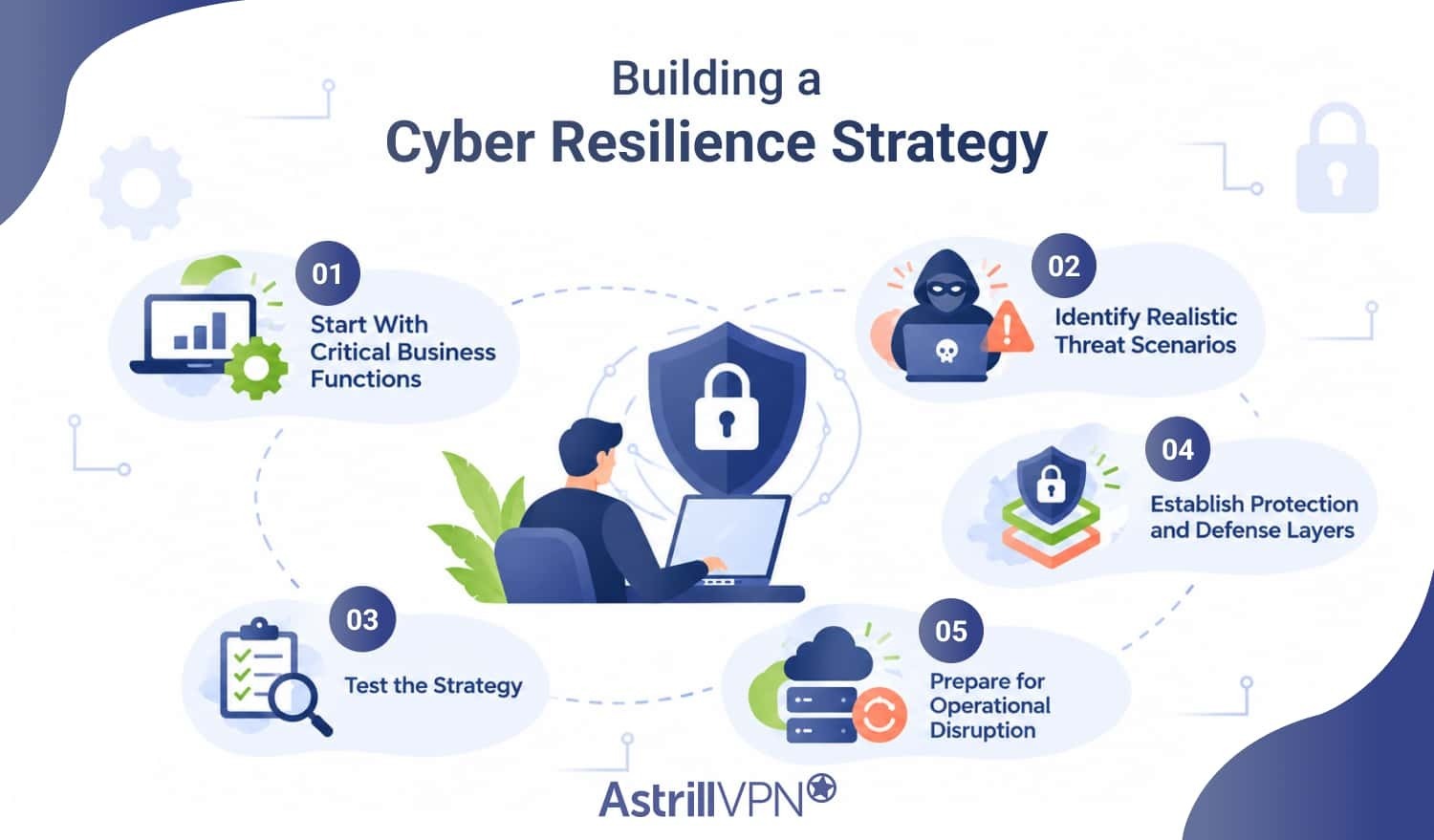
Start With Critical Business Functions
The first step is identifying what the business absolutely needs to continue operating. Instead of beginning with a list of cybersecurity products, start with business processes. Determine which services generate revenue, support customers, meet regulatory obligations, or keep essential operations running. Then identify the technology and data supporting those functions.
Identify Realistic Threat Scenarios
A resilience strategy should be based on realistic scenarios rather than generic statements.
Examples include:
- Ransomware
- Credential theft
- Insider threats
- Cloud account compromise
- DDoS attacks
- Supply-chain compromise
- Data destruction
- Phishing
- AI-enabled social engineering
- Third-party service outages
For each scenario, determine what could fail and how the organization would respond.
Establish Protection and Defense Layers
No single security tool can protect an entire business. Organizations should use multiple layers, including identity security, endpoint protection, network controls, encryption, segmentation, monitoring, vulnerability management, and secure backup systems. Layered defenses reduce dependence on any single point of control.
Prepare for Operational Disruption
A resilient strategy should explicitly answer what happens if critical systems are unavailable. For example, if a cloud application is inaccessible, employees should know whether there is an alternative workflow. If corporate email is compromised, the organization should have an alternate communication channel. If customer records are encrypted by ransomware, recovery teams should know where clean backups are located and how restoration will be performed.
Test the Strategy
Testing is one of the most important parts of resilience.
Organizations can conduct:
- Tabletop exercises
- Phishing simulations
- Backup restoration tests
- Disaster recovery exercises
- Incident response drills
- Red-team exercises
- Ransomware simulations
- Third-party outage exercises
Testing exposes weaknesses that may remain invisible on paper.
Protect and Defend: Where Network Security Fits?
The anticipate and withstand stages of resilience require organizations to reduce exposure before an incident occurs. Network security is one layer of that defense. Secure remote access, encrypted communications, segmentation, strong authentication, and monitoring can reduce opportunities for attackers to intercept traffic or exploit exposed connections.
This is particularly relevant for hybrid and remote teams. Employees may connect to business systems from hotels, airports, cafés, co-working spaces, or other public networks. Unsecured networks can create opportunities for traffic interception and credential exposure. A business VPN can add a network-level layer of protection by encrypting traffic between the employee’s device and the VPN service.
Where VPNs Fit Into a Cyber Resilience Strategy?
A VPN should not be treated as a complete cyber resilience solution. It does not replace MFA, endpoint security, patch management, backups, incident response, identity controls, or business continuity planning. Instead, it can contribute to the protection and withstand stages of a broader resilience strategy.
For remote and hybrid organizations, AstrillVPN can serve as a single layer to protect network traffic when employees connect through potentially untrusted networks.
Astrill’s current materials describe AES-256 encryption in protocols such as StealthVPN and OpenWeb. Its StealthVPN documentation also describes automatic reconnection and DNS leak protection.
AES-256 Encryption
Encryption helps prevent intercepted network traffic from being readable to unauthorized parties. For employees accessing business dashboards, cloud applications, internal tools, or other sensitive services over public Wi-Fi, encrypted VPN traffic can reduce the risk associated with network-level interception.
Kill Switch
A VPN kill switch is designed to block internet traffic if the VPN connection drops, helping prevent traffic from unexpectedly reverting to an unprotected connection. Astrill documents its kill-switch functionality as a way to prevent traffic exposure during temporary VPN connection failures. This can support resilience by reducing the chance that a brief connectivity failure creates an unexpected security gap.
Split Tunneling
Split tunneling allows organizations or users to determine which traffic should pass through the VPN and which traffic can use the regular internet connection. This can be useful where only business-sensitive applications require encrypted routing. Astrill’s documentation describes application and site filtering that allows users to choose which traffic goes through the VPN tunnel.
However, split tunneling should be configured carefully. Sensitive business applications should adhere to organizational security policies rather than be excluded solely for convenience.
The Cyber Resilience Act Explained
The Cyber Resilience Act (CRA) is an EU regulation that establishes cybersecurity requirements for products with digital elements. It applies to hardware and software products that are connected directly or indirectly to devices or networks. The regulation focuses on cybersecurity throughout the product lifecycle, including planning, design, development, maintenance, vulnerability handling, and product security.
When Does the Cyber Resilience Act Apply?
The CRA entered into force on December 10, 2024. Its main obligations will apply from December 11, 2027. However, some requirements begin earlier. Reporting obligations under Article 14 start on September 11, 2026, while provisions concerning notification of conformity assessment bodies apply from June 11, 2026. For businesses involved in developing or selling digital products in the EU market, understanding these timelines is important.
What Does the Cyber Resilience Act Require?
The CRA introduces mandatory cybersecurity requirements for manufacturers covering the lifecycle of products with digital elements.
Organizations may need to address areas such as:
- Secure product design
- Vulnerability management
- Security updates
- Risk assessment
- Cybersecurity documentation
- Incident and vulnerability reporting
- User security information
- Conformity assessment
Certain products considered particularly important from a cybersecurity perspective may also require third-party assessment before being placed on the EU market.
Why the Cyber Resilience Act Matters for Cyber Resilience?
The CRA shifts some cybersecurity responsibility toward the security of digital products themselves. That aligns closely with the principles of cyber resilience because secure products are more likely to withstand attacks, receive appropriate vulnerability management, and remain supportable throughout their lifecycle. For manufacturers and software developers, resilience therefore needs to be considered during product design rather than added only after a security incident.
How to Measure Cyber Resilience?
Cyber resilience should be measurable. Organizations can track a combination of technical, operational, and business metrics.
Mean Time to Detect
Mean Time to Detect (MTTD) measures how long it takes an organization to identify a security incident. A lower MTTD generally means defenders have less time to respond after an attacker enters the environment.
Mean Time to Respond
Mean Time to Respond (MTTR) measures how quickly the organization takes meaningful containment or remediation action. A strong resilience program should reduce response delays through clearly defined roles, automation, monitoring, and tested procedures.
Mean Time to Recover
Recovery time is particularly important because resilience is not achieved simply by detecting an attack. Measure how long it takes to restore critical systems to an acceptable operating condition.
Recovery Point Objective Performance
Organizations should test whether backups actually meet their RPO requirements. If the business has an RPO of 4 hours but a backup restoration results in 24 hours of data loss, the resilience strategy is not meeting its stated objective.
Backup Restoration Success Rate
Tracking successful restoration tests can reveal whether backups are usable. A backup that exists but cannot be restored is not an effective recovery capability.
Critical Service Availability
Measure whether essential business functions remain operational during security incidents or infrastructure failures. This helps distinguish cybersecurity performance from actual business resilience.
Incident Containment Time
Organizations can measure how long it takes to isolate compromised endpoints, accounts, applications, or network segments. Shorter containment periods can reduce the scope of an incident.
Exercise Performance
Track results from tabletop exercises and technical simulations.
Useful indicators include:
- Time to identify the incident
- Time to activate the response team
- Time to isolate affected systems
- Percentage of participants completing assigned responsibilities
- Recovery time achieved
- Number of unresolved weaknesses discovered
A Practical Cyber Resilience Measurement Scorecard
Organizations can create a resilience dashboard around five areas:
| Area | Example Metric |
| Prevention | Percentage of critical systems covered by security controls |
| Detection | Mean Time to Detect |
| Response | Mean Time to Respond |
| Recovery | Mean Time to Recover |
| Continuity | Percentage of critical services maintained during an incident |
| Backup | Successful restoration rate |
| People | Security training and exercise completion |
| Improvement | Number of remediation actions completed after exercises |
The objective is not to create a perfect score. The goal is to identify measurable weaknesses and demonstrate improvement over time.
Common Cyber Resilience Challenges for SMEs
Small and medium-sized enterprises often face unique obstacles when building resilience.
Limited Security Budgets
SMEs may not have the budget for large security teams, advanced monitoring platforms, or dedicated incident response personnel. This makes prioritization essential. Businesses should focus first on high-impact controls such as MFA, secure backups, patching, least privilege, endpoint protection, incident response planning, and employee awareness.
Lack of Specialized Expertise
Many SMEs do not have dedicated cybersecurity professionals. Managed security services, external specialists, security training, and well-documented procedures can help close this gap.
Legacy Systems
Older systems may be difficult to patch, segment, monitor, or replace. Organizations should identify legacy systems that support critical processes and develop compensating controls where immediate replacement is impossible.
Third-Party Dependencies
Cloud providers, payment processors, software vendors, contractors, and managed service providers can become part of the organization’s attack surface. Cyber resilience needs to extend beyond the company’s internal network.
Inadequate Testing
Many organizations create incident response and disaster recovery documents, but rarely test them. Regular exercises are essential because they reveal whether employees, technology, communications, and recovery processes actually work under pressure.
Best Practices for Improving Cyber Resilience
The following are the best practices for improving cyber resilience.
Use Defense in Depth
Avoid depending on one security product. Combine identity security, endpoint protection, network controls, encryption, monitoring, backups, and response procedures.
Apply Least Privilege
Users should receive only the access they need to perform their responsibilities. This can limit the damage caused by compromised accounts.
Segment Critical Systems
Network and application segmentation can prevent attackers from moving freely between systems.
Maintain Tested Backups
Backups should be protected from unauthorized modification and regularly tested through actual restoration exercises.
Establish Clear Incident Roles
Employees should know who makes decisions during a security incident and who handles technical response, communications, legal obligations, and recovery.
Test Under Realistic Conditions
A plan that has never been tested may fail when the organization needs it most. Use simulations to test ransomware response, cloud outages, credential compromise, data loss, and third-party failures.
Review Third-Party Risk
Assess vendors based on their security practices, incident notification capabilities, business continuity measures, and dependency on other suppliers.
Build a Culture of Continuous Improvement
Resilience should be treated as an ongoing program rather than a one-time project. Threats change, technology changes, employees change, and business dependencies change. The resilience strategy needs to change with them.
Conclusion
Cyber resilience is about more than preventing cyberattacks. It is about ensuring that an organization can anticipate threats, withstand attacks, continue essential operations, recover efficiently, and adapt afterward.
A strong cyber resilience strategy combines preventive cybersecurity with detection, response, recovery, business continuity, and continuous improvement. Organizations should measure resilience through practical indicators such as detection and recovery times, backup restoration success, service availability, and performance during incident exercises.
The growing importance of AI-enabled attacks and new regulations such as the EU Cyber Resilience Act make this approach increasingly relevant. Businesses should therefore view resilience as a continuous organizational capability rather than a single cybersecurity project.
Tools such as business VPNs can contribute to the protection layer, particularly for remote and hybrid workers using untrusted networks. AstrillVPN’s encryption, kill switch, and traffic-routing capabilities can serve as a single network-security layer within that broader strategy. Still, they should complement, not replace, MFA, endpoint security, backups, monitoring, incident response, and business continuity controls.
Ultimately, the strongest cyber resilience strategy is one that assumes disruption is possible and ensures the business is prepared to keep operating, recover quickly, and become stronger after every incident.
Frequently Asked Questions
Here are some of the most frequently asked questions.
The key components include risk identification, asset management, preventive security controls, continuous monitoring, incident response, backup and recovery, business continuity, crisis communication, and continuous improvement. A strong framework connects these capabilities so that an organization can anticipate threats, withstand disruption, recover operations, and adapt after an incident.
Cyber resilience can be measured by metrics such as Mean Time to Detect, Mean Time to Respond, Mean Time to Recover, recovery-point performance, backup restoration success, incident containment time, critical-service availability, and performance during disaster-recovery or incident-response exercises.
The most important question is not simply whether an organization experienced an attack. It is how effectively the organization maintained critical operations and returned to normal afterward.
No. A cybersecurity product can strengthen one part of a resilience strategy, but no single technology guarantees resilience. For example, a VPN can protect network traffic, endpoint security can help detect malware, and backups can support recovery. None of these alone provides complete protection. Resilience requires multiple technical controls, trained employees, documented processes, business continuity planning, incident response, and regular testing.
Cyber resilience covers both. Data recovery is important, but resilience also considers whether essential business functions can continue during an attack. NIST describes resilience as maintaining required capabilities under adversity and recovering to an effective operational posture. This means a resilient business may continue critical operations in a degraded state while security teams contain the incident and recovery teams restore affected systems.
At a minimum, organizations should review their resilience plans regularly and after major changes such as significant technology deployments, acquisitions, cloud migrations, major incidents, new regulatory requirements, or changes to critical suppliers. High-risk organizations may need more frequent testing and review. The important point is that the plan should be treated as a living document rather than something written once and forgotten.
Common barriers include limited budgets, lack of cybersecurity expertise, legacy technology, insufficient monitoring, inadequate backup testing, weak incident response planning, and dependence on third-party providers.
SMEs can address these challenges by prioritizing their most critical business processes, implementing foundational controls first, using managed services where appropriate, and regularly testing their recovery capabilities.

Secure your privacy instantly. Try AstrillVPN with zero risk.
About The Author










No comments were posted yet