




Why AstrillVPN Is Essential Against 2026’s AI-Powered Cyber Attacks?

Artificial intelligence not only enables more advanced forms of cybercrime but also dramatically increases the speed at which attacks are executed. CrowdStrike’s 2026 Global Threat Report shows that the number of AI-aided attacks has surged by 89% in the year, and the average time to break into eCrime has been reduced to 29 minutes, with the fastest-ever breakout at 27 seconds. This means that for an individual or an enterprise, attackers can transition from discovery to credential theft and data exfiltration almost instantaneously.
A standard VPN is unlikely to stop all AI-fueled attacks. AstrillVPN still offers a very good basic means of privacy protection and network security through its encrypted traffic features, IP masking, leak protection, and helps safeguard against accidental exposure.
Table of Contents
The Rise of AI-Powered Cyber Attacks in 2026
Cyberattacks have always been a labor-intensive activity requiring the attacker to do a lot of the work themselves. Criminals had to conduct the investigation by finding their victims through various means, then write up the messages in a believable way, identify weaknesses in the target, create malicious software, and, finally, perform various tasks manually throughout the intrusion. This model, however, is being revolutionized by the use of generative AI alongside automation.
Hackers are already leveraging artificial intelligence to speed up information gathering, produce social-engineering content that elicits a reaction, create malicious scripts, pinpoint potential targets, and tailor their methods on the spot during the attack. CrowdStrike said that AI-aided adversaries raised their activity levels by 89%. Legitimate AI systems also became victims of criminal attacks. Over 90 entities were exposed to various forms of malicious AI prompt injections or hacking of AI development platforms.
From Isolated Threats to Automated Attack Chains
The most successful cyberattacks often consist of interconnected activities that follow a specific sequence. An attacker may, for instance, begin by gathering information on the target, then gain access, steal credentials, elevate privileges, move laterally, and finally transfer data. Such actions form an organized and efficient sequence aimed at breaching the system’s security.
Artificial intelligence could facilitate or fast-track several aspects of such an attack chain. First, an attacker can exploit publicly available information to pinpoint target employees, craft customized phishing messages, write malicious code, and, once a system is compromised, study the victim’s settings. The end product is a significant reduction in the time between an initial compromise and the damage being done.
CrowdStrike’s 2026 research illustrates just how compressed this timeline has become. The average eCrime breakout time fell to 29 minutes, while the fastest recorded breakout occurred in only 27 seconds. In one incident, attackers began exfiltrating data within four minutes of initial access.
This acceleration makes basic security controls more important, not less. Reducing the amount of information exposed over a network connection can make reconnaissance more difficult and provide another layer of protection when users connect over untrusted networks.
The Numbers Behind the Threat
The growing use of AI in phishing provides another indication of how quickly the threat landscape is changing. Analysis of KnowBe4 phishing data found that 82.6% of the phishing emails analyzed exhibited some use of AI.
The broader trend is also visible in breach data. Recent reporting on IBM research indicates that AI-related incidents are becoming a significant share of cyber incidents, with organizations increasingly facing attacks that use AI to enhance traditional techniques.
The significance of these numbers lies not simply in the fact that criminals are using AI. It is AI that makes established attacks easier to personalize, automate, and repeat. A phishing campaign that once required substantial manual preparation can now be generated and modified at a scale that would have been difficult for a small criminal operation to achieve.
How AI Is Weaponizing Phishing and Social Engineering?
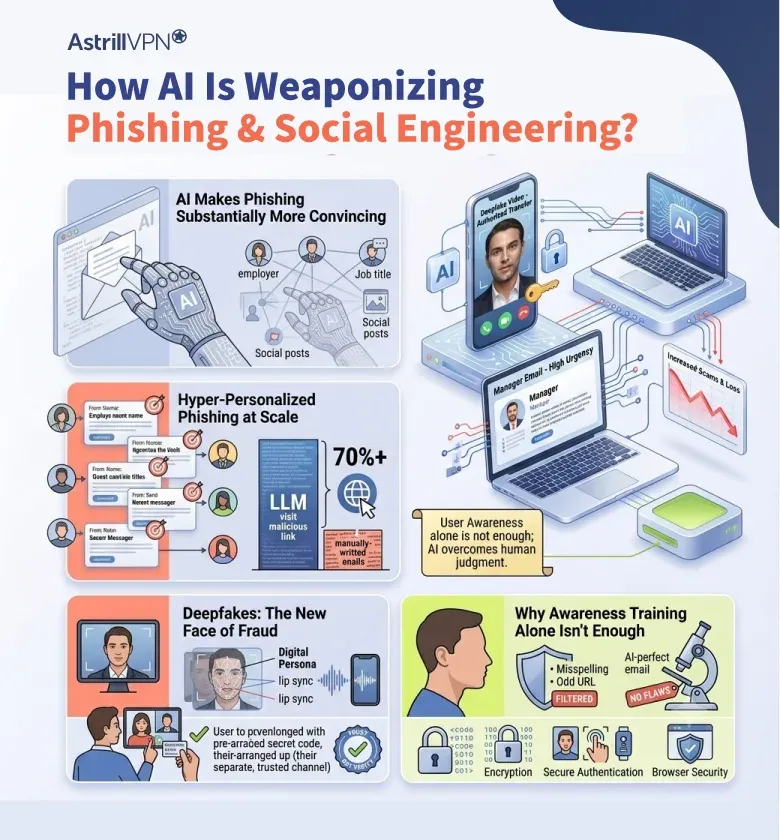
Phishing remains one of the most effective ways for attackers to reach victims because it targets people rather than software vulnerabilities alone. AI makes this approach substantially more convincing.
Instead of sending poorly written messages with obvious spelling mistakes, criminals can generate professional emails that imitate corporate communication, replicate familiar terminology, and convey a sense of urgency. AI can also help attackers research publicly available information about their victims before constructing the message.
Hyper-Personalized Phishing at Scale
AI-powered phishing can be customized for specific individuals rather than relying on one generic message.
For example, an attacker might identify someone’s employer, job title, recent professional activity, colleagues, and interests. AI can then help transform that information into a convincing message that appears to come from a manager, customer, supplier, recruiter, or financial institution.
Research into LLM-generated phishing has demonstrated why this matters. In a 2025 study involving more than 71,000 simulated emails, researchers found that LLM-assisted phishing could effectively persuade recipients to visit malicious landing pages.
The threat becomes even more serious when text-based phishing is combined with voice cloning or video deepfakes. An attacker no longer has to rely on an email alone; they can potentially create an entire fake interaction around it.
Deepfakes: The New Face of Fraud
Deepfakes have introduced another dimension to social engineering by enabling attackers to imitate a trusted person’s face or voice. One of the most widely reported examples occurred at engineering company Arup. An employee was deceived during a video conference involving digitally recreated senior executives and subsequently authorized transfers totaling approximately $25 million.
The lesson is important: sophisticated social engineering cannot always be defeated simply by telling users to “look for suspicious messages.” A video call with a familiar face is no longer absolute proof that the person on the other side is genuine. This is why financial requests, password reset instructions, and other high-risk actions should be independently verified through a separate, trusted communication channel.
Why Awareness Training Alone Isn’t Enough?
Security awareness remains essential, but awareness cannot eliminate every threat. AI-generated communications can remove many of the traditional warning signs people were trained to recognize. Messages can be grammatically correct, personalized, professionally formatted, and consistent with previous conversations.
Technical safeguards, therefore, need to complement human judgment. Encryption, secure authentication, endpoint protection, browser security, DNS protection, and network privacy can create additional defensive layers around the user.
A VPN does not determine whether an email is fraudulent, nor can it identify a deepfake video. Its value is different: it helps protect the network connection and reduces unnecessary exposure of information such as the user’s public IP address.
Autonomous Malware and Real-Time Adaptation
AI is also changing the malware landscape. Traditional malware often depended on predefined behaviors and signatures. Modern threats can increasingly use automation and adaptive techniques to make detection and response more difficult.
Self-Modifying, Signature-Evading Malware
AI-assisted malware can alter its behavior, code structure, or execution strategy to evade conventional detection methods.
Attackers can also use AI to generate new scripts and modify existing malware more quickly. CrowdStrike reported examples of threat actors using AI-generated scripts to accelerate credential theft and erase forensic evidence.
This does not mean every piece of malware is independently thinking or operating like something out of science fiction. Instead, AI acts as an accelerator for criminals, allowing them to automate tasks that previously required skilled operators.
For users, this reinforces the need for layered security. VPN encryption should work alongside updated operating systems, antivirus or endpoint protection, strong authentication, secure browsers, and safe online behavior.
Compressed Vulnerability Timelines
Another major concern is the shrinking window between vulnerability discovery and exploitation. AI can help attackers analyze technical information, understand vulnerable software, generate code, and automate parts of the exploitation process. CrowdStrike’s 2026 report found a 42% increase in the number of zero-day vulnerabilities exploited before public disclosure.
The faster attackers can turn information into operational exploitation, the less time organizations have to patch. For consumers, the practical response is straightforward: update operating systems, browsers, applications, routers, and VPN software as soon as security updates become available.
Why Encryption Matters More Than Ever?
Encryption is one of the most important foundations of online security because it protects data while it travels between your device and the destination. This becomes particularly important when using public Wi-Fi, hotel networks, airports, cafés, shared networks, or other environments where you cannot fully control the network infrastructure.
AstrillVPN’s Encrypted Tunnel Explained
When you connect to AstrillVPN, your internet traffic is routed through an encrypted VPN tunnel before reaching the wider internet. Astrill states that its service uses 256-bit encryption and supports protocols such as OpenWeb, StealthVPN, and WireGuard. OpenWeb uses AES-256 encryption, while WireGuard uses modern cryptographic technologies including Curve25519, ChaCha20, and Poly1305.
In practical terms, encryption makes intercepted traffic much harder to understand. Instead of exposing ordinary network traffic to someone monitoring the connection, the VPN creates an encrypted channel between the device and the VPN server. This can be particularly useful on networks where the user has little control over who else is connected.
Stopping Credential Theft Before It Starts
AI-powered phishing attempts may ultimately steal usernames, passwords, session tokens, or other credentials. A VPN cannot prevent someone from voluntarily entering credentials into a fake website. However, encrypted network traffic can reduce the opportunity for attackers to intercept information while it travels across an unsecured connection.
Astrill also provides DNS leak protection designed to prevent DNS requests from escaping outside the VPN tunnel. Its documentation explains that DNS requests can otherwise expose information about the websites a user is attempting to access. That distinction is important. A VPN is not a replacement for phishing protection, but it can reduce network-level exposure for the user.
Masking Your Digital Footprint from AI-Driven Reconnaissance
Modern attackers increasingly use publicly available information to build profiles of potential victims. Your IP address can provide information about your approximate network location and can sometimes be used as one element of broader reconnaissance. AstrillVPN masks the user’s public IP address by routing traffic through a VPN server.
This does not make someone invisible online. Websites can still use cookies, browser fingerprinting, account information, and other identifiers. However, hiding the residential or local IP address removes one useful piece of information from an attacker’s toolkit. In an era where automated systems can rapidly collect and analyze information, reducing unnecessary exposure is increasingly valuable.
AstrillVPN Features Built for the AI Threat Era
A VPN should not be viewed as a complete cybersecurity system. Its strongest role is as a network privacy and encryption layer that works alongside other security controls. AstrillVPN offers several features that are particularly relevant in a threat environment where attackers increasingly rely on automation and rapid reconnaissance.
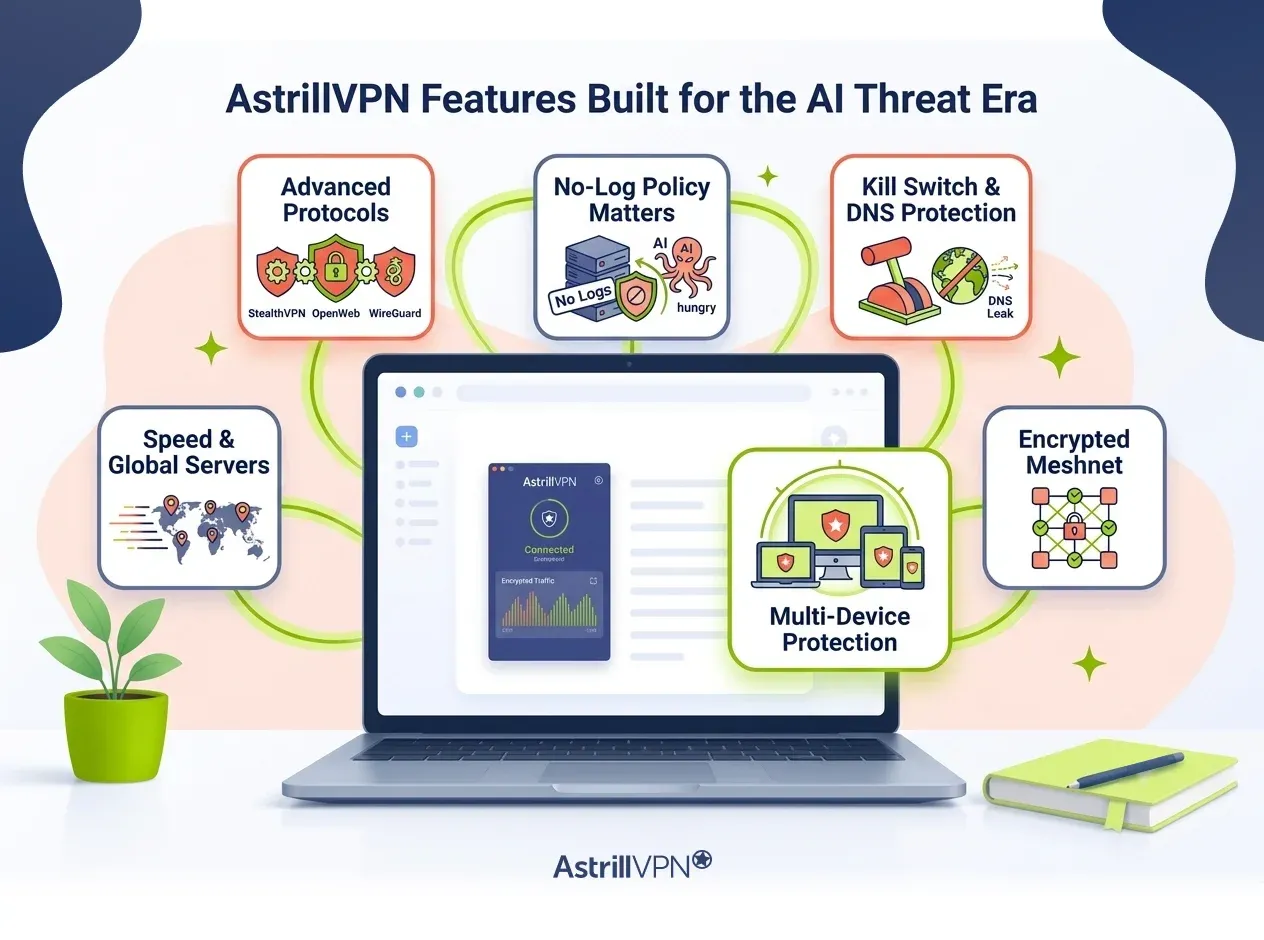
Advanced Protocols: StealthVPN, OpenWeb, and WireGuard
Different networks create different security and connectivity challenges. Astrill supports multiple protocols, allowing users to select an appropriate connection method.
StealthVPN adds traffic obfuscation designed to make VPN traffic harder for automated firewall systems and deep packet inspection systems to identify. Astrill states that StealthVPN uses AES-256 protection and can automatically reconnect when a connection drops.
OpenWeb is Astrill’s lightweight proprietary protocol. Astrill states that OpenWeb traffic is encrypted using AES-256 and designed to resemble ordinary HTTPS traffic to outside observers.
WireGuard is a modern VPN protocol built on a streamlined architecture and contemporary cryptography. Astrill supports WireGuard within its VPN application.
These protocols address different connection requirements, but their security value should not be overstated. They help secure network traffic; they do not directly detect deepfakes, malicious attachments, or fraudulent websites.
No-Log Policy and Why It Matters Against Data-Hungry AI Systems?
The data economy surrounding cybercrime makes privacy increasingly important. AI systems can process enormous amounts of information, and attackers can use the collected data to identify patterns, relationships, and potential targets. Limiting the information retained by online services can therefore reduce the historical data that could be useful in a future compromise.
Astrill says it operates a no-logs VPN service and does not maintain permanent records of users’ online activity. Its published policy states that limited connection-related information may be temporarily processed for service operations, while noting that website activity is not logged.
This is an important distinction: “no logs” does not mean that a VPN provider knows absolutely nothing about an account or connection. Users should always review a provider’s current privacy policy to understand what information is collected, how long it is retained, and why.
Kill Switch and DNS Leak Protection
A VPN is only useful while the protected connection is active. If a VPN connection unexpectedly drops and the device immediately resumes normal internet access, the user’s real IP address and network traffic could become exposed.
Astrill’s kill switch is designed to block internet activity when the VPN connection drops. Astrill also provides DNS, IPv6, and WebRTC leak protection features intended to reduce different forms of IP or DNS exposure. These features are especially useful for people who frequently move between Wi-Fi networks or rely on laptops and mobile devices outside the home.
Multi-Device Protection for Every Entry Point
Cybersecurity is no longer limited to a single desktop computer. A typical household may have smartphones, laptops, tablets, smart TVs, gaming consoles, and other connected devices. Each internet-connected device represents another potential entry point.
Astrill supports VPN sharing and can route connections from other devices through a protected VPN connection. Its current feature information also states that personal plans support up to 5 devices connected simultaneously in a household. For devices that cannot directly run a VPN application, router-based VPN configurations or VPN sharing can extend network protection to additional equipment.
Practical Steps to Strengthen Your Defense With AstrillVPN
Using a VPN is most effective when it forms part of a broader security strategy. The following practices can help reduce exposure to AI-powered threats.
Enable AstrillVPN Across Your Important Devices
Install and enable AstrillVPN on devices you regularly use for sensitive activities, particularly when connecting through public or unfamiliar Wi-Fi networks. For households with multiple connected devices, consider an appropriate router or VPN-sharing configuration where supported. This can help protect devices that cannot run a VPN application directly.
Combine VPN Protection With Multi-Factor Authentication
A VPN protects the network connection, while multi-factor authentication helps protect accounts. Use MFA wherever it is available, particularly for email, banking, cloud storage, social media, work accounts, and administrator accounts. If an attacker obtains a password through an AI-generated phishing campaign, MFA can provide another barrier against account takeover. Where possible, use phishing-resistant authentication methods rather than relying exclusively on SMS codes.
Verify Identities Before Acting on Urgent Requests
Deepfake technology makes visual and audio confirmation less trustworthy than it once was. If someone suddenly requests a money transfer, a password reset, a confidential document, or another sensitive action, verify the request through a separate trusted channel. For example, call a known phone number rather than replying to the original message or joining another meeting the sender provided.
The Arup incident demonstrates why this matters: the victim was deceived even though the fraudulent request was presented through a convincing video conference involving apparent senior executives.
Keep Software and VPN Clients Updated
AI can accelerate the exploitation of vulnerabilities, making delayed patching increasingly risky. Keep your operating system, browser, applications, router firmware, security software, and VPN client updated. Security updates frequently address vulnerabilities that attackers could otherwise exploit. The objective is simple: reduce the time window during which a known vulnerability remains exploitable.
Avoid Oversharing Personal Information Online
AI-powered reconnaissance becomes more effective when attackers have more information to work with. Avoid publicly posting unnecessary details about your workplace, travel plans, family members, financial activities, account information, or internal business processes.
Review privacy settings on social networks and professional platforms. Remember that information that seems harmless on its own can become valuable when automated systems combine it with other publicly available data.
Conclusion
AI has made cyberattacks faster, more scalable, and increasingly convincing. Users need layered protection that combines secure authentication, updated software, endpoint security, privacy-conscious behavior, and protected network connections.
AstrillVPN can serve as an important part of that foundation. Its encrypted VPN tunnel, IP masking, DNS leak protection, kill switch, multiple protocols, and stated no-logs approach can reduce network-level exposure and strengthen privacy when browsing online.
However, it is important to understand what a VPN can and cannot do. AstrillVPN will not identify every AI-generated phishing email, stop a deepfake from impersonating someone you know, or remove malware from an infected device. Its role is to secure the connection and reduce exposure while other security layers handle authentication, malware detection, identity verification, and application security.
In 2026, that layered approach matters more than ever. As attackers use AI to move at machine speed, protecting your digital footprint and securing every network connection can help reduce the opportunities available to them.
Frequently Asked Questions
Here are some of the most frequently asked questions.
AstrillVPN can provide an important layer of protection against certain network-level risks associated with AI-powered cyberattacks. Its encrypted VPN connection helps protect internet traffic from interception, while IP masking reduces exposure of the user’s public IP address.
A VPN cannot stop phishing attacks because phishing primarily targets users via fraudulent emails, websites, messages, or social engineering techniques. However, a VPN can encrypt the connection between your device and the VPN server, reducing IP exposure. Users should still verify suspicious links, avoid entering credentials into unfamiliar websites, and use multi-factor authentication.
Yes. A VPN is not an antivirus or malware-detection system. If malicious software is installed on a device, it can potentially operate despite the VPN connection. AI-powered malware may use techniques designed to evade conventional security controls. For comprehensive protection, use a VPN alongside reputable endpoint security, regular software updates, secure authentication, and safe downloading practices.
Yes. When connected to AstrillVPN, websites and online services generally see the VPN server’s public IP address rather than your original public IP address. This can reduce the amount of network-location information directly exposed to websites and potential attackers. IP masking does not make users completely anonymous, as other identifiers, such as account identifiers, cookies, and browser characteristics, can still reveal information.
AI allows attackers to automate reconnaissance, phishing, malware development, and other activities at much greater speed. Encryption helps protect data while it travels across networks, reducing opportunities for unauthorized parties to intercept and understand network traffic. It is therefore an important defensive layer, even though it does not address every stage of an AI-powered attack.

Secure your privacy instantly. Try AstrillVPN with zero risk.
About The Author










No comments were posted yet