




Why is It Important to Have a Astrill VPN for Small Business

Running a small business means more than just offering great products or services; it also requires safeguarding valuable business data. In a year when the Verizon 2026 Data Breach Investigations Report analyzed more than 22,000 confirmed data breaches, the most in the report’s history, it’s clear that no business is too small to fall under the radar of cybercriminals.
Despite their size, small businesses are particularly vulnerable because many need more robust cybersecurity infrastructure that larger corporations can afford. That is when VPN is essential for small businesses to protect sensitive data and maintain business continuity.
Table of Contents
Importance of Data Security in Small Businesses
For small businesses, data is their lifeline. Whether it’s customer information, financial records, or proprietary business strategies, losing or exposing any of these can have catastrophic consequences. Unlike large corporations, which might have the financial resources to recover from a breach, many small businesses struggle to survive after a major data loss.
IBM’s 2026 Cost of a Data Breach Report puts the global average cost of a data breach at a record $4.99 million, a financial hit that many businesses can’t withstand.
A VPN acts as a shield, encrypting data and ensuring that sensitive information remains secure even when transmitted over vulnerable networks like public Wi-Fi. Imagine you’re running a remote business, and employees access sensitive documents while traveling.
Without a VPN, this data could easily be intercepted by malicious actors. But with a VPN, your business communications are wrapped in an encrypted layer, making them unreadable to anyone attempting to snoop.
What a VPN Does and Does Not Protect
A VPN is one of the simplest security tools to use on this planet, and is very often the most suitable security solution for a small/medium sized company. However, a VPN is not a complete security solution. The key to using a VPN safely and effectively is to know exactly what it does and more importantly, where its protection starts and ends.
What a VPN Protects
- Data in transit: All information, such as email, file uploads and logins, are encrypted between the user’s end point and the VPN server. This means that no-one can intercept and read information as it is being transmitted over a public network.
- Public Wi-Fi: Secure use of public Wi-Fi at hotels, airports and co-working spaces. (Attacker only sees encrypted traffic on same network.)
- Your IP address and location: These will be hidden and replaced by the IP address of the VPN server, helping to mask your true location from websites, competitors, online tracking systems and more.
- Browsing activity visible to ISP: Your ISP will know you’re using a VPN but won’t be able to see what you’re doing online.
- Access to sensitive tools: With a dedicated IP, you can set cloud dashboards and admin panels to accept logins only from your team’s IP address.
What a VPN Does Not Protect
- Phishing: If an employee enters their password on a fake login page, the VPN simply encrypts that password on its way to the attacker. Multi-factor authentication and staff training are what stop phishing.
- Malware on devices: A VPN doesn’t scan files or remove infections. That’s the job of endpoint protection and regular updates.
- Weak or stolen passwords: Stolen credentials work just as well over an encrypted connection. Use unique passwords, turn on MFA, and run a password leak test to check for exposed credentials.
- Unpatched software: Attackers exploiting an outdated server, router, or plugin don’t need to intercept your traffic. Patching closes that door.
- Stored data: A VPN protects data in transit, not while it sits on laptops, servers, or in cloud storage. Encryption at rest and regular backups cover that.
- Compliance on its own: A VPN supports secure data transmission, which is one requirement under regulations like GDPR and HIPAA. It doesn’t make your business compliant by itself.
Business VPN vs Personal VPN: Which Does Your Team Need?
Most providers sell two types of plans. A personal VPN protects one user and their devices. A business VPN protects a team and gives you tools to create, manage, and remove employee accounts from one place. The encryption is the same. The difference is control.
| Feature | Personal VPN | Business VPN |
|---|---|---|
| Users | One person | Each employee gets their own account |
| Account management | Users manage their own logins | An admin adds, removes, and resets accounts centrally |
| When someone leaves | No central way to revoke access | Access removed in a few clicks |
| Dedicated IPs | Optional, usually for one user | Easier to set up for team-wide IP allowlisting |
| Billing | Individual subscription | One bill, priced per account |
| Best for | Personal privacy, streaming, travel | Teams handling client data, remote staff, shared tools |
When a Personal VPN Is Enough
- If you’re a freelancer or a solo founder / entrepreneur then a personal plan would usually cover you for your needs as you’re the only user.
When to Switch to a Business VPN
- Move to a business plan when any of these apply:
- You hire your first employee or contractor who touches company data.
- Your team shares one VPN login to access the web to various locations.
- You need a fixed IP to lock down admin panels, banking portals, or client systems.
- No way to confirm whether access has been removed for someone who has left.
Why is AstrillVPN the Best Small Business VPN?
AstrillVPN has been around since 2009 and runs its network on dedicated servers in 50+ countries rather than low-cost virtual servers. Here’s how its features line up with what a small business actually needs.
Business Control Panel
All employees are set up with their own Astrill accounts through the Business Control Panel. Add/delete employees, reset passwords, upgrade/downgrade plans, all of this can be done by you in a couple of clicks; no need to call the IT department. Remove someone’s access in a couple of seconds when they leave. This is one of the largest attack vectors that exist today: old login info that was never changed.
StealthVPN for Restricted Networks and Business Travel
If your team travels to, or works with partners in, countries with heavy internet controls, standard VPN protocols are often detected and blocked. Astrill’s StealthVPN protocol is built to disguise VPN traffic so it can get past firewalls and deep packet inspection, keeping staff connected to email, cloud storage, and collaboration tools. VPN rules differ by country, so check local laws before traveling.
The Right Protocol for Every Task
Astrill supports WireGuard, OpenVPN, OpenWeb, and StealthVPN, so your team can switch protocols based on the situation. Use WireGuard for fast, stable video calls, OpenVPN for wide device compatibility, OpenWeb for quick everyday browsing, and StealthVPN on restrictive networks.
Smart Mode and App Guard
Smart Mode sends traffic through the VPN only where needed and lets local sites connect directly, keeping everyday browsing fast. App Guard blocks internet access for selected apps if the VPN connection drops, so sensitive tools never fall back to an unprotected connection.
Router-Level Protection for the Office
Install Astrill on a supported router to protect every device on your office network, including devices that can’t run a VPN app, such as printers and smart TVs. You can route all devices through the VPN or only the ones you choose.
24/7 Business Support
Astrill’s support team is split into Tech and Sales divisions and is available around the clock. If you don’t have in-house IT, someone is always there to help troubleshoot a connection issue before a client call.
VPN, Zero Trust, or SASE: What Makes Sense for a Small Business?
There is a common opinion that VPNs are old-fashioned, while security in business is moving to the Zero Trust / SASE model. This model, however, is mostly relevant for big companies with hundreds of endpoints in the cloud.
Zero Trust is a security model. This model does not assign default trust to users or even devices. Instead, every user and every device must verify every time they connect to your network. SASE (Secure Access Service Edge) is a way to implement a Zero Trust security model by combining networking and security services, such as secure web gateways and Zero Trust Network Access in a single cloud service.
SASE products are typically priced per user. Even more important, SASE products require significant setup effort and ongoing maintenance effort. A small business with 10 employees or so is unlikely to have dedicated IT staff to deal with a SASE product.
A VPN gives small teams encrypted connections, IP masking, and controlled access through dedicated IPs, with setup that takes minutes. Many businesses start there, add MFA and endpoint protection, and adopt Zero Trust habits like least-privilege access and regular account reviews as they grow. For a deeper look, read our breakdown of SASE vs VPN.
How to setup Astrill VPN for Small Businesses
Setting up AstrillVPN for your small business is a straightforward process. Follow the steps below to ensure smooth and secure VPN integration into your business environment:
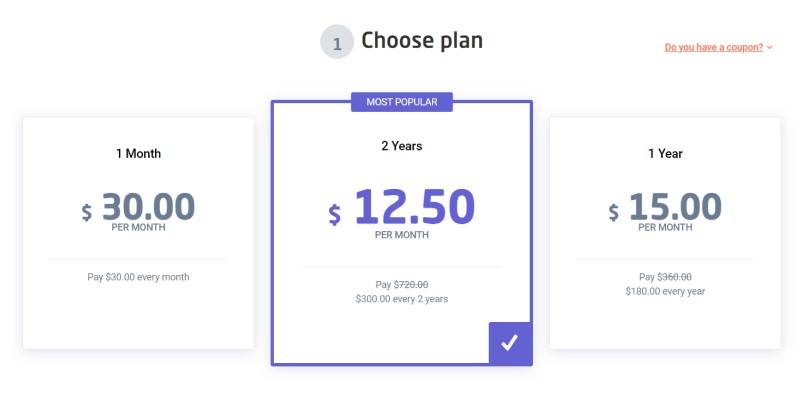
- Visit AstrillVPN’s website and sign up for a business plan that fits your requirements. The business package is scalable, so whether you have a few employees or a growing team, AstrillVPN can handle your security needs.
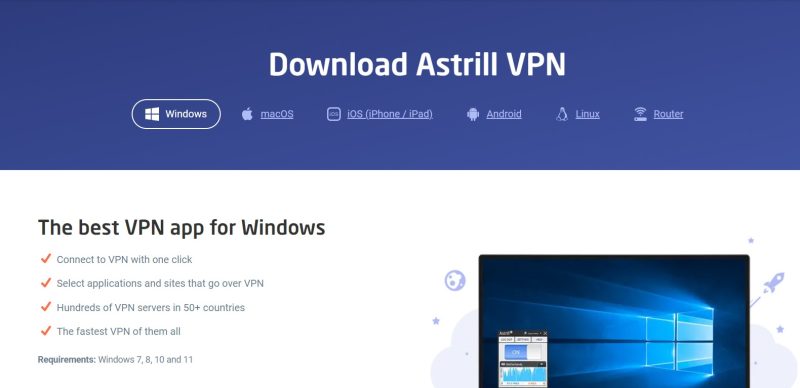
- Download and install the AstrillVPN app on the devices using the VPN.
- To cover all devices connected to your office’s network, you can install AstrillVPN directly on your router. Follow this link to configure AstrillVPN on your router.
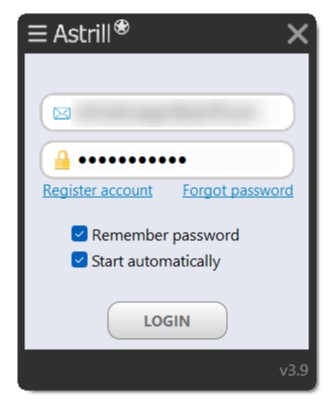
- After downloading the app, log in using your AstrillVPN credentials.
- Select a server of your choice, or you can also get private IP addresses for your team.
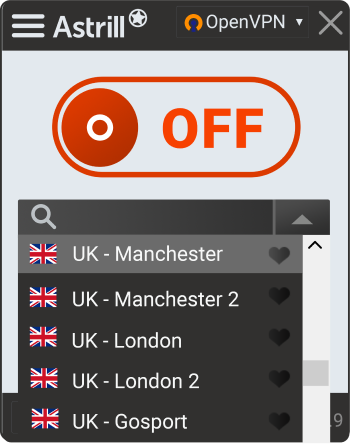
- Turn on the connection and secure your network.
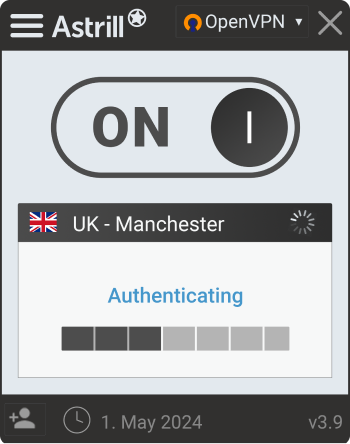
Key Benefits of Using a VPN for Small Businesses
As cyber threats become more sophisticated and data privacy concerns grow, a VPN can provide businesses with a cost-effective solution to bolster security and ensure operational continuity. Below are some of the most critical advantages of using a VPN solutions for small businesses:
1. Improved Data Security
Data is the lifeblood of any small business, and protecting it is essential for business success. Whether it’s customer information, financial records, or intellectual property, the loss or exposure of sensitive data can be devastating. According to Nexa Lab’s 2024 report on cybersecurity, 62% of small businesses were victims of cyberattacks in 2023, and many of these attacks resulted in significant financial and operational damage.
A VPN encrypts all data sent between your business network and external systems, making it nearly impossible for hackers to intercept or steal this information. This level of encryption is vital for businesses dealing with sensitive customer data, such as payment details or private communications. For example, if employees work remotely or access your network from public Wi-Fi, a VPN ensures their connection is secure, preventing unauthorized access.
2. Secure Remote Access
As remote work becomes more common, secure access to business networks is a major concern for small businesses. According to a 2023 Buffer report, 97% of remote workers want to continue working remotely in some capacity for the rest of their careers. However, this flexibility opens doors to potential security risks, especially if employees log in from unsecured networks at home or in public spaces.
A VPN allows employees to securely access company files, databases, and systems from anywhere as if they were physically in the office. By creating a secure, encrypted connection, the VPN protects sensitive data and prevents unauthorized users from accessing your business’s internal systems. This means employees can work productively without compromising your business’s security.
3. Cost Savings
While small businesses might avoid additional expenses, investing in a VPN can save long-term costs. VPNs eliminate the need for expensive on-premise secure networks and reduce the reliance on hardware firewalls. Most reputable VPN providers offer flexible subscription plans, enabling businesses to choose a plan that suits their budget and needs.
Additionally, by preventing cyberattacks, data breaches, and intellectual property theft, VPNs can help small businesses avoid the costly consequences of these incidents.
4. Bypass Geo-Restrictions
Small businesses often need to access region-specific content or tools restricted by geographical location. For example, your marketing team might need to access a website or service that is only available in another country. A VPN can assign your business a local IP address in the required region, allowing you to bypass geo-restrictions and access content as if you were physically there.
This can be especially useful for businesses that operate internationally or work with foreign clients. Whether for accessing region-specific research or using global tools that are otherwise restricted, a VPN makes it easy to expand your business’s digital reach.
5. Maintain Privacy and Anonymity
One of the less talked about but equally important benefits of using a VPN is maintaining your business’s privacy and anonymity online. Hackers, competitors, and internet service providers (ISPs) often track online activities, gathering insights into your business’s operations. By masking your IP address and encrypting your traffic, a VPN makes it difficult for third parties to track your digital footprint.
For example, a small business conducting market research or analyzing competitors can use a VPN to stay anonymous and prevent rivals from monitoring their online activities. Additionally, a VPN keeps your ISP from throttling your internet speed based on bandwidth usage, ensuring your connection remains fast and secure.
Choosing the Right VPN for Your Small Business
Selecting the right VPN for your small business can feel overwhelming, especially with many available options. However, the key to making the best choice lies in understanding your business needs and evaluating potential VPNs based on essential criteria like security features, ease of use, scalability, and cost-effectiveness.
Below are the factors to consider while choosing the right VPN for your small business.
1. Security Features
The primary reason for using a VPN is to enhance your business’s cybersecurity. Look for VPNs that offer strong encryption standards, like AES-256-bit encryption, considered military-grade and impenetrable for hackers. In addition, features like a kill switch, multi-factor authentication, and no-log policies are essential to protect your business data. In 2024, reports show that 62% of small businesses are victims of cyberattacks (StrongDM), which makes securing your network a priority.
VPNs such as AstrillVPN offer multiple layers of encryption, a no-log policy, and StealthVPN protocol, specifically designed to bypass firewalls and protect your business from prying eyes with obfuscated servers. These features make AstrillVPN a good contender for small businesses that need robust security.
2. Ease of Use and Integration
Not all small businesses have dedicated IT teams, so ease of setup and user-friendliness are crucial when choosing a VPN. A VPN solution for small businesses with a simple interface and clear installation instructions can minimize operational disruption. According to a 2024 survey, 47% of small businesses don’t have dedicated IT staff, so an intuitive VPN that is easy to integrate with existing systems can save time and reduce errors.
Look for VPNs that offer user-friendly apps across multiple devices and platforms (Windows, MacOS, Android, iOS). Additionally, consider VPNs that allow easy scalability as your business grows.
3. Scalability
As your business expands, so should your VPN. Scalability is a key consideration for future-proofing your choice. For instance, if you start with five employees but expect to expand to fifty within the next few years, your VPN should offer the ability to seamlessly add more users or devices.
A report by Nexa Lab in 2024 highlighted that small businesses are increasingly targeted as they scale, making choosing a VPN that grows with your security needs essential. Opt for VPN providers that offer customizable plans to accommodate more users without sacrificing performance or security.
4. Cost Considerations
For many small businesses, budget constraints are a significant factor in decision-making. However, spending on cybersecurity, including VPNs, is an investment in safeguarding your business.
When choosing a VPN, compare pricing plans and look for flexible subscription options. Some VPNs, like AstrillVPN, provide various service tiers, allowing businesses to pay for their needed features without unnecessary add-ons.
5. Multi-Device and Remote Work Support
With more small businesses adopting remote work, especially post-pandemic, having a VPN that supports multiple devices and secure remote access is critical. Your VPN should allow employees to securely connect to the company network from any location without compromising security.
Ensure the VPN you select can handle remote work requirements, including the ability to secure connections on public Wi-Fi and across various devices.
6. Server Locations and Speed
A VPN’s server locations impact speed and access to geo-restricted content. Select a VPN with servers in various geographic locations if your business operates in multiple countries or needs access to resources from different regions. For instance, AstrillVPN offers servers in 58 countries, which helps ensure fast and stable connections while supporting your team’s global operations.
Common Risks Faced by Small Businesses Online
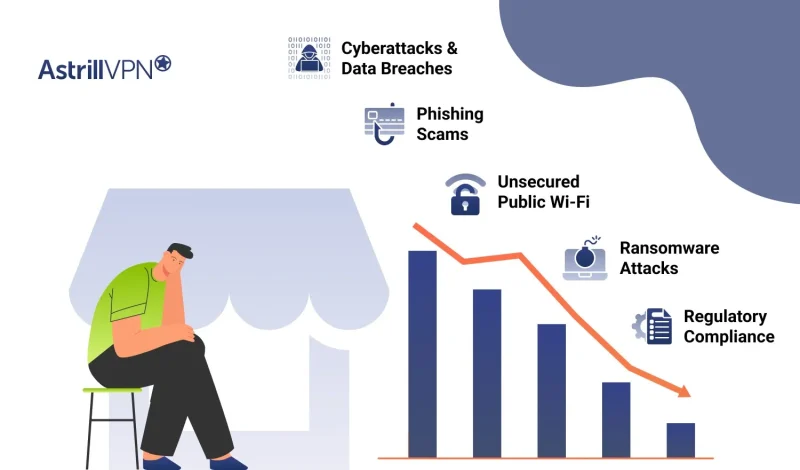
Small businesses are often seen as easy targets by hackers. Some of the most common risks include:
Cyberattacks and Data Breaches
Cyberattacks don’t just happen to large corporations. According to Accenture, 43% of cyberattacks are aimed at small businesses, yet only 14% are prepared to defend themselves. These attacks can range from stealing sensitive customer data to corrupting entire systems. By using a VPN, small businesses can protect themselves by encrypting data at all touchpoints, making it far more difficult for hackers to penetrate their network.
Phishing Scams
Small businesses are often targeted with phishing scams, where hackers attempt to deceive employees into giving away sensitive information like passwords or bank details. With a VPN, even if an employee mistakenly clicks on a phishing link, the encrypted connection makes it harder for attackers to access critical data.
Unsecured Public Wi-Fi
Whether working in a coffee shop or traveling for business, using public Wi-Fi networks poses a significant risk to data security. Unsecured Wi-Fi networks are prime hunting grounds for hackers. A VPN allows your business to operate securely from anywhere, turning untrusted networks into safe havens for your data.
Ransomware Attacks
Ransomware attacks, in which hackers lock your business data and demand a ransom to restore it, have risen dramatically. In 2021, ransomware incidents increased by 92%, according to America’s Cyber Defence Agency 2021. For a small business, the aftermath of such an attack can be devastating. While a VPN alone won’t prevent ransomware, it does add an extra layer of protection by securing data transfers and limiting exposure to compromised systems.
Regulatory Compliance
Many small businesses need to comply with strict regulations concerning data protection, whether it’s GDPR for European customers or HIPAA in healthcare. Failure to comply can result in steep fines. VPNs help businesses stay compliant by ensuring that data is transferred securely, reducing the risk of breaches and associated penalties.
Common Mistakes to Avoid When Using a VPN for Your Small Business
Using a VPN can greatly enhance your small business’s cybersecurity, but certain mistakes can weaken its benefits. Here are the key errors to avoid when using a VPN:
1. Using Weak or Shared Passwords
Relying on weak or shared passwords can compromise the entire VPN system. Each user should have a unique, strong password, ideally combined with multi-factor authentication (MFA) to add an extra layer of security. Implementing a password management system and enforcing regular updates will help strengthen security.
2. Failing to Update VPN Software Regularly
Not updating VPN software regularly leaves your business vulnerable to security breaches. VPN providers frequently release updates that patch security flaws and improve overall performance. Ensuring your software is always up to date is essential for maintaining secure business operations.
3. Not Configuring VPN Settings Properly
Improper configuration of VPN settings is a common issue, particularly during initial setup. Misconfigurations can result in some parts of your network remaining exposed to external threats. Configuring the VPN to encrypt all data traffic and using secure protocols like OpenVPN or WireGuard is crucial. If you or your team are not sure how to setup VPN for small business, then seek help from the VPN provider’s support team, especially if your business lacks an IT department.
4. Overlooking Device-Level Security
While a VPN protects network traffic, it does not secure individual devices from threats like malware, phishing attacks, or insider breaches. It’s important to pair your VPN with robust endpoint protection, such as antivirus software, firewalls, and security measures on all devices accessing the VPN. This ensures that both your network and connected devices are fully protected.
5. Relying Solely on a VPN for Security
Though a VPN is a critical tool for data security, it shouldn’t be the only measure your business relies on. A comprehensive cybersecurity strategy should include firewalls, antivirus software, employee training on recognizing phishing attacks, and regular security audits to cover all potential vulnerabilities.
Conclusion
Implementing a VPN for your small business network is critical in safeguarding your digital assets and ensuring secure remote access. You can significantly enhance your cybersecurity posture by carefully evaluating your needs, selecting a reputable provider like Astrill, and following best practices for setup and maintenance. Train your employees on proper VPN usage and regularly update your systems to avoid emerging threats. With the right VPN solution, you’ll empower your team to work efficiently from anywhere while protecting your sensitive data. Embrace this powerful technology to give your small business a competitive edge in today’s interconnected digital landscape.
FAQs
When is VPN essential for small business?
A VPN is essential for small business when handling sensitive data, enabling remote work, or accessing geo-restricted content. It’s crucial for protecting customer information, safeguarding intellectual property, and ensuring secure communication. When VPN is essential for small business, it provides a layer of security against cyber threats and data breaches.
What are the best VPN solutions for small business?
The best VPN for small businesses depends on specific needs. Look for providers offering strong encryption, multiple server locations, and reliable customer support. When choosing, consider factors like ease of use, scalability, and compatibility with your existing network infrastructure.

Secure your privacy instantly. Try AstrillVPN with zero risk.
About The Author










No comments were posted yet